
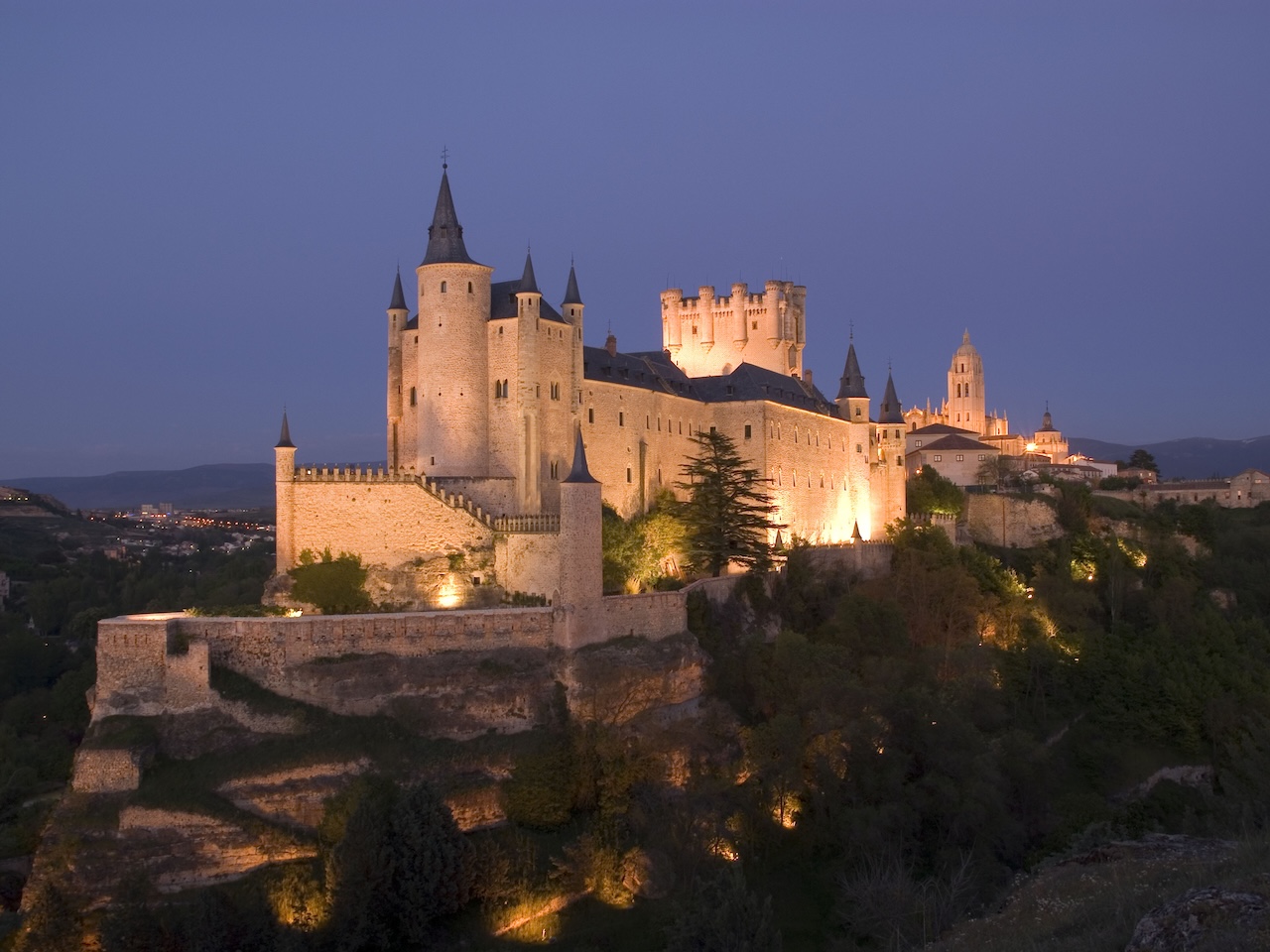

Day trips from Madrid are a great way to delve into the Spanish countryside, learn about the culture and escape the big city vibes. Here is our guide to the best Madrid day trips, what to expect and how long to spend in each destination.
One of Madrid’s least-celebrated advantages is its geography. Planted almost exactly at the centre of the Iberian Peninsula, Spain’s capital sits within easy reach of some of the most historically and architecturally significant cities in the country — and several of them are UNESCO World Heritage Sites.
Within an hour by high-speed train (and don’t worry, they’re dead easy), you can be walking through a Roman aqueduct, gazing up at a Gothic cathedral, or exploring the walled medieval streets of a city that has barely changed in five centuries. Within two hours, you can reach a dramatic cliff-top city of hanging houses, unlike anywhere else in Europe.
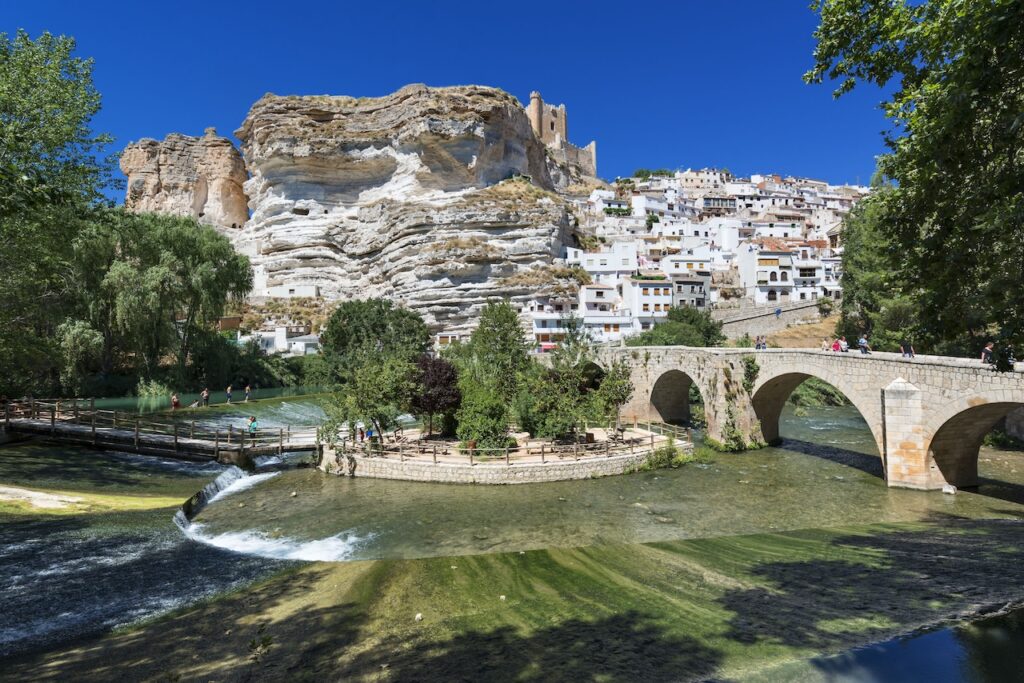
The result is that Madrid functions as an exceptional base for day trip exploration, and the surrounding region of Castilla y León and Castilla-La Mancha offers an extraordinary variety: from the imperial grandeur of El Escorial and the three-culture heritage of Toledo to the fairy-tale romanticism of Segovia, the austere medieval drama of Ávila and the vertiginous landscapes of Cuenca.
Whether you travel independently by train or bus, or join one of the well-organised guided tours that depart daily from the city centre, each of these destinations can be comfortably seen in a single day — and each offers something entirely different. Here is everything you need to know.
Practical Information: Getting Around from Madrid
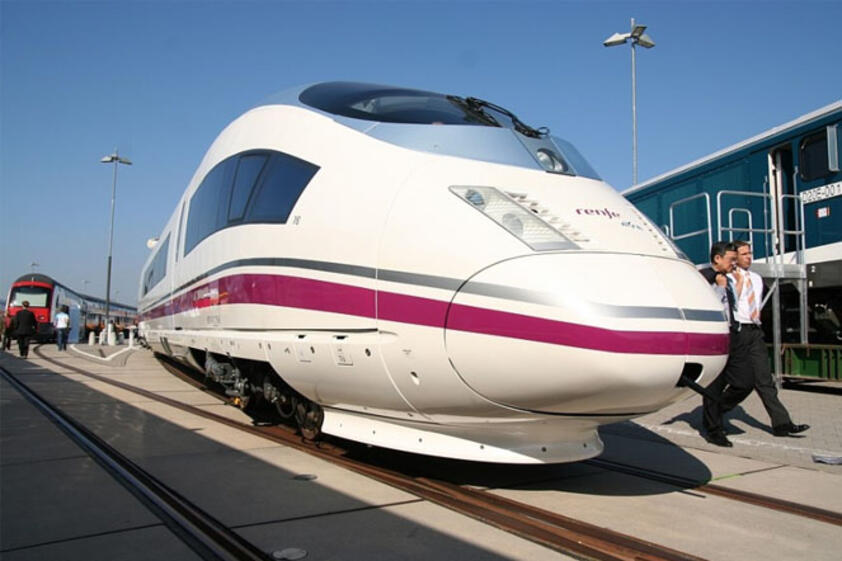
The main departure stations for day trips from Madrid are Atocha (for high-speed AVE trains to Toledo and Cuenca, and regional trains south), Chamartín (for trains to Ávila and Segovia via the northern route) and Príncipe Pío (also for trains to Ávila). The Estación Sur bus station at Méndez Álvaro (Metro: Méndez Álvaro, line 6) serves buses to Toledo, Ávila and Cuenca, among other destinations. All are easily reachable by metro from the city centre.
Train tickets can be booked online at renfe.com or via the Renfe app and should be purchased in advance, particularly for high-speed services to Toledo and Cuenca. Regional train services to Segovia and Ávila are cheaper and do not require booking, though it helps.
Guided tours are an efficient and informative alternative to independent travel. Several reputable tour operators run daily departures to all five destinations, typically combining transport, a knowledgeable English-speaking guide and often entrance fees in a single package. These are especially worthwhile for first-time visitors to Toledo or El Escorial, where the context a guide provides transforms the experience. Combined tours (Toledo and Segovia in a day, for example) are popular but demanding; allocate at least a full day to any destination you want to absorb properly.
What to bring: I would definitely suggest comfortable walking shoes (all five destinations involve significant walking, often on cobblestoned streets), sunscreen and water in summer (when temperatures in these inland cities regularly exceed 35°C), and a light layer in spring and autumn when the high meseta can be cooler than Madrid. Many attractions are closed on Mondays, so check opening hours before you travel.
1. Toledo
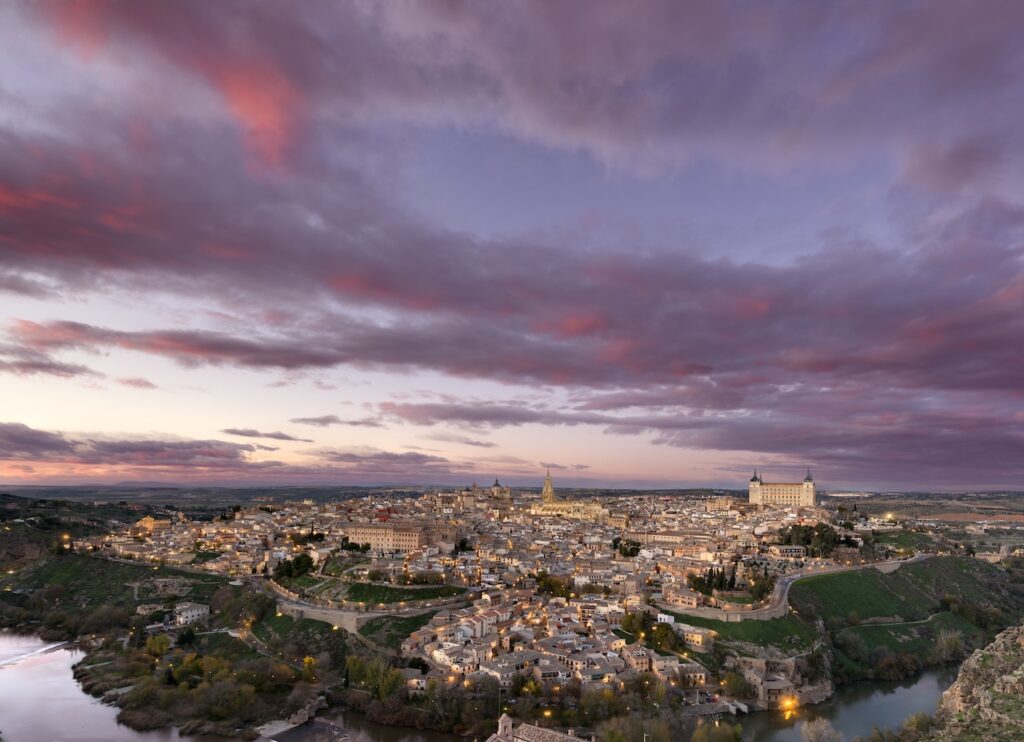
Distance from Madrid: 73km | Travel time: 30 minutes by AVE from Atocha; 45 minutes to 1 hour by bus from Plaza Elíptica
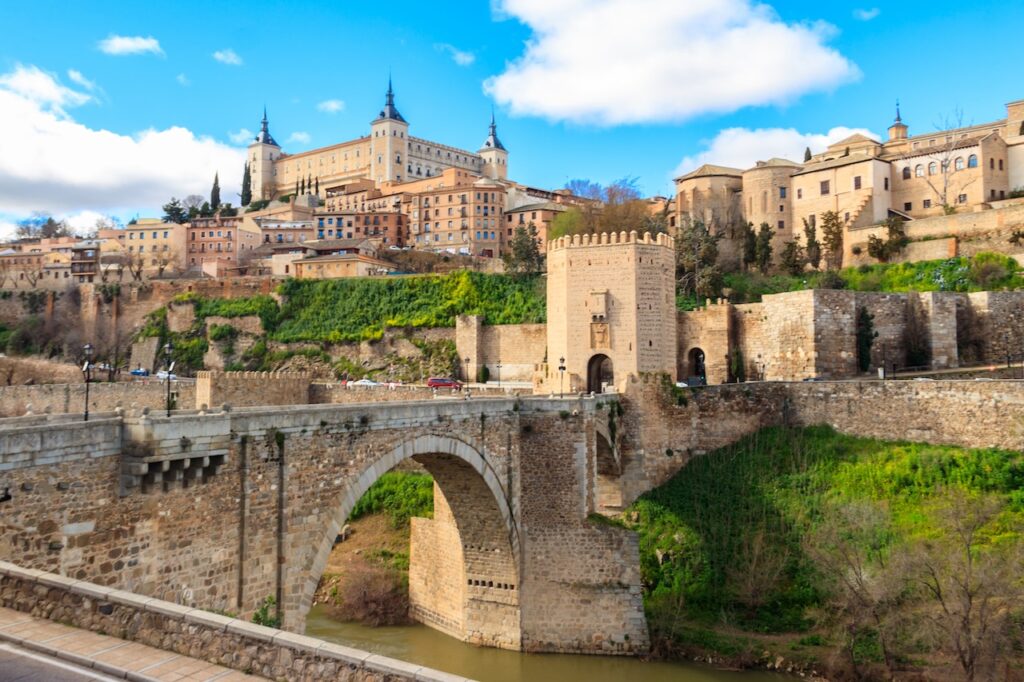
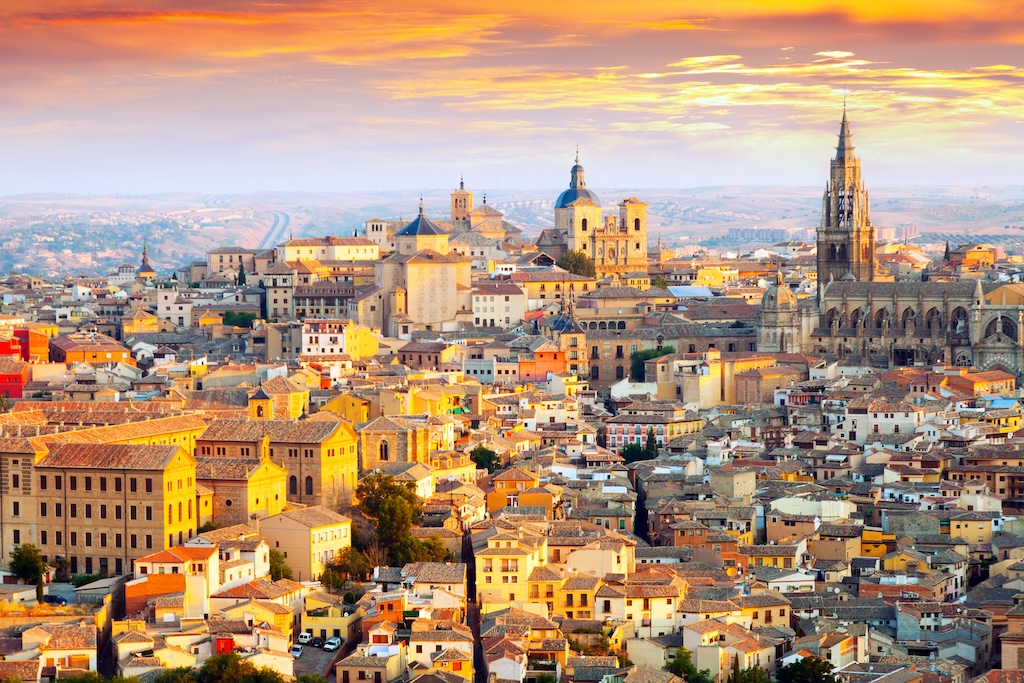
No day trip from Madrid generates more enthusiasm or more debate than Toledo, and it deserves both. The imperial city sits on a rocky promontory above a bend in the Tagus River, its skyline — dominated by the twin towers of the cathedral and the square bulk of the Alcázar — one of the most recognisable in Spain.
For centuries, it was one of the most important cities in Europe, serving as the capital of the Visigoth kingdom, a major centre of Islamic scholarship, and the seat of the Castilian court before Madrid’s ascendancy. It is above all known as the Ciudad de las Tres Culturas— the City of Three Cultures — for the extraordinary period of medieval coexistence between its Christian, Muslim and Jewish communities, a legacy embedded in the architecture of almost every street.
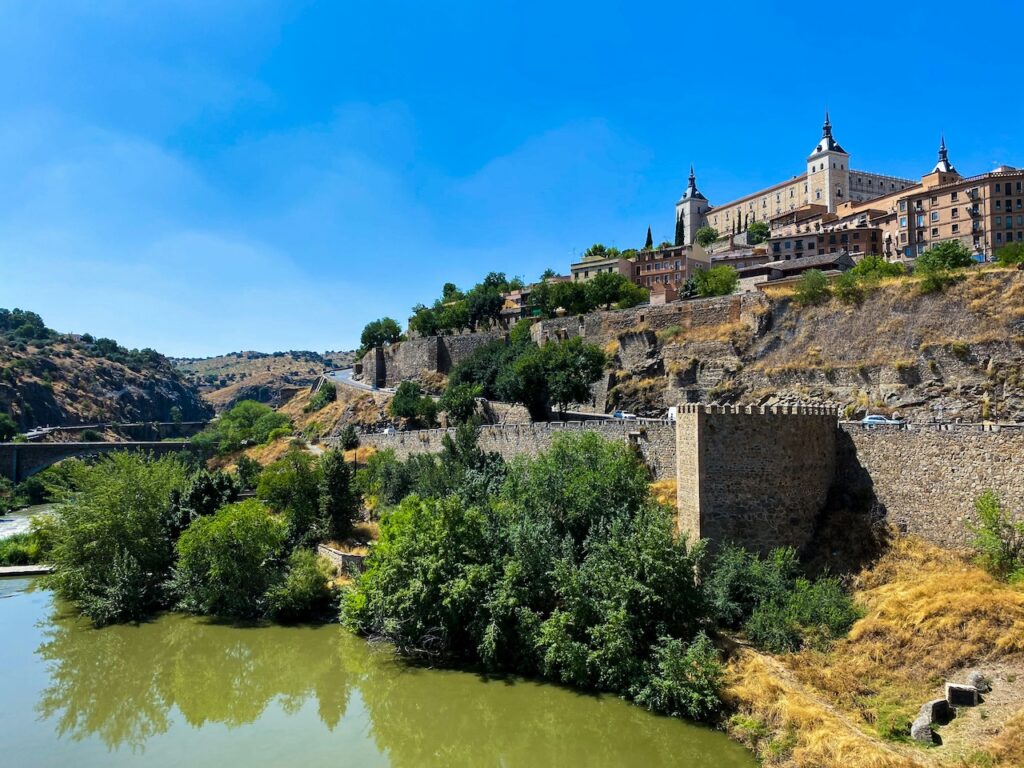
The must-sees are, in ascending order of time required: the Mirador del Valle (a viewpoint reached by bus or taxi from which the entire city sits before you in one photograph — approach Toledo from this direction first before entering the old city); the Jewish Quarter, whose two surviving medieval synagogues — the 12th-century Santa María la Blanca, with its extraordinary horseshoe arches, and the El Tránsito Synagogue with its remarkable Mudéjar plasterwork — stand as testament to the city’s Sephardic heritage; and the Church of Santo Tomé, home to El Greco’s masterpiece The Burial of the Count of Orgaz (I’d suggest booking ahead to skip the queue).
Also worthy of your time is the Catedral Primada, a soaring 13th-century Gothic cathedral of staggering ambition and scale, whose sacristy contains paintings by El Greco, Goya and Titian and whose Transparente — a baroque altarpiece of hallucinatory complexity — is one of the most astounding works of art in Spain. Also, don’t miss the Alcázar (above), a 16th-century fortress now housing an extensive military museum, which is worth time for its extraordinary hilltop views alone.
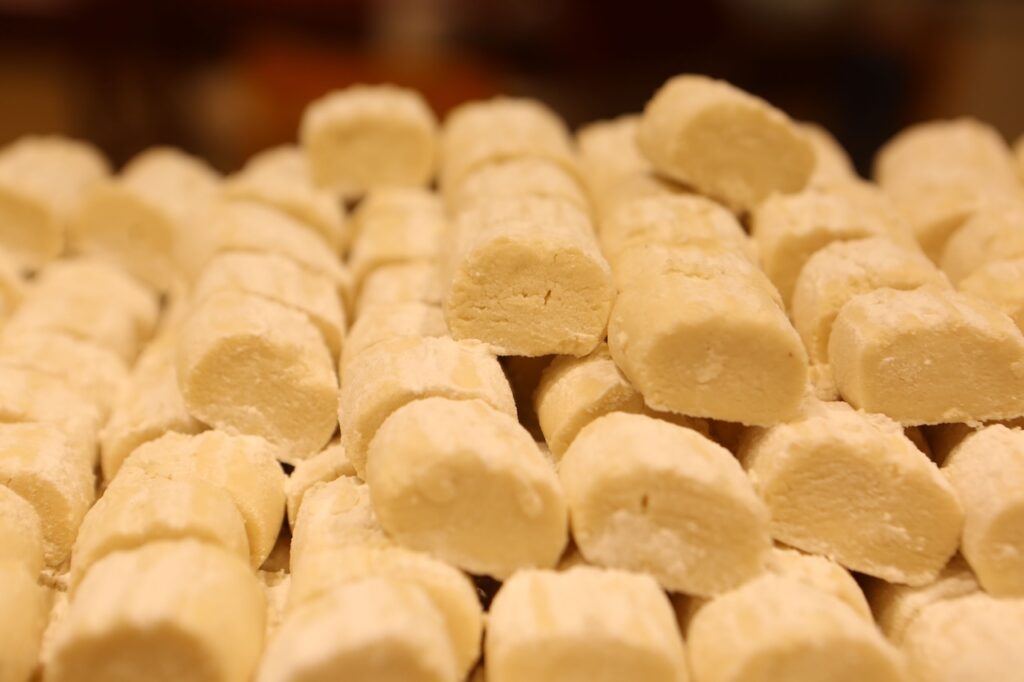
Toledo’s culinary speciality is mazapán — marzipan shaped into elaborate figures and available from confectionery shops across the old city (it makes for a great gift for those back home). The city is also famous for its damasquinado craftwork: gold inlaid on steel in intricate patterns, practised here since Moorish times and sold in workshops throughout the historic centre.
How to get there: AVE from Atocha (30 minutes, from around USD11.60 one way; book online). ALSA bus from Plaza Elíptica (every 30 minutes, around 45 minutes, from approximately USD6.40 one way). Note: the bus station in Toledo is a short walk from the old city; from the train station, a bus or taxi into the old city is necessary.
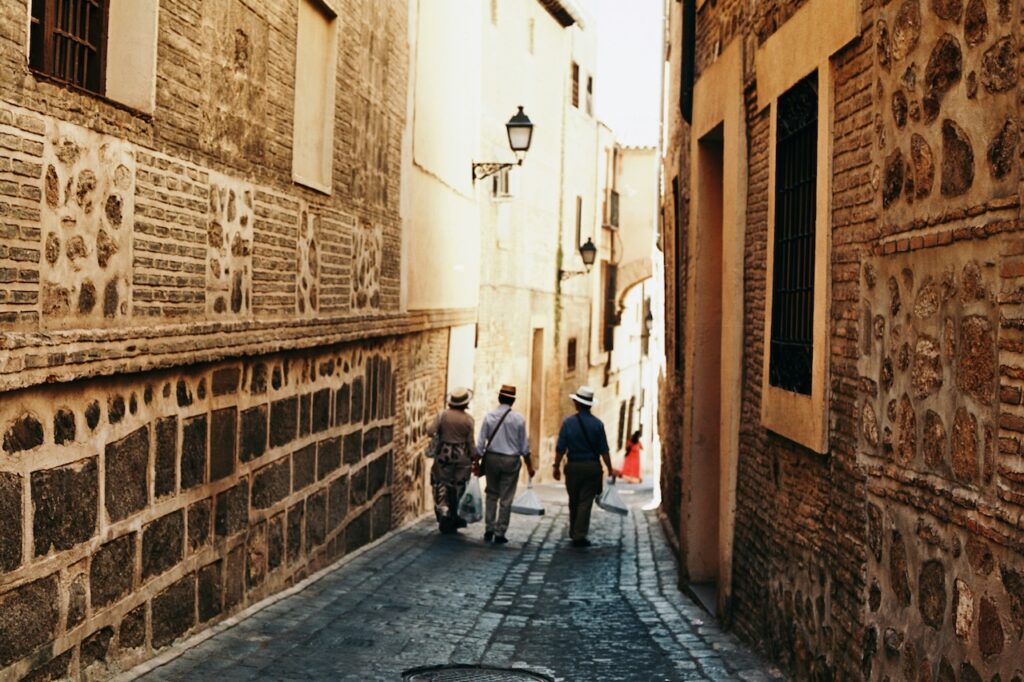
How long do you need: A full day (7–8 hours in the city) to see the cathedral, Jewish Quarter, El Greco sites and the Alcázar without feeling rushed. Half-day tours from Madrid give you a good overview but require choices.
Best combined with: Segovia (a popular two-city tour, though ambitious) or as a standalone.
Don’t miss: Arriving at the Mirador del Valle before entering the city; the El Tránsito Synagogue’s Mudéjar interior; El Greco’s Burial of the Count of Orgaz at Santo Tomé.
2. Segovia
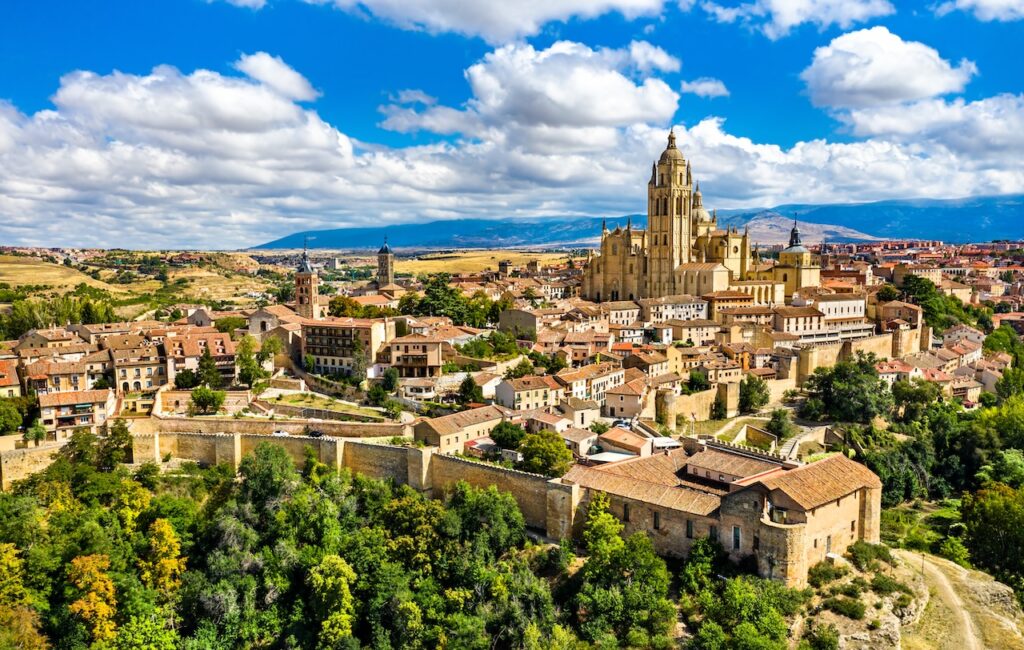
Distance from Madrid: 92km | Travel time: 30 minutes by AVE from Chamartín; 1 hour 15 minutes by Avanza bus from Moncloa
Segovia is the most perfectly composed of Madrid’s day trip destinations — a compact, walkable old city that aligns its three great monuments in a near-straight line from one end to the other, making navigation intuitive and the experience deeply satisfying. The city is a UNESCO World Heritage Site, and its three headline attractions span almost two thousand years of history, each exceptional by any measure.
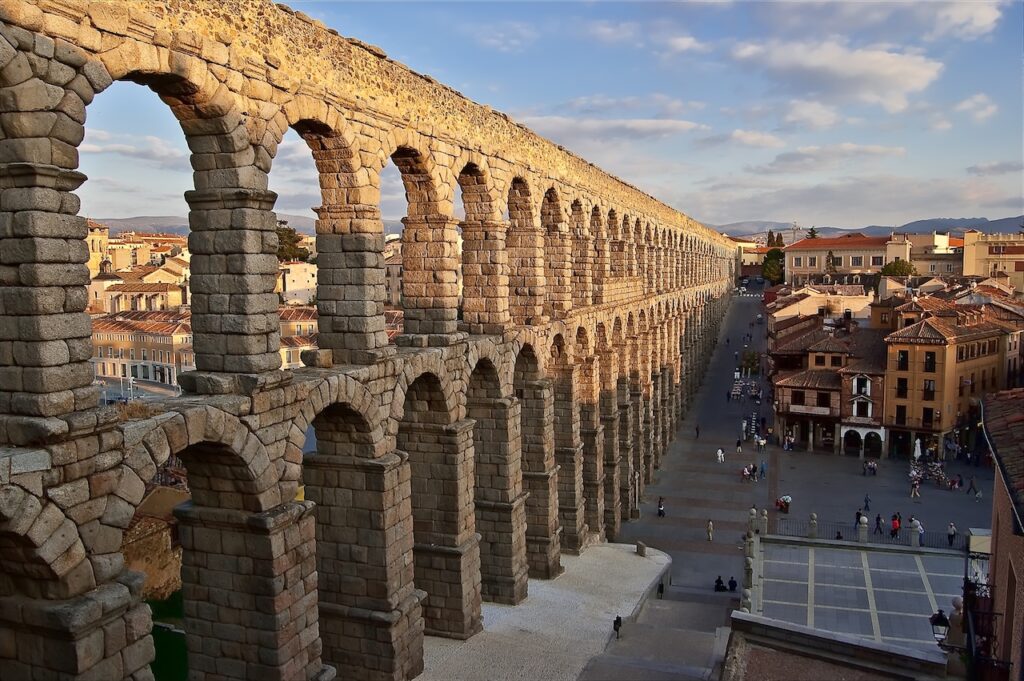
The Aqueduct of Segovia (below), which greets visitors at the city’s entrance, is one of the finest surviving examples of Roman engineering in the world. Built in the late 1st or early 2nd century AD without the use of mortar — its 20,000 granite blocks held in place purely by the precision of their cutting — it stands 28 metres tall at its highest point and runs for nearly a kilometre through the heart of the city. Walking through its arches and looking up at the scale of the construction is a genuinely humbling experience.
From the aqueduct, the main pedestrian street winds uphill through the former Jewish Quarter to the Cathedral of Segovia, a beautiful late Gothic structure completed in 1577 and affectionately known as the Dama de las Catedrales (Lady of the Cathedrals) for its graceful, lace-like exterior. At the city’s western tip, dramatically cantilevered above the confluence of two rivers, stands the Alcázar — a turreted, spire-studded palace that is among the most romantic castles in Europe, and one that is widely credited as an inspiration for Walt Disney’s Cinderella Castle. The interior, with its ornate throne room, armour collection and 360-degree views from the Tower of John II, is as impressive as the exterior suggests.
Segovia’s gastronomic signature is cochinillo asado — roasted suckling pig (below), cooked until the skin crackles and the flesh falls from the bone. The finest version is traditionally served at Mesón de Cándido, a legendary restaurant beside the aqueduct operating since 1884, but the dish is available across the city. A day in Segovia that ends with cochinillo and a glass of Ribera del Duero in the shadow of the aqueduct is one of the great Spanish travel experiences.

How to get there: AVE from Chamartín (around 30 minutes, from approximately USD8 each way; note the station is outside the city and requires a bus connection into the old town). Avanza bus from Moncloa (1 hour 15 minutes, around USD9.30 return; drops you much closer to the aqueduct and is often preferred by independent travellers).
How long do you need: 5–6 hours comfortably covers the aqueduct, cathedral, Alcázar and a leisurely lunch.
Best combined with: Ávila (the two cities are close and combine well as a full day) or El Escorial (under an hour apart).
Don’t miss: The view of the Alcázar from the Mirador de la Pradera de San Marcos below the city; lunch at any restaurant offering cochinillo asado; the climb to the tower of the Alcázar for panoramic views.
3. El Escorial
Distance from Madrid: 50km | Travel time: 1 hour by Cercanías train from Atocha or Chamartín; 1 hour by bus from Moncloa
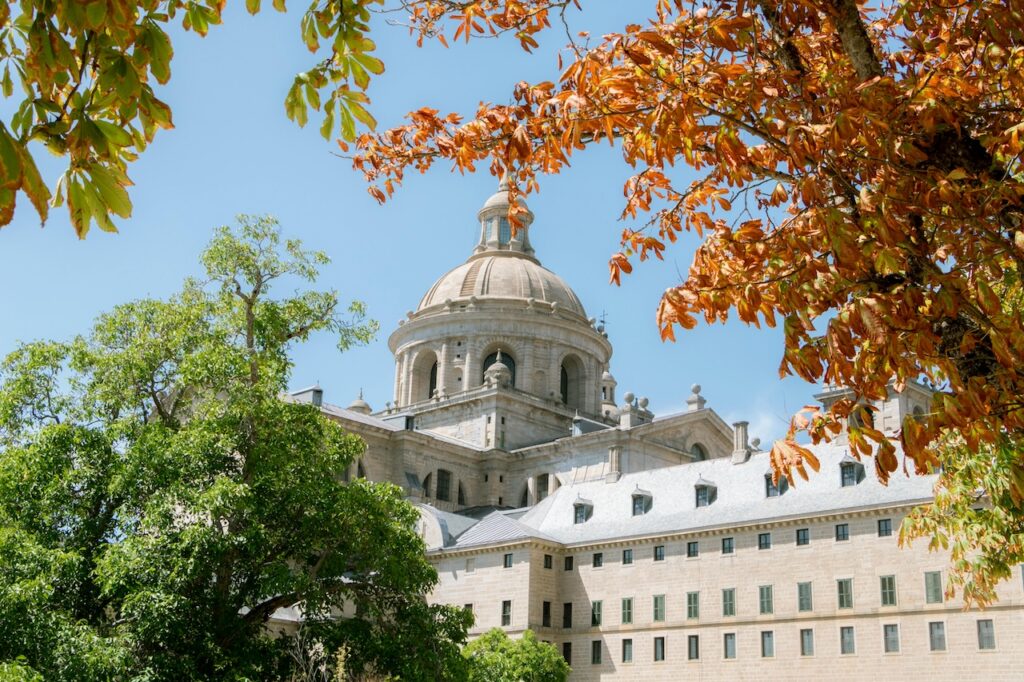
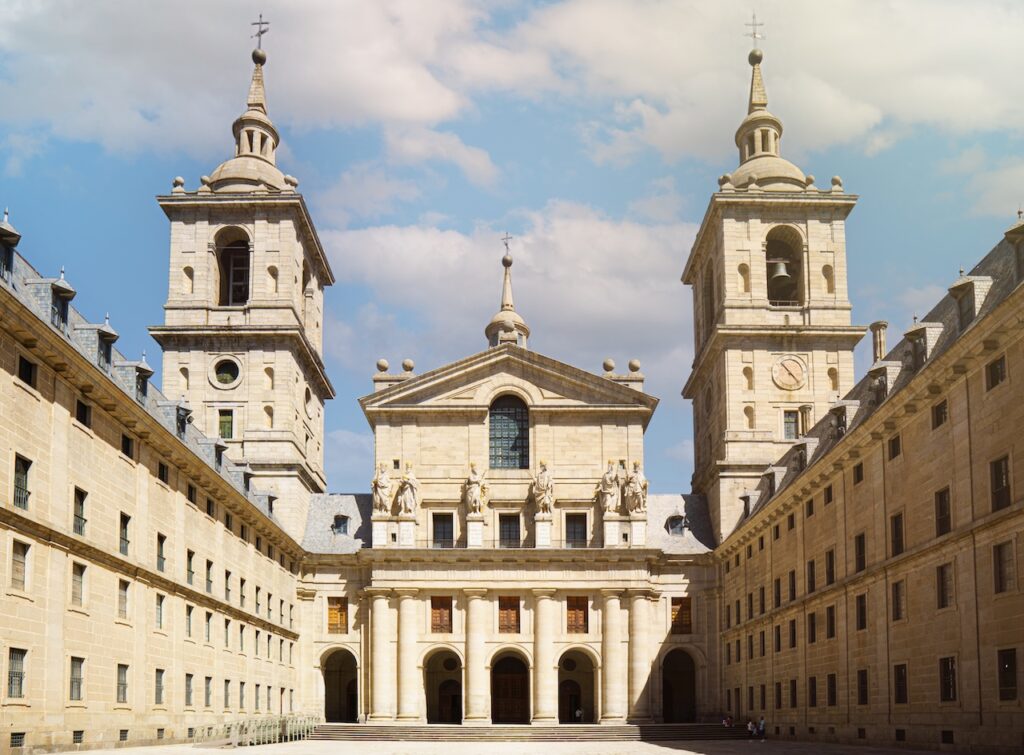
The smallest of Madrid’s five great day trip destinations in terms of visitor time required, El Escorial more than compensates with sheer monumental gravity. The Royal Site of San Lorenzo de El Escorial (below) was declared a UNESCO World Heritage Site in 1984 and is one of the most extraordinary buildings in Europe.
A vast, austere complex of monastery, palace, basilica and royal library, it was constructed between 1563 and 1584 by King Philip II, who intended it simultaneously as a memorial to his victory at the Battle of San Quintín, a royal pantheon, and an expression of the imperial ambition of the Spanish Habsburg dynasty at the height of its global power.
The building’s architect, Juan de Herrera, created a style of such severe geometric purity — grey granite, perfect symmetry, minimal ornamentation — that it gave its name to a whole architectural movement: herreriano. From outside, the monastery is almost overwhelming in its scale and austerity: a rectangle nearly 210 metres long and 160 metres wide, its four corner towers and central dome visible from miles away across the Guadarrama mountains.
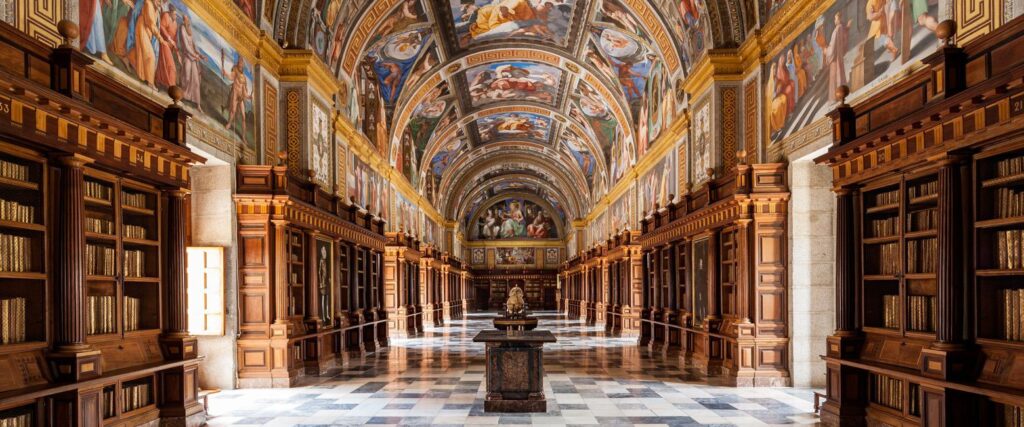
Inside, the contrast with the exterior’s severity is startling: the Royal Pantheon holds the remains of almost every Spanish monarch since Carlos I; the Library contains 45,000 historic volumes and Flemish manuscripts of extraordinary beauty arranged in its barrel-vaulted hall; the Basilica, with its soaring nave and altarpiece, contains paintings by Titian, Tintoretto and El Greco; and the Chapter Rooms are hung with some of the finest Flemish and Spanish masterworks in any royal collection. Allow at least three to four hours for the complex; the adjoining gardens and the views across to Madrid in clear weather are an additional pleasure.

The village of San Lorenzo de El Escorial, which has grown up around the monastery, has excellent restaurants serving hearty Castilian cuisine. A combined visit with nearby Segovia or Ávila — both under an hour away — is practical for those with more time.
How to get there: Cercanías C-8a train from Atocha or Chamartín to El Escorial station (1 hour), then a short bus connection to the monastery. Herranz bus from Moncloa (approximately 1 hour, around USD5.80 one way). Buy monastery tickets online in advance to avoid queues.
How long do you need: 3–4 hours for the monastery and grounds; 5–6 hours if you add a village lunch and the gardens.
Best combined with: Segovia (both are northwest of Madrid and can be paired in a full day) or Ávila.
Don’t miss: The Royal Pantheon; the Library; the views back towards Madrid from the monastery gardens on a clear day.
4. Ávila
Distance from Madrid: 112km | Travel time: 1 hour 40 minutes by train from Príncipe Pío or Chamartín; 1 hour 20 minutes by Jiménez Dorado bus from Estación Sur
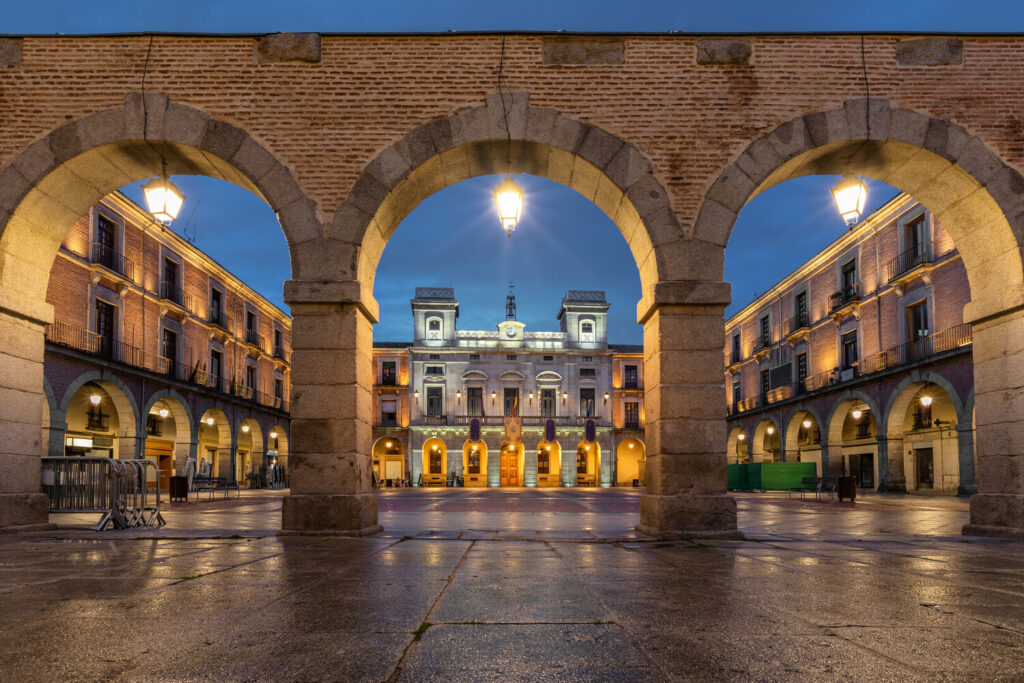
Ávila is the highest provincial capital in Spain, perched at 1,130 metres above sea level on the Castilian plateau, and its defining characteristic is immediately apparent: the city walls. Built between the 11th and 14th centuries and stretching for 2.5 kilometres around the entire old city with 88 towers and 9 gates, Ávila’s medieval fortifications are the best-preserved in Spain — intact, walkable and extraordinary.
Around 1.5 kilometres of the wall can be walked on top, via two sections accessed from near the cathedral and at the Puerta del Alcázar gate, and the views from the battlements — over the terracotta rooftops of the old city on one side and the open Castilian countryside on the other — are among the most spectacular in the country. Entry costs USD5.80 per person.
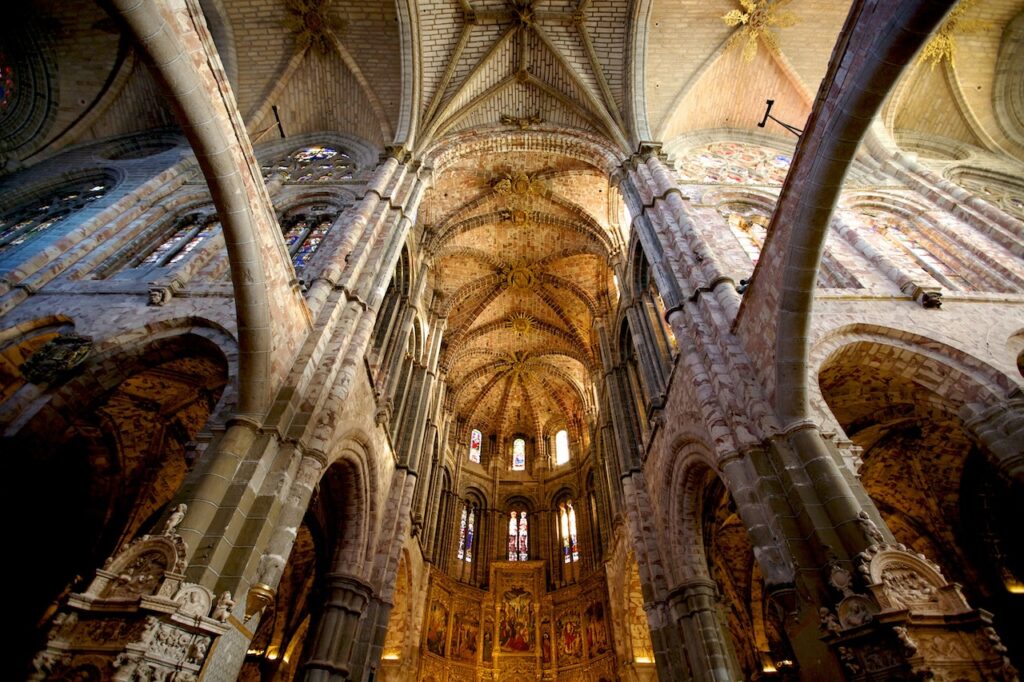
Within the walls, the Cathedral of Ávila (above) is a deeply unusual building: begun in the 12th century, it is considered the first Gothic cathedral built in Spain, but its thick granite apse is built directly into the city wall, making it simultaneously a place of worship and a defensive fortification. The interior contains one of the finest retables in Castile, and the tomb of El Tostado, bishop of Ávila in the 15th century, is a masterwork of funerary sculpture.
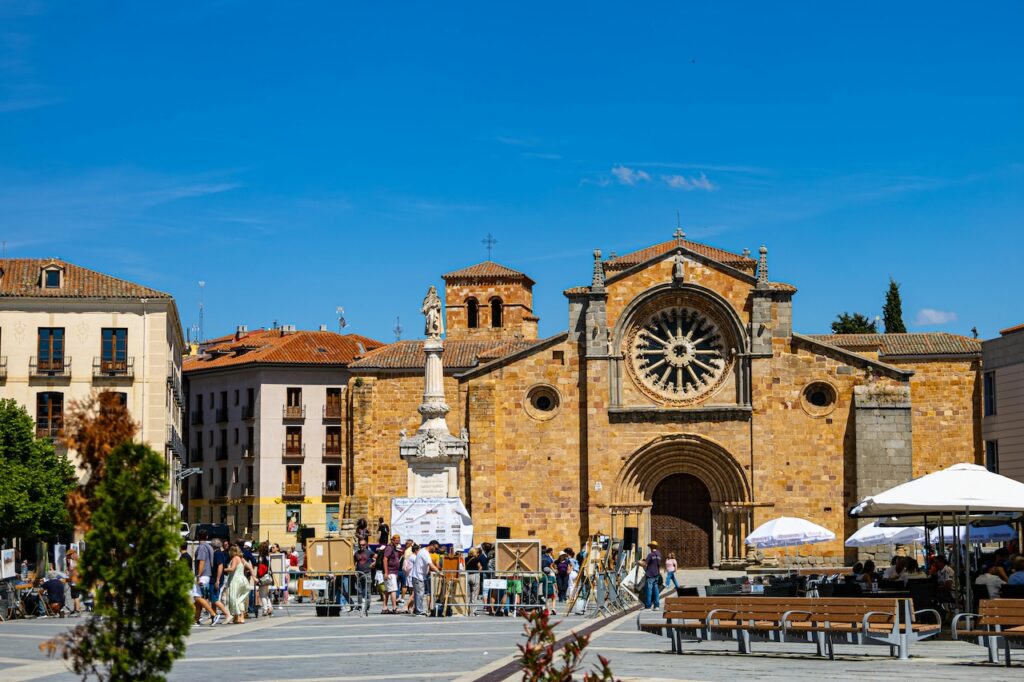
The Basilica of San Vicente (below), just outside the walls, is a superb example of Romanesque architecture whose carved capitals and magnificent doorway are among the most accomplished in the region. The Convento de Santa Teresa, built on the supposed birthplace of St Teresa of Ávila — the 16th-century mystic, writer and religious reformer who is among the most significant figures in Spanish Catholic history — completes the essential tour. The viewpoint of the Cuatro Postes (four posts), a short taxi ride outside the city, offers the most famous and photographed panorama of the walls from the outside.
A quieter and less-visited destination than Toledo or Segovia, Ávila has an authenticity and an austere beauty that reward travellers who choose it. Its yemas de Ávila — egg-yolk sweets shaped into spheres and dusted with sugar, a confection associated with the convent tradition — are the essential souvenir.
How to get there: Train from Príncipe Pío or Chamartín (1 hour 40 minutes, from around USD12.80 each way; the station is a 15–20 minute walk or short taxi ride from the old city walls). Bus from Estación Sur (1 hour 20 minutes, drops near the city walls).
How long do you need: 3–4 hours covers the walls, cathedral and key churches comfortably; 5–6 hours for a more leisurely day, including lunch.
Best combined with: Segovia or El Escorial (both under an hour away by car or bus, making a natural half-day each).
Don’t miss: Walking the battlements at golden hour; the view from the Cuatro Postes viewpoint; yemas de Ávila from any of the old-city confectionery shops.
5. Cuenca
Distance from Madrid: 165km | Travel time: 55 minutes by AVE from Atocha; 2 hours 10 minutes by Avanza bus from Estación Sur
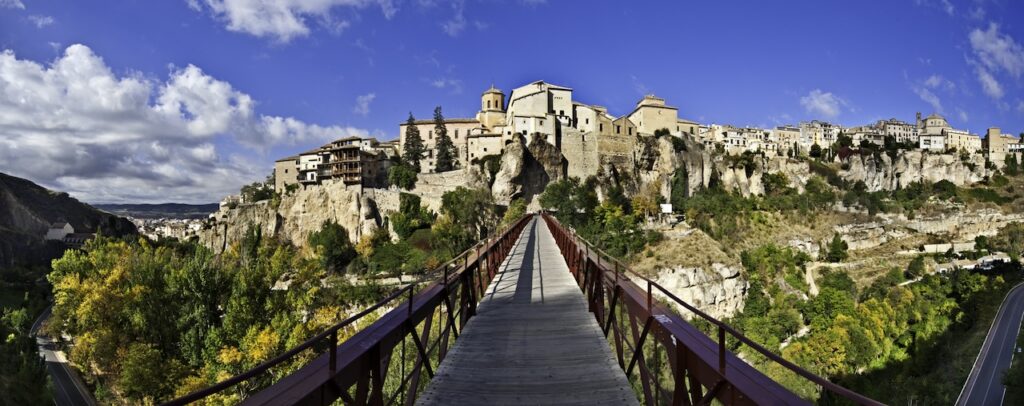
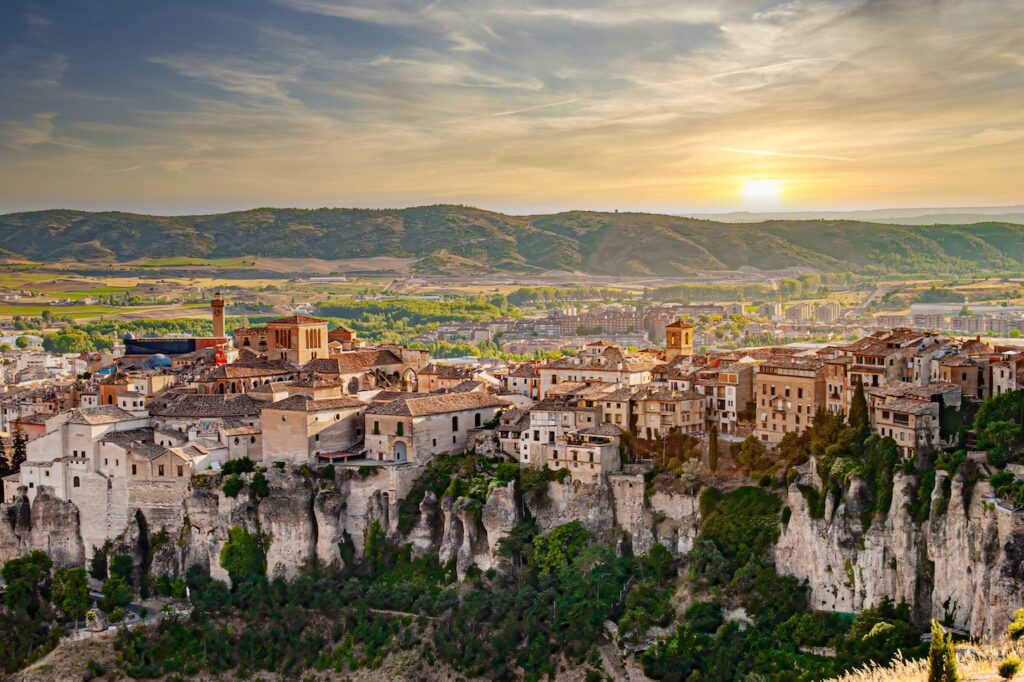
The most dramatically situated of Madrid’s day trip destinations, and the most distinctive in character, Cuenca is a UNESCO World Heritage Site of a different kind: not a city of royal grandeur or medieval conquest but a place of sheer, vertiginous spectacle, perched on a narrow ridge between two river gorges, its ancient buildings quite literally hanging over the abyss.
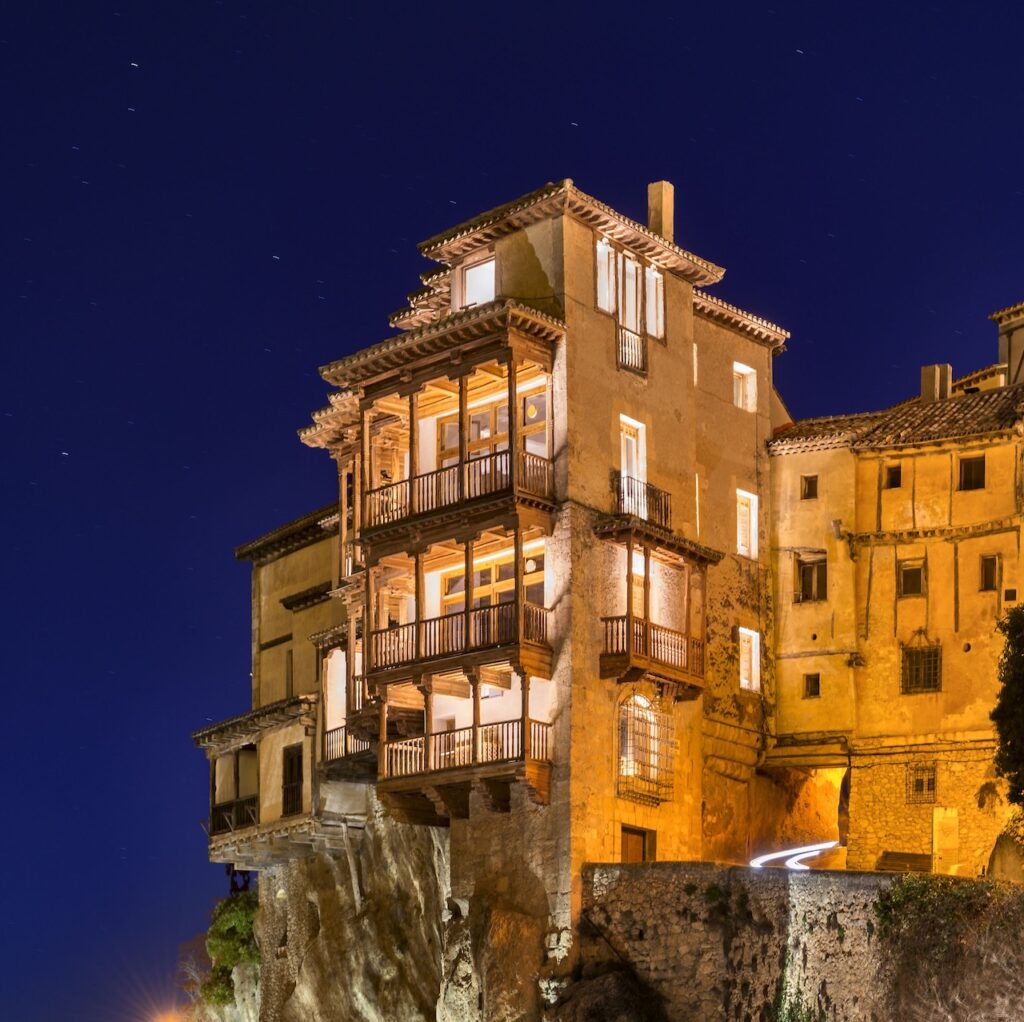
The Casas Colgadas — the Hanging Houses (below) — are the image that defines Cuenca: a row of medieval timber-framed houses, built in the 15th century, that jut out over the edge of the Huécar gorge on wooden cantilevered balconies, their reflections shimmering in the river 40 metres below. They are one of the most photographed and architecturally improbable structures in Spain, and they are even more extraordinary in person than in photographs.
The best view is from the Puente de San Pablo, an iron footbridge that spans the gorge and faces the houses directly; standing on it at sunset, with the cliffs turning amber and the river glinting below, is one of the great visual experiences of Spanish travel.
Within the old city, the Cathedral of Cuenca is the oldest Gothic cathedral in Castile, begun in the 12th century on the site of a mosque, and its unfinished western façade gives it a unique, romantically incomplete character. The Hanging Houses themselves now contain the Museum of Spanish Abstract Art, an unexpectedly excellent collection of 20th-century Spanish art installed in the medieval interiors.
The Ciudad Encantada (Enchanted City) — a natural landscape of extraordinary limestone rock formations sculpted by millennia of wind and water into shapes that resemble animals, bridges and human figures — is located around 35 kilometres from Cuenca and makes a worthwhile addition for visitors with a car, though independent day trippers from Madrid typically focus on the old city itself.
Cuenca is significantly less visited than Toledo or Segovia, and the old city in the late afternoon, after the day-trippers have thinned, has a quiet, almost otherworldly quality. The local cuisine leans towards hearty Castilian staples: morteruelo (a rich, spiced game pâté) and ajoarriero (salt cod in a garlicky tomato and pepper sauce) are both typical of the region.

How to get there: AVE from Atocha to Cuenca-Fernando Zobel station (around 55 minutes, from approximately USD11.60 each way; note the AVE station is outside the city and requires a bus or taxi to the old town — approximately 10–15 minutes). Avanza bus from Estación Sur (2 hours 10 minutes, drops closer to the centre).
How long do you need: 5–6 hours in the old city; a full day if you want to add the Enchanted City.
Best combined with: Best visited as a standalone, given the travel time; the old city is compact and rewarding without needing another destination added.
Don’t miss: The Casas Colgadas at sunset from the Puente de San Pablo; the Museum of Spanish Abstract Art inside the Hanging Houses; a walk along the gorge paths below the city.
Frequently Asked Questions
Day trips are a great way to change the scenery and the energy of a trip. Here’s what you need to know before you embark on one of these Madrid day trips.
Which is the Best Day Trip from Madrid?
For most visitors, Toledo is the single most rewarding day trip — its combination of historic depth, artistic wealth and dramatic setting is unmatched in the region, and it is the closest to a complete picture of Spanish history in a single walkable city. Segovia runs it close for sheer scenic impact and is arguably easier to cover in half a day. If you have three or more days in Madrid and can do multiple trips, the ideal sequence is: Toledo first (full day), Segovia second (full day or half-day combined with Ávila or El Escorial), and Cuenca third for something more unusual.
How Many UNESCO World Heritage Sites are within day-trip distance of Madrid?
All five destinations in this guide — Toledo, Segovia, El Escorial, Ávila and Cuenca — are UNESCO World Heritage Sites or contain UNESCO-listed monuments. Alcalá de Henares (birthplace of Cervantes, 40 minutes from Atocha) and Aranjuez (Royal Palace and gardens, 45 minutes) are two further UNESCO sites within easy reach.
Is it Better to take the Train or a Guided Tour?
Both have genuine advantages. Independent train travel is cheaper, more flexible (you set your own pace) and perfectly practical for all five destinations. Guided tours save the logistics of figuring out connections, include a knowledgeable guide, often cover entrance fees and are particularly valuable for Toledo and El Escorial, where historical context significantly enriches the experience. For travellers with limited time or first-time visitors to Spain, a well-chosen guided tour is often the better investment.
Can I do Two Cities in One Day?
Yes, with caveats. Segovia and Ávila pair well together (both are northwest of Madrid and under an hour apart by car). Segovia and El Escorial work similarly. Toledo, on its own merits a full day; combining it with another city leaves insufficient time at both. Cuenca is best visited alone, given its travel time. If you are taking a guided tour, check how much time is actually spent at each site, as some combined tours sacrifice depth for breadth.
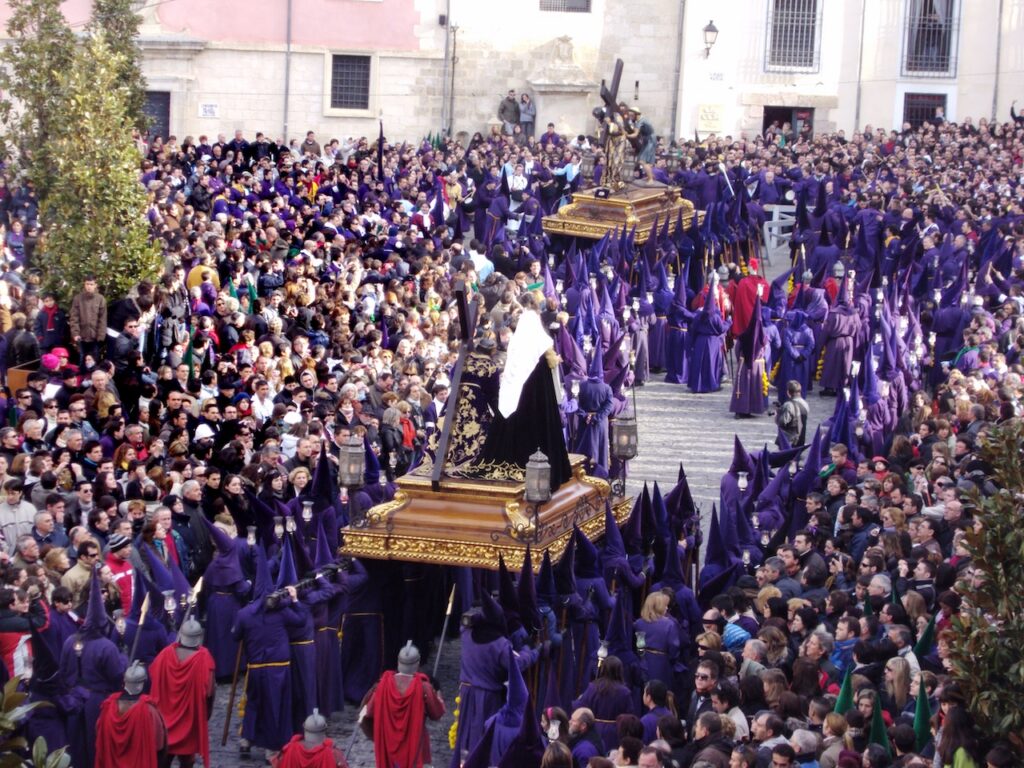
What is the Best Time of Year for Day Trips from Madrid?
Spring (April and May) and autumn (September and October) are ideal: mild temperatures, clear skies and manageable crowds. July and August are popular but demanding — temperatures in these inland cities regularly exceed 35–40°C, and crowds at Toledo and Segovia peak significantly.
Winter day trips (November to February) offer the fewest tourists and a particular atmospheric quality, though some outdoor viewpoints and smaller sites may have reduced hours. Christmas in Toledo, with its illuminated streets and nativity traditions, is a genuinely special experience. If you’re headed to Madrid in peak season, be sure to book your hotel well in advance.
Are Day Trips From Madrid Suitable for Children?
Yes — all five destinations have a strong visual impact that engages younger travellers. Segovia’s Alcázar, which resembles a fairy-tale castle and has interactive armour displays, is reliably popular with children. Ávila’s walkable city walls are a physical adventure as much as a historical one. Toledo’s sword and damascene craft shops are a perennial distraction. Cuenca’s gorge and hanging houses have a dramatic, almost adventure-playground quality when seen from the bridge. El Escorial is the least child-focused in its appeal, but the gardens and size of the monastery are still impressive.
Do I Need to Book Attraction Tickets in Advance?
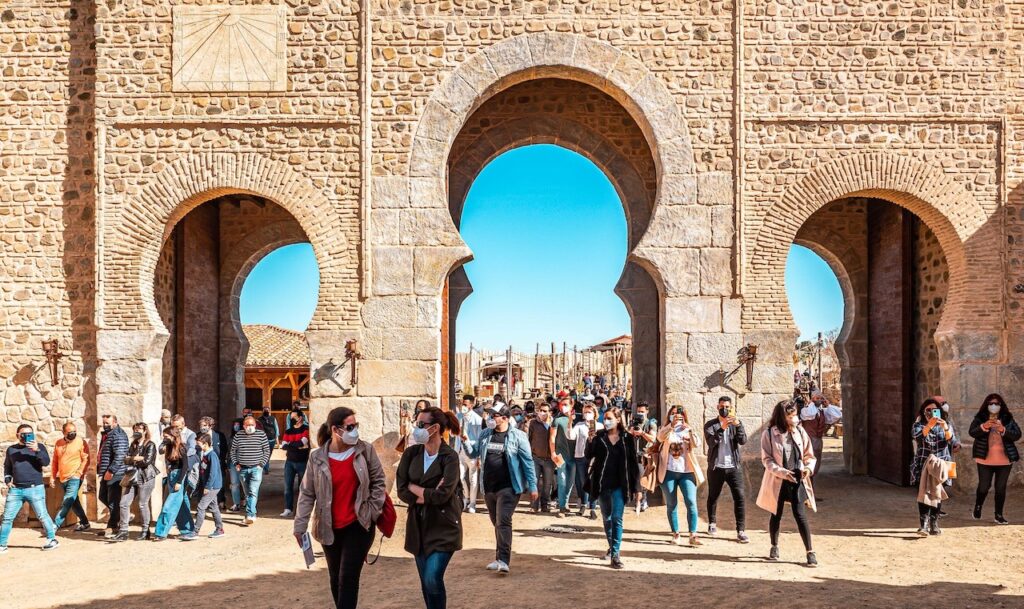
For Toledo Cathedral, the Alcázar of Segovia and El Escorial monastery, booking tickets online in advance is strongly recommended, particularly in spring, summer and at weekends, when queues at the door can be substantial. For Ávila and Cuenca, advance booking is helpful but less critical. All five destinations offer online ticketing through their own websites. Families will also love Puy du Fou España (above), a historical theme park located on the outskirts of Toledo.
What is the Cheapest Way to Get to These Destinations?
Buses are consistently the most economical option: ALSA buses to Toledo from Plaza Elíptica cost around US$6.40 one way; Avanza buses to Segovia from Moncloa and to Cuenca from Estación Sur are similarly priced. Regional trains to Ávila cost approximately US$12.80 each way. High-speed AVE services to Toledo and Cuenca are faster but more expensive, typically US$11.60-17.40 each way. Booking train tickets several days in advance via renfe.com reduces costs significantly.
Getting There
You can now reach Madrid more easily than ever with Cathay Pacific recently increasing its direct flights to the city from Hong Kong, where it links up with Iberia’s network across Europe and South America.
If you’re spending time in the Spanish capital while you explore, check out our guides to the best luxury hotels in Madrid, the most exciting neighbourhoods, and the city’s coveted Golden Triangle of Art. And once you return from your day trip, head to one of the city’s best rooftop bars, where you can sip vermouth and dine on tapas like a local. Also, don’t miss Madrid’s best markets for great take-home souvenirs.


