
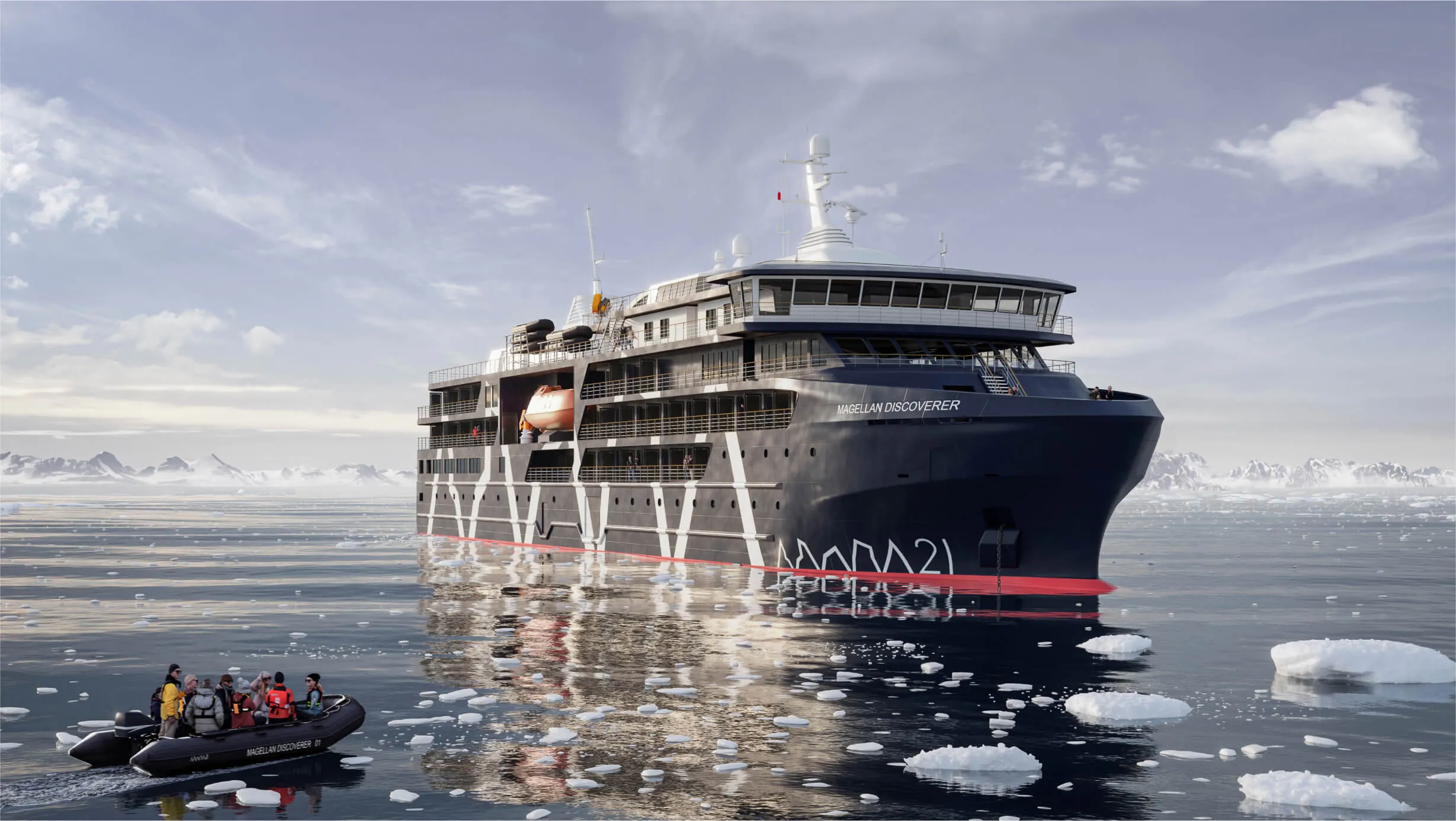

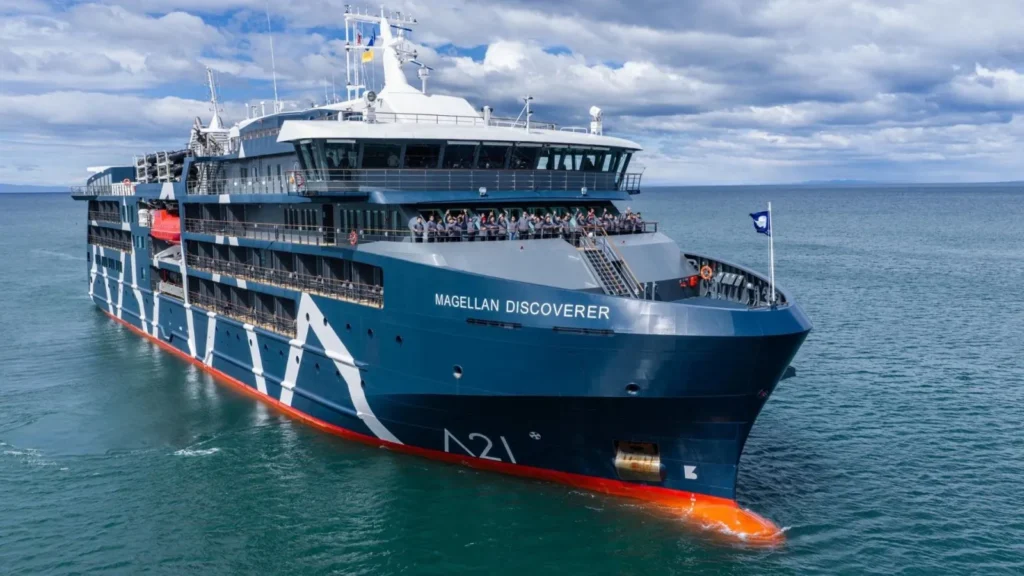
Antarctica21’s Magellan Discoverer is the first hybrid-electric ship with azimuth propulsion ever built in the Americas and has been designed from the keel up for travellers who would rather fly over the Drake Passage than sail it.
There is a particular kind of quiet that settles over an Antarctic bay at dawn – the creak of shifting ice, the distant exhale of a humpback, the chatter of a gentoo colony carrying across still water. For most of the expedition era, the hum of a ship’s diesel engines has been the one sound visitors brought with them.
The new Magellan Discoverer, which sets sail from Punta Arenas on its maiden voyage on 15 December, has been built to take that sound away, at least for the moments that matter most.
The 94-metre polar expedition ship is the newest vessel in the fleet of Antarctica21, and the most ambitious ship yet from the Chilean cruise company that, more than two decades ago, rewrote the rules of how travellers reach the bottom of the world.
Antarctica21 and the Air-cruise

Founded in Punta Arenas, the Patagonian port that has long served as a gateway to the Antarctic, Antarctica21 pioneered the Antarctic air-cruise in 2003. Rather than spending two days each way crossing the notoriously restless Drake Passage, guests board a flight of roughly two hours from Punta Arenas to King George Island in the South Shetlands, where their ship is waiting.
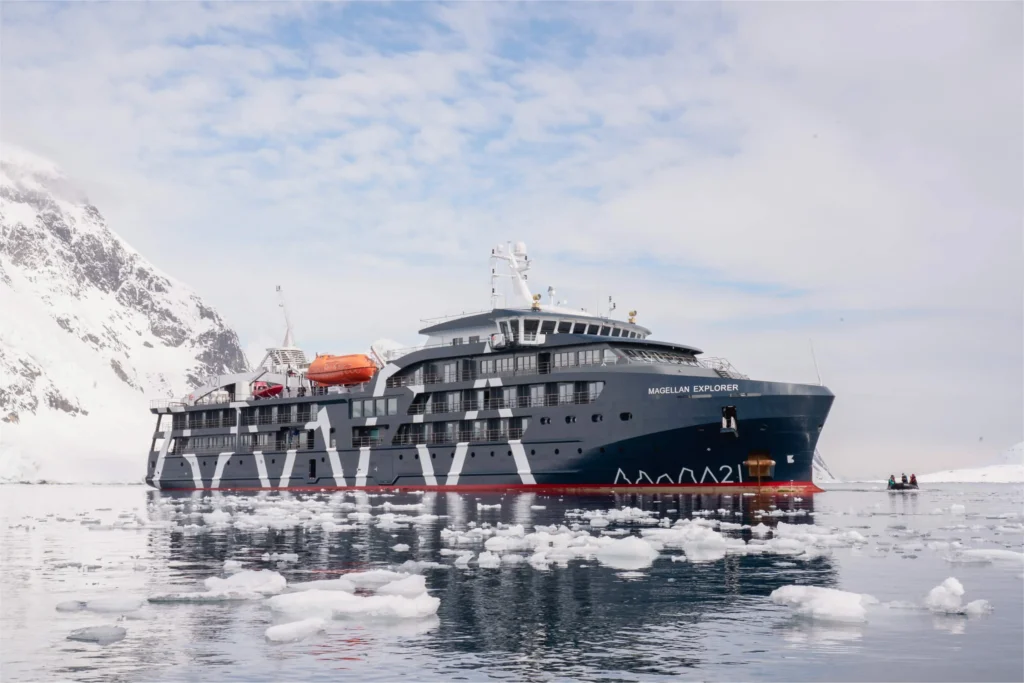
For time-poor travellers – and anyone with a fragile constitution – it’s a compelling proposition, and it has become the signature experience for the company, which is a member of the International Association of Antarctica Tour Operators (IAATO) and holds CarbonNeutral certification. Magellan Discoverer joins its sister ship, Magellan Explorer, which was delivered in 2019 by the same yard.
Design & Innovations
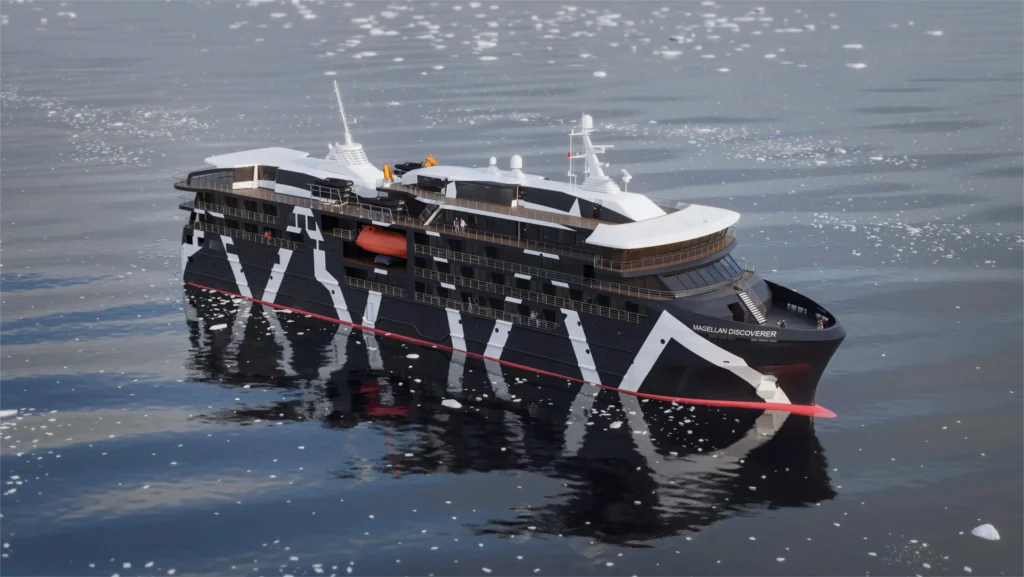
Weighing in at around 5,900 tonnes and built to Polar Class 6 – the ice-class standard that allows it to operate safely through the austral summer – Magellan Discoverer is billed as the first hybrid diesel-electric vessel with azimuthal propulsion to be built anywhere in the Americas.
The innovation that will matter most to guests sits below the waterline. An ABB Onboard DC Grid links two main engines to a Corvus Energy battery storage system, which in turn drives a pair of ABB Azipod units capable of turning a full 360 degrees. On battery power alone, the ship can move in near silence with zero emissions, and Antarctica21 intends to use this mode for low-speed transits, approaches to landing sites and manoeuvres close to wildlife. The pods are also designed to reduce underwater noise, a meaningful consideration in waters where whales communicate across vast distances.
The environmental thinking extends throughout. Selective catalytic reduction brings the engines in line with IMO Tier III emissions standards, a heat-recovery system channels exhaust heat into the ship’s heating and hot water, and retractable fin stabilisers smooth the ride while cutting drag. On board, an air-purification system using bipolar ionisation keeps cabins and public spaces fresh, while a dedicated science laboratory, with both wet and dry space, supports visiting researchers and the citizen-science programmes in which guests can take part.
The interiors are the work of Tomas Tillberg Design, whose team visited Magellan Explorer and Explorers House – Antarctica21’s private expedition centre in Punta Arenas – to capture the brand’s understated, residential feel. Outside, a 360-degree walking deck wraps the ship, and an accessible bow gives guests a front-row seat as the vessel noses through brash ice.
Accommodation
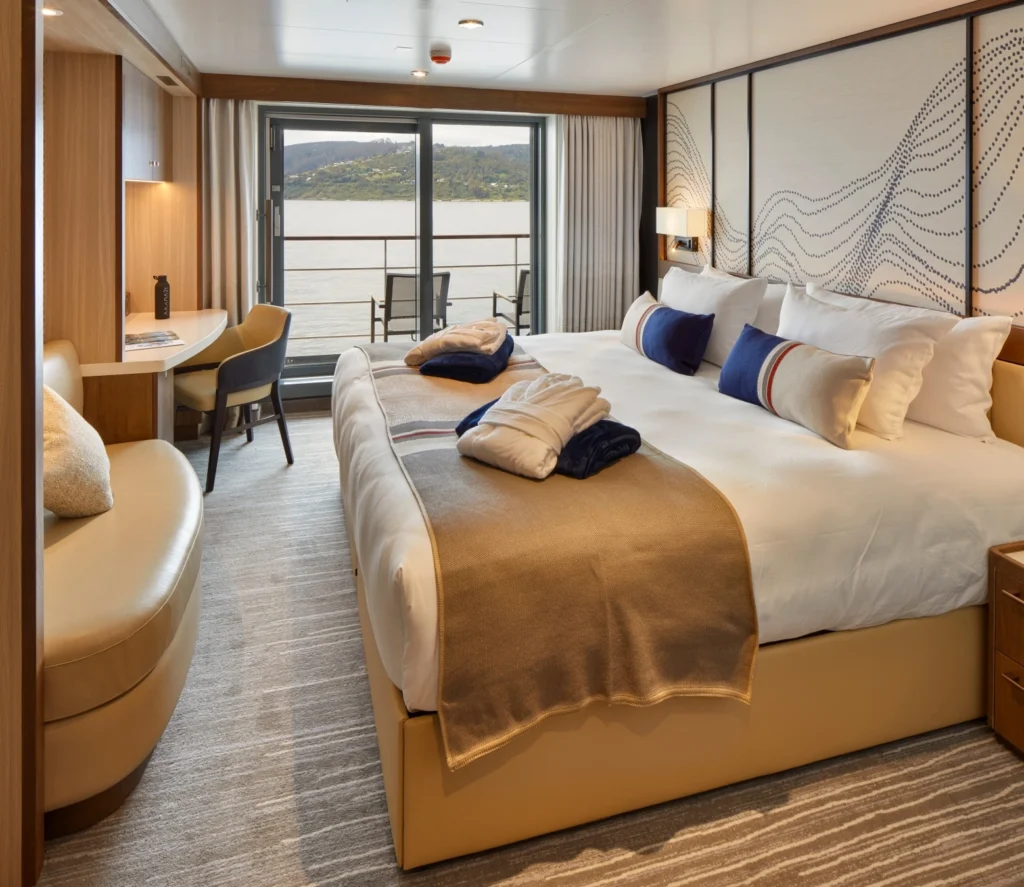
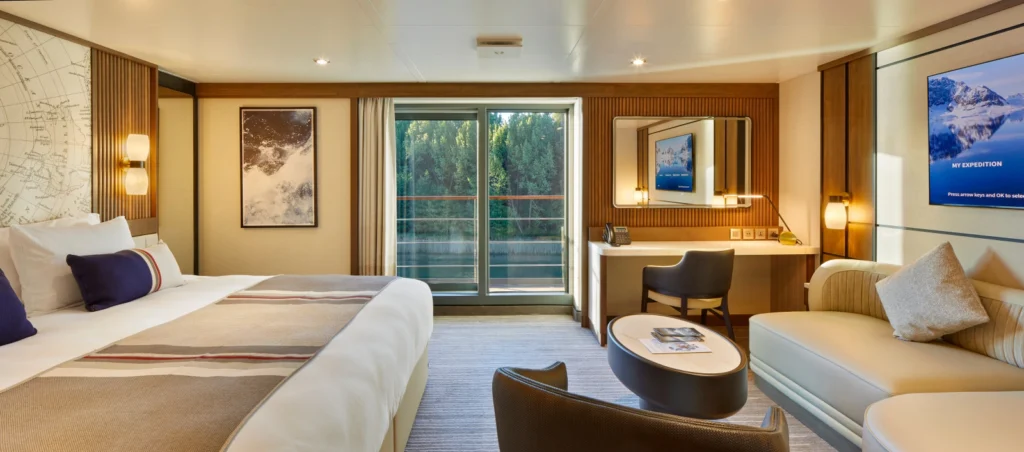
With 40 cabins and room for no more than 88 guests on its air-cruises, Magellan Discoverer is intimate by any measure. Every cabin has its own private balcony – still a rarity in polar waters – along with an en-suite shower room, a desk, a safe, a fridge and a coffee maker.
The entry point, the Deluxe Veranda Cabin, offers a generous 26 square metres with beds that convert between a king and twins, while the Single Veranda Cabin, also 26 square metres with a king bed, is a welcome nod to solo travellers. Step up to the Grand Veranda Suite and the space grows to 38 square metres, adding a sofa bed and a walk-in wardrobe. For families and friends travelling together, the Family Veranda Suite (up to four guests) and Triple Veranda Suite (up to three) each span 52 square metres across two connecting rooms with two bathrooms.
A Taste of Chile at the End of the World
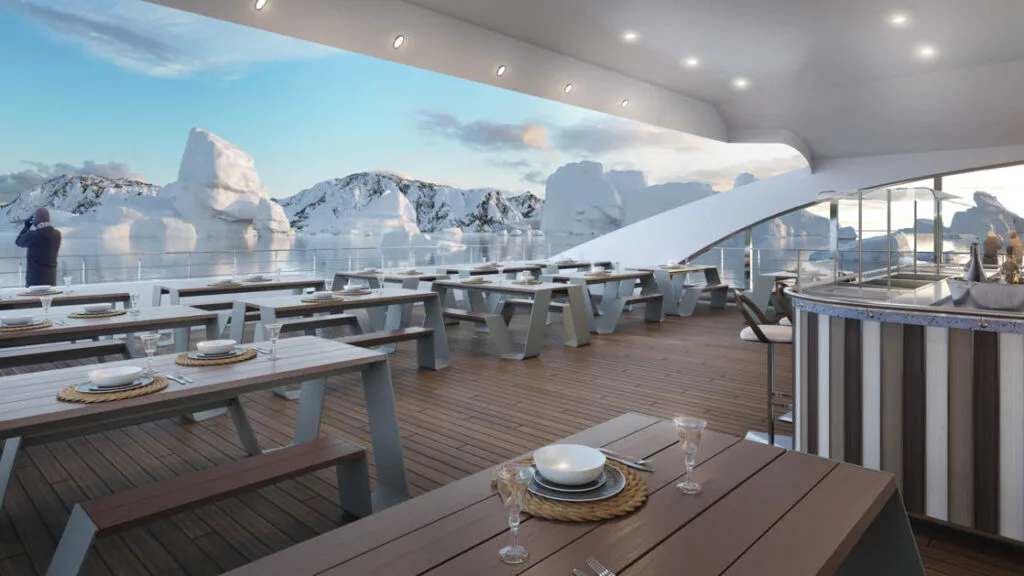
The dining room has been sized to seat every guest at a single sitting, its wide windows framing icebergs and passing wildlife through each meal. Breakfast and lunch are served as buffets, while dinner moves to table service, with menus drawing on regional Chilean flavours and premium Chilean wines poured at lunch and dinner. When the weather plays along, a sheltered outdoor barbecue area offers the most improbable Antarctic pleasure: dining al fresco among the ice.
Between meals, the Panoramic Lounge and its bar serve as the ship’s social heart, doubling as the venue for the expedition team’s briefings and lectures, while a library stocked with polar literature offers a quieter retreat with a view.
A Sauna with a View of the Ice
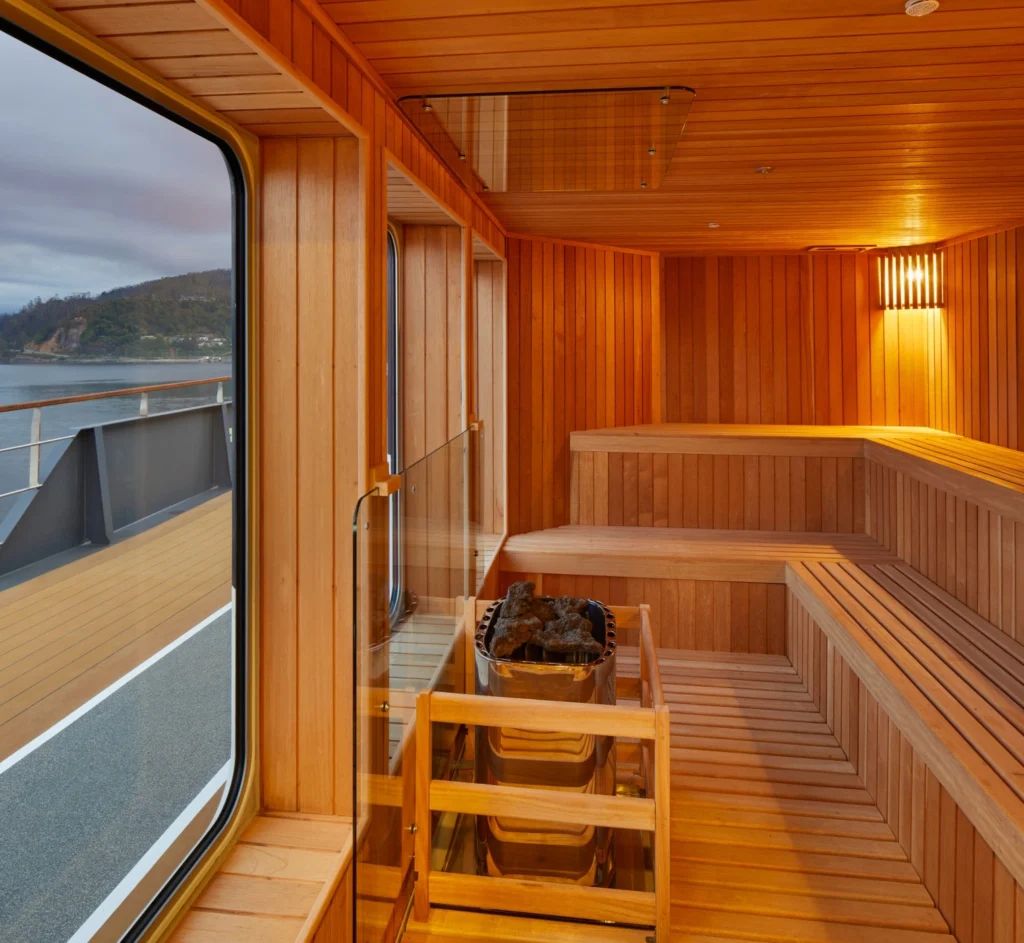
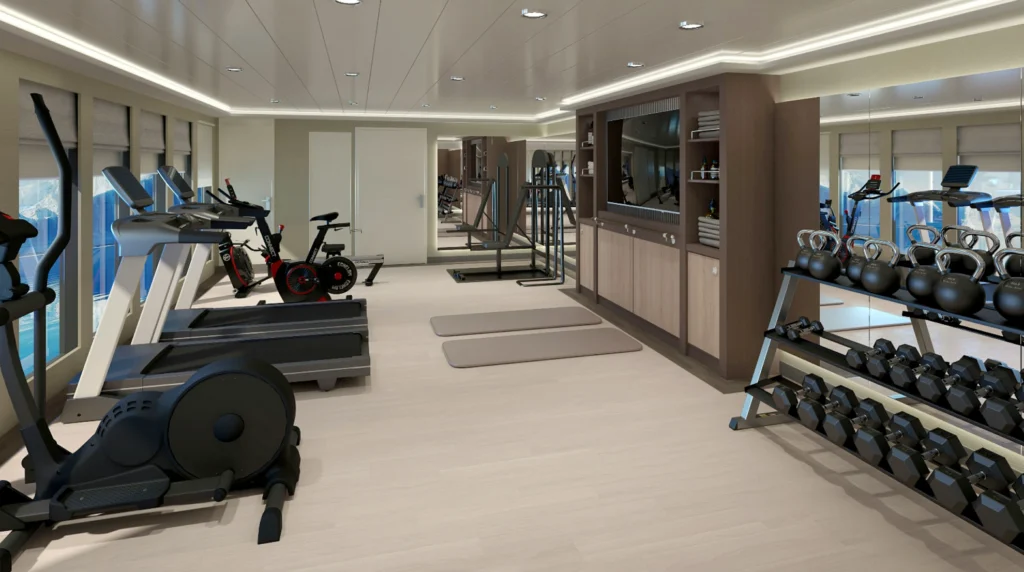
The standout feature of the new ship is the sauna, a spacious retreat with a large panoramic window so guests can warm through after a morning on the water while watching icebergs drift past. A gym designed by Anytime Fitness completes the wellness offering. It’s a pared-back programme compared with the spas on larger expedition ships, but is in keeping with a vessel whose real draw lies beyond the glass.
Talking of, Magellan Discoverer carries an expedition team and crew of 67 – an unusually high ratio for a ship of this size – and the daily rhythm revolves around Zodiac cruises and shore landings among penguin colonies, seals and whales. A purpose-designed Zodiac embarkation area, with hangers, lockers and seating, makes kitting up in polar gear less of a scramble.
Those wanting a closer encounter can add sea kayaking (priced at US$995 per person for the inaugural voyage), as well as guided hiking and snowshoeing, while the traditional polar plunge awaits the brave. Back on board, expert-led lectures and the science programme add depth to what guests have seen.
Where Magellan Discoverer Will Cruise
The ship’s inaugural voyage, departing Punta Arenas on 15 December 2026, is a one-off. Over ten days it sails south through the Strait of Magellan, Tierra del Fuego and the Beagle Channel before crossing the Drake Passage to the Antarctic Peninsula, with guests flying home from King George Island.
Thereafter, the ship settles into Antarctica21’s air-cruise programme alongside Magellan Explorer, offering the line’s eight-day Classic Antarctica Air-Cruise, which explores the South Shetland Islands and the ice-filled fjords of the western Antarctic Peninsula. Alongside it are the shorter Antarctica Express, the Polar Circle Air-Cruise, which pushes south towards the Antarctic Circle, and a longer Antarctica & South Georgia voyage.