
From Art Deco carriages crossing Europe to a contemporary odyssey through the Andes and Australia’s outback icons, these luxury trains prove that the journey matters more.
Long before the private jet, the great age of travel belonged to the railway. Trains like the Orient Express turned crossing a continent into an event in itself, with formal dinners, sleeping cars dressed in mahogany and brass, and days spent simply watching the world change outside the window.
That golden age never really ended — it just got quieter, more exclusive, and considerably more comfortable, with modern engineering now layered discreetly beneath the vintage styling many of these trains still champion.

Today’s finest luxury trains – most of which I’ve travelled on personally – span every continent, from vintage restorations still running century-old carriages to purpose-built sleeper trains launched within the last decade. Some cross deserts, others climb to nearly 5,000 metres in the Andes, and a handful exist purely to showcase a single country’s landscape at a walking pace.
Here are the very best luxury trains from across the globe.
1. Venice Simplon-Orient-Express
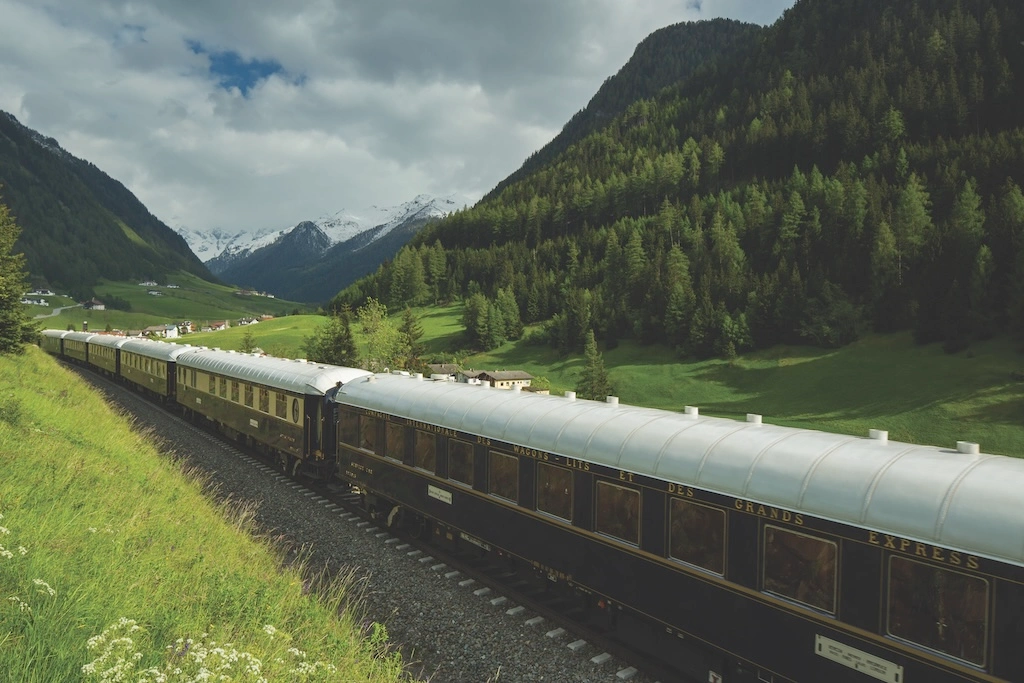
Route: London to Venice, with extended itineraries to Paris, Istanbul, Florence and the Amalfi Coast, operated by Belmond.
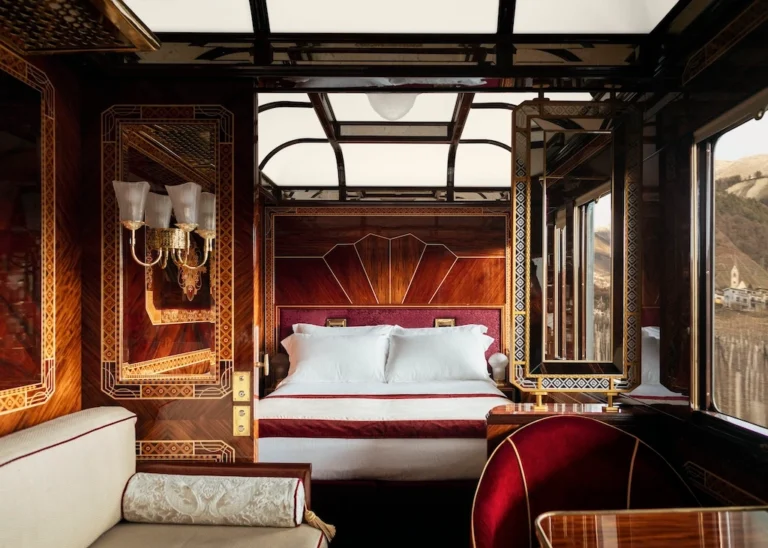
The most famous train in the world (and my first foray into luxury trains at the tender age of 22) traces its name to the original Orient Express, launched in 1883, though today’s train uses genuine 1920s carriages once used on the historic route, restored to their original marquetry and brass fittings.
Its Art Deco style remains unmatched, with navy-and-gold liveried cars, white-gloved stewards and a strict evening dress code that turns dinner into theatre. While famous passengers that travelled on the original Orient Express include Leo Tolstoy, Marlene Dietrich and Lawrence of Arabia, the VSOE has welcomed the likes of Kate Moss, Pharrell Williams and the Beckhams, among many others.

Accommodations
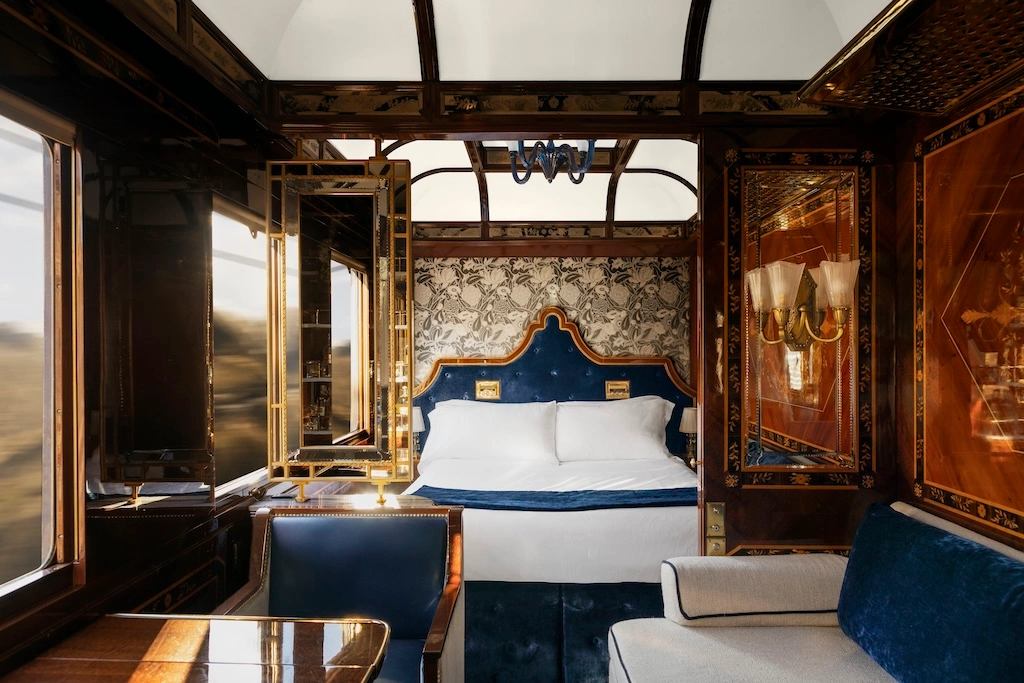
Cabins convert from day salons into sleeping berths each evening, ranging from compact Historic Cabins with a fixed upper and lower berth to the newer Grand Suites, which add a permanent double bed, a marble-clad en-suite bathroom with rainfall shower, a personal wardrobe with hanging space, and dedicated butler service on call throughout the journey.
Interconnecting cabins are available for families or groups travelling together, and every category retains the original 1920s wood marquetry panelling unique to each carriage.
For the ultimate splurge, book (well ahead) for L’Observatoire, a sublime sleeper carriage designed by the French artist JR. It’s the first carriage on the train designed by an artist, and the most spacious accommodation on board, one that draws on astronomical observatories and the cabinets of curiosities of Renaissance Europe. The carriage features a single bedroom, as well as a private lounge that can be rearranged into a private dining room for up to five people, a library, a marble bathroom and a hidden tea room.
Dining
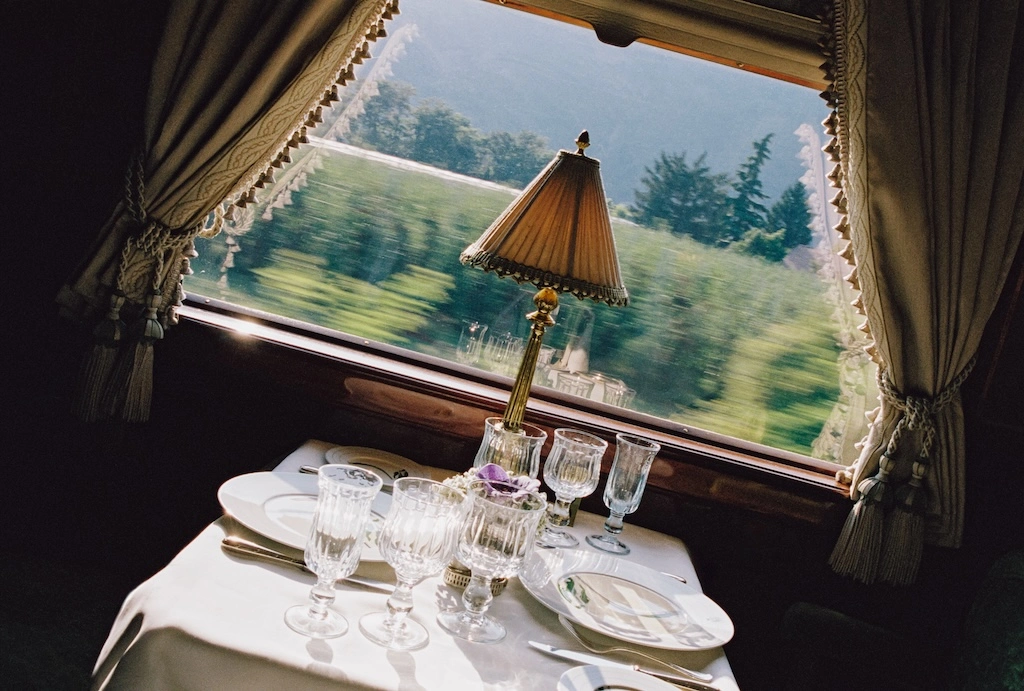
Three vintage dining cars — each with its own distinct Art Deco marquetry theme — serve a formal, multi-course French-inflected menu that changes by route and season, designed by a rotating roster of guest chefs and paired with fine wines selected specifically for the journey.
Afternoon tea is served in the cabin or Bar Car, and evenings close with cocktails and live piano in the Bar Car, where the resident pianist has become as much a part of the VSOE tradition as the carriages themselves.

Activities
On the Venice Simplon-Orient-Express’s standard route between Venice and Paris, the main pleasures are the dining and the atmosphere. In addition to glorious dinners and soirees in the lounge, guests have had access to Writers On The Rails, an anthology of original short stories by six authors, including David Nicholls and Bernardine Evaristo.
Multi-night itineraries often include stopovers at Belmond’s own hotels in Florence, Portofino and Venice, allowing guests to extend the journey off the rails entirely.
Seasonality: Runs roughly March through November, pausing over the depths of winter.
2. Rovos Rail Pride of Africa
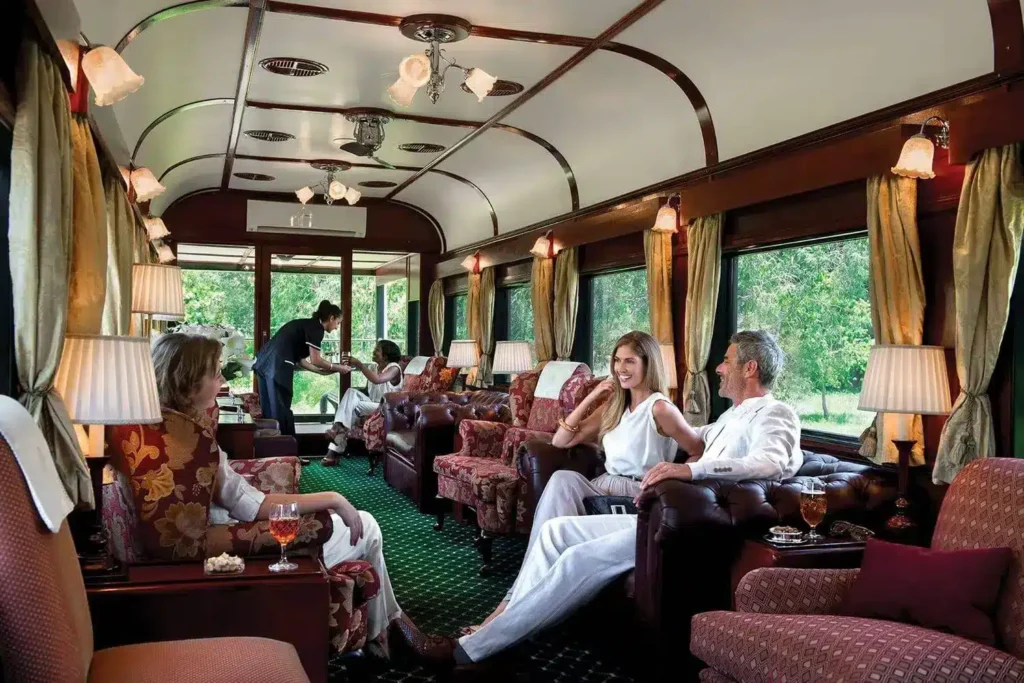
Route: Pretoria to Cape Town, Durban, Victoria Falls, Namibia and Dar es Salaam, operated by Rovos Rail.
Family-owned since 1989 by founder Rohan Vos, Rovos Rail uses restored vintage carriages from the National Railways of Zimbabwe to create a compelling rail adventure in Southern Africa. Journeys range from a 48-hour taster to a 15-night crossing of the continent, all built around the unhurried, Edwardian-era romance of African exploration, with a staff of over 430 dedicated to restoring and running the fleet from its Pretoria depot.
Accommodations
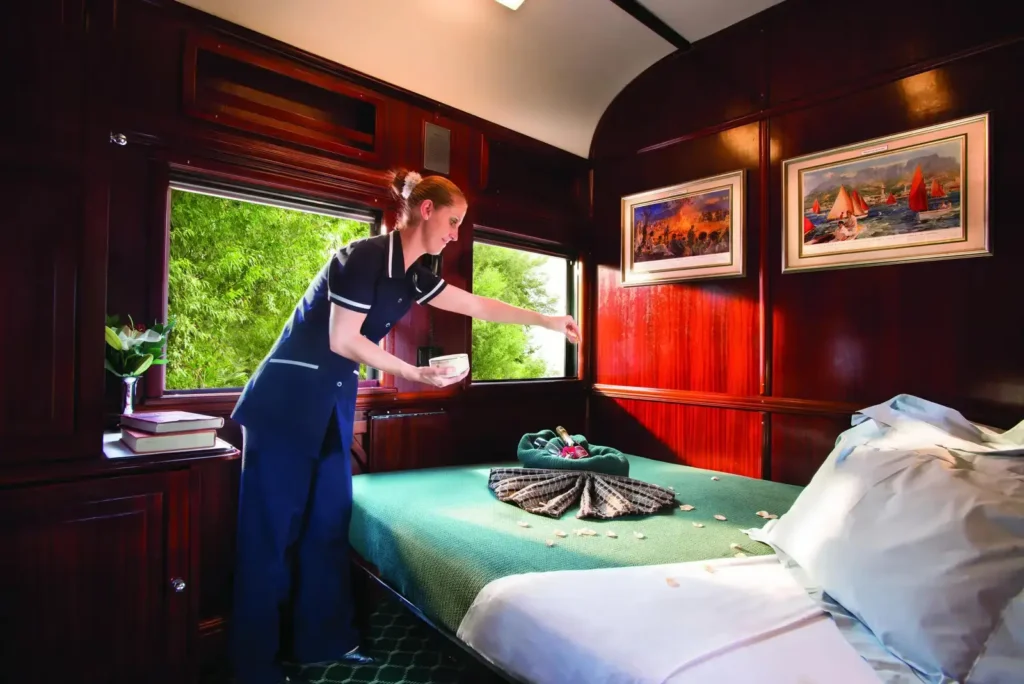
Three cabin grades run the full spectrum of comfort. The Pullman Suite at seven square metres offers a compact but genuinely private berth with an en-suite shower, while the Deluxe Suite adds more floor space and an elegant sitting area by day, perfect for gazing out across the savannah.
The Royal Suite, at 16 sqm, occupies half a carriage all on its own, and features a private lounge, a twin or double bed dressed in fine linens, and an en-suite bathroom with a glorious Victorian-style bathtub, sink and separate shower. All suites are fitted with individual climate control, a rarity on vintage rolling stock.

Dining
Two formal restaurant cars, each seating guests at white-linen-dressed tables, serve a set multi-course menu built around South African ingredients — Karoo lamb, Cape seafood, seasonal game — accompanied by an extensive list drawn from the country’s leading wine estates and poured by attentive, formally dressed waitstaff.
A strict smart-casual dress code is enforced during the day, followed by elegant wear at dinner, so dress to impress before meeting your fellow guests for pre-dinner drinks in one of the train’s two lounge cars.

Activities
Off-train excursions are included at nearly every stop, from guided game drives through private reserves to walking tours of historic mining towns and, on the Victoria Falls route, a guided visit to the falls themselves. The open-air observation car at the rear of the train, with its wraparound balcony, remains the best vantage point for watching the African bush unfold, and is especially popular at sunrise and sunset.
Seasonality: Operates year-round, though the longest cross-continent routes run on a fixed seasonal schedule.
3. Rocky Mountaineer
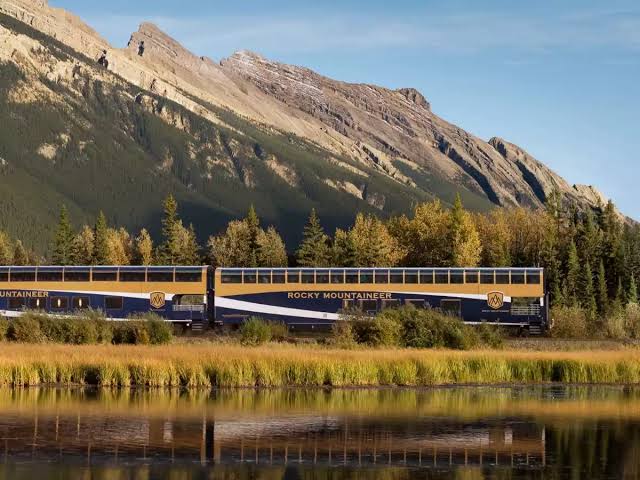
Route: Vancouver to Banff, Jasper and Lake Louise across the Canadian Rockies, plus a newer Colorado-to-Utah route, operated by Rocky Mountaineer.
Founded in 1990, when it took over the route from VIA Rail, the Rocky Mountaineer pioneered the daytime-only glass-dome format: the train never runs overnight, so every mile of mountain scenery is seen in daylight, with guests overnighting in hotels along the route instead. More than two million passengers have now travelled its Canadian routes, and a newer Colorado-to-Utah itinerary has since extended the brand into the American Southwest.

Accommodations
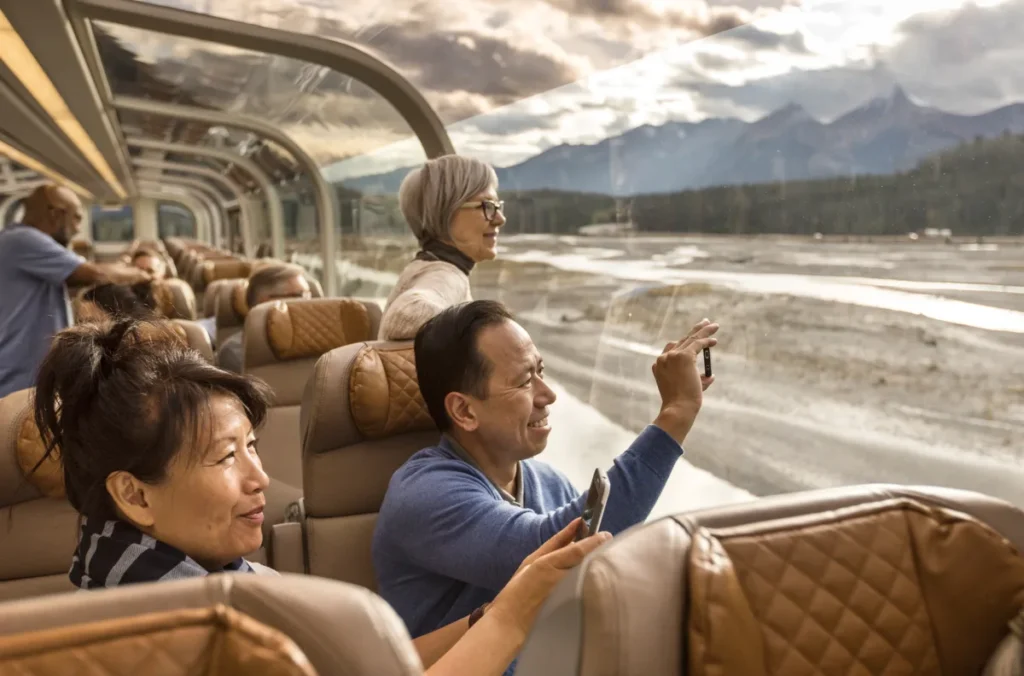
GoldLeaf carriages are entirely bi-level, with a glass-domed upper deck for panoramic viewing and a dedicated dining room and outdoor viewing platform below, giving guests a genuine change of scene between meals and sightseeing.
SilverLeaf offers a single-level carriage with a glass-topped roof, oversized reclining seats and large picture windows, a strong option for travellers prioritising value without sacrificing the core scenic experience. Neither class includes onboard sleeping accommodation — every night is spent at a hand-picked hotel along the route, included in the fare.

Dining
Regionally inspired Pacific Northwest and Canadian menus rotate throughout the journey, built around ingredients like wild salmon, bison and seasonal produce from British Columbia and Alberta. GoldLeaf guests dine at assigned tables in the dedicated dining car below the dome, served across multiple courses, while SilverLeaf passengers are served fresh meals directly at their window seats, allowing them to keep watching the scenery throughout.
Activities
Onboard hosts narrate the passing landscape and point out wildlife — black bears, bald eagles, mountain goats and, on lucky days, grizzlies — while an open-air viewing platform on GoldLeaf carriages lets guests step outside for unobstructed photography.
Included overnight hotel stays in towns like Kamloops or Banff break the multi-day journey into manageable stages and add an extra layer of exploration beyond the train itself.
Seasonality: April through October; the train does not operate through the Canadian winter.
4. Indian Pacific

Route: Sydney to Perth via Adelaide, 4,351 kilometres across the continent, operated by Journey Beyond.
Running since 1970 and named for the two oceans it connects, the Indian Pacific crosses the Nullarbor Plain — the world’s longest stretch of dead-straight railway — over four days and three nights, taking in the Blue Mountains, outback mining towns and the vast, pink-tinged salt lake country of South Australia. New Australis and Aurora suites, introduced in 2026, have added a genuinely ultra-luxury tier to what was already Australia’s most storied rail journey.

Accommodations
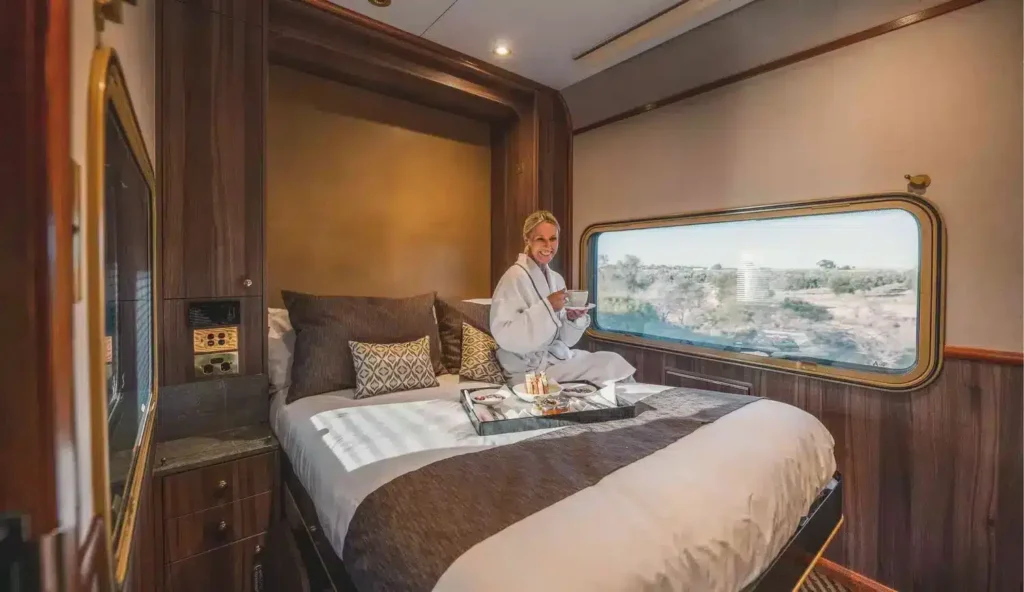
Gold Twin and Gold Single cabins offer classic compact sleeper comfort with fold-down beds and compact en-suite bathrooms. Platinum Service steps up to a private en-suite, more generous proportions and turn-down service each evening; and those new Australis and Aurora suites deliver a separate bedroom and lounge area, a double vanity bathroom stocked with Jurlique amenities, a personal writing desk, in-suite bar and dedicated butler service in the most spacious accommodation ever offered on an Australian train.
Dining
The Queen Adelaide Restaurant serves regionally inspired Australian menus that change with the seasons, built around native ingredients like saltbush lamb and Barossa produce, with all wine, beer and spirits included throughout the journey. Meanwhile, the Outback Explorer Lounge stays open through the day for casual drinks, card games and conversation, while suite guests can also arrange private in-suite dining.

Activities
Off-train excursions are included at nearly every stop: a visit to Broken Hill’s Pro Hart Gallery and its outback mining history, a guided wine tasting through the Barossa Valley near Adelaide, exploration of Kalgoorlie’s historic goldfields, and a genuinely unique stargazing evening beside the train at the remote Rawlinna siding, deep in the treeless Nullarbor, where the night sky is unlike anywhere else on the route.
Seasonality: Runs year-round, twice weekly each direction in peak season and weekly off-peak.
5. Great Southern
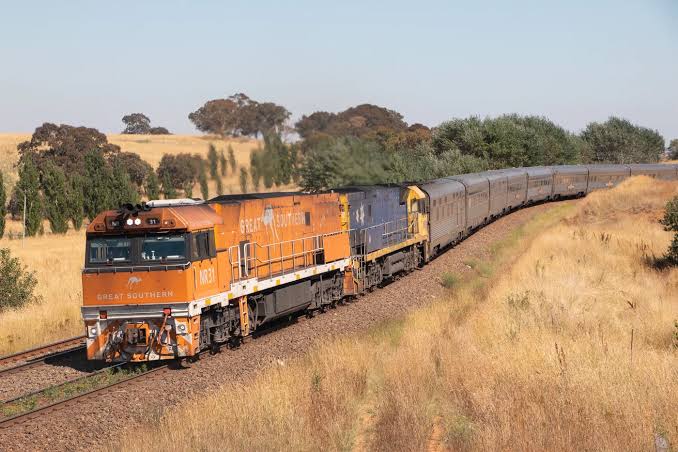
Route: Adelaide to Brisbane via the Hunter Valley, Canberra or Melbourne, operated by Journey Beyond.
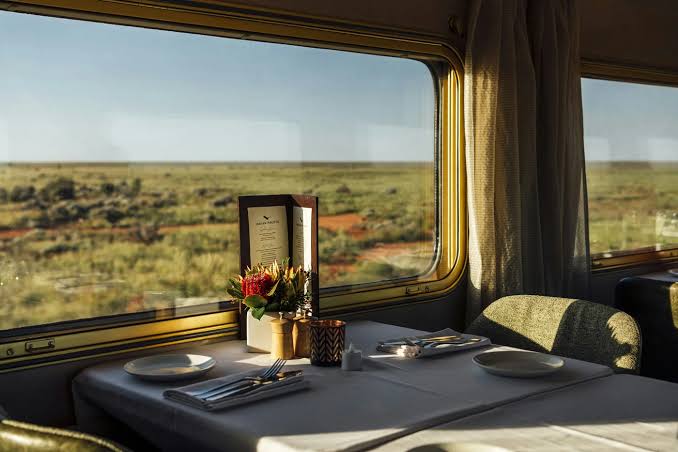
The newest of Australia’s three great trains, Great Southern (which uses The Ghan’s rolling stock during summer) was launched in 2019 to showcase the country’s East Coast rather than the outback, threading together coastal New South Wales, wine country and capital cities across a laid-back, three-to-four-day itinerary between South Australia and Queensland. Sister train to The Ghan and Indian Pacific, it completes Journey Beyond’s trio of luxury Australian rail journeys.

Accommodations
Platinum cabins offer double or twin configurations with a private ensuite bathroom, plush bedding and generous storage for longer trips, while Gold Twin and Gold Single cabins provide comfortable, more compact sleeper berths with shared end-of-carriage facilities, better suited to solo travellers or those prioritising value.
Every cabin includes daily housekeeping and turn-down service, and the lounge carriages offer a relaxed alternative to spending the whole journey in-cabin.
Dining
All-inclusive dining draws heavily on regional produce found directly along the route — Hunter Valley wine, Coffs Harbour seafood, Victorian produce — served across a set multi-course menu in a dedicated dining carriage designed for long, sociable meals, with premium Australian wines and full beverage service included in every fare.

Activities
A standout beachside dining experience in Coffs Harbour puts guests’ tables directly on the sand at sunset; a guided tour through the historic vineyards of the Hunter Valley includes cellar-door tastings; and, depending on direction of travel, the route also stops in Canberra for a cultural tour or Melbourne for a taste of the city’s laneways and food scene.
Seasonality: Operates only from December to February, Australia’s summer, making it the most seasonally limited of the country’s three flagship trains.
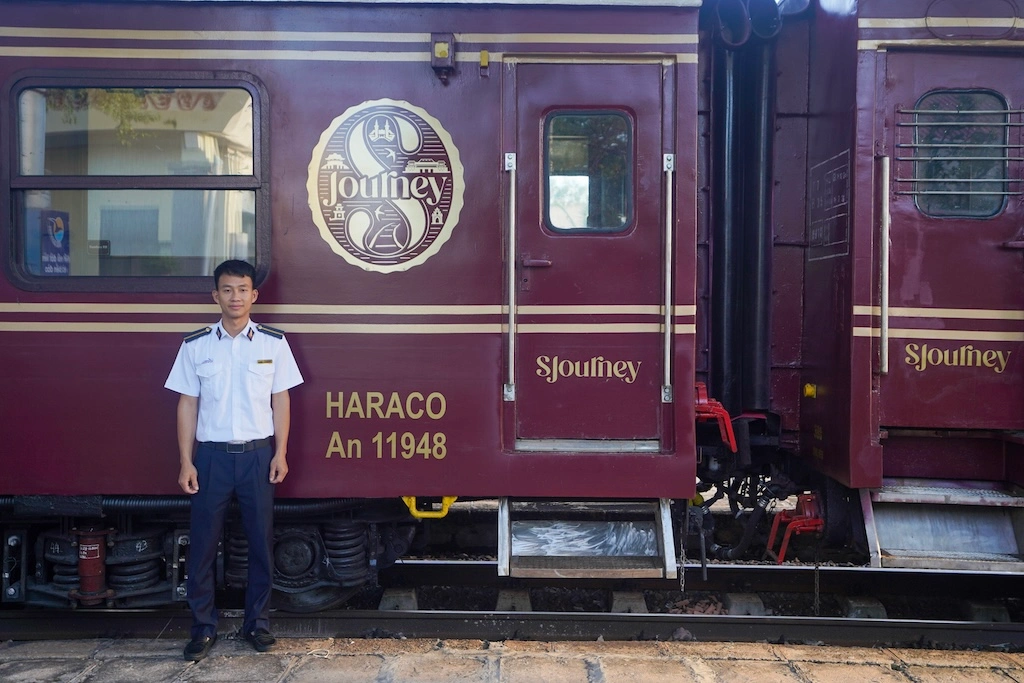
6. SJourney
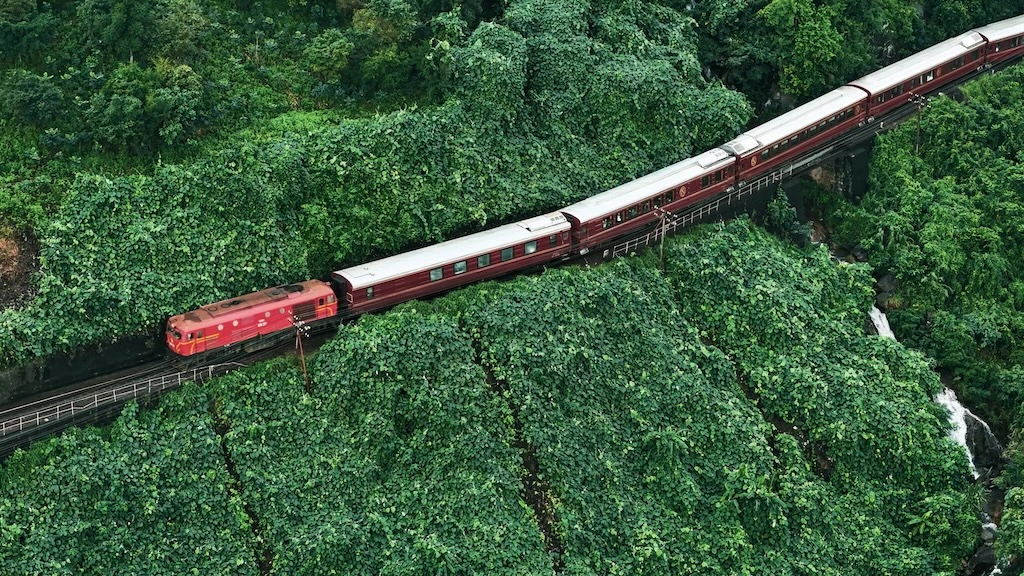
Route: Hanoi to Ho Chi Minh City, an eight-day, seven-night journey the length of Vietnam, operated by SJourney.
Vietnam’s first dedicated luxury train, SJourney reframes a well-worn backpacker route as a slow, curated passage through the country’s culture and landscape, from emerald rice paddies and limestone karsts in the north to the tropical marshlands of the south, with local guides joining at each stop.
The train, which features 13 carriages catering to up to 60 passengers, has also quickly built a reputation among honeymooners and milestone-anniversary travellers for the depth of its curated cultural programme.
Accommodations
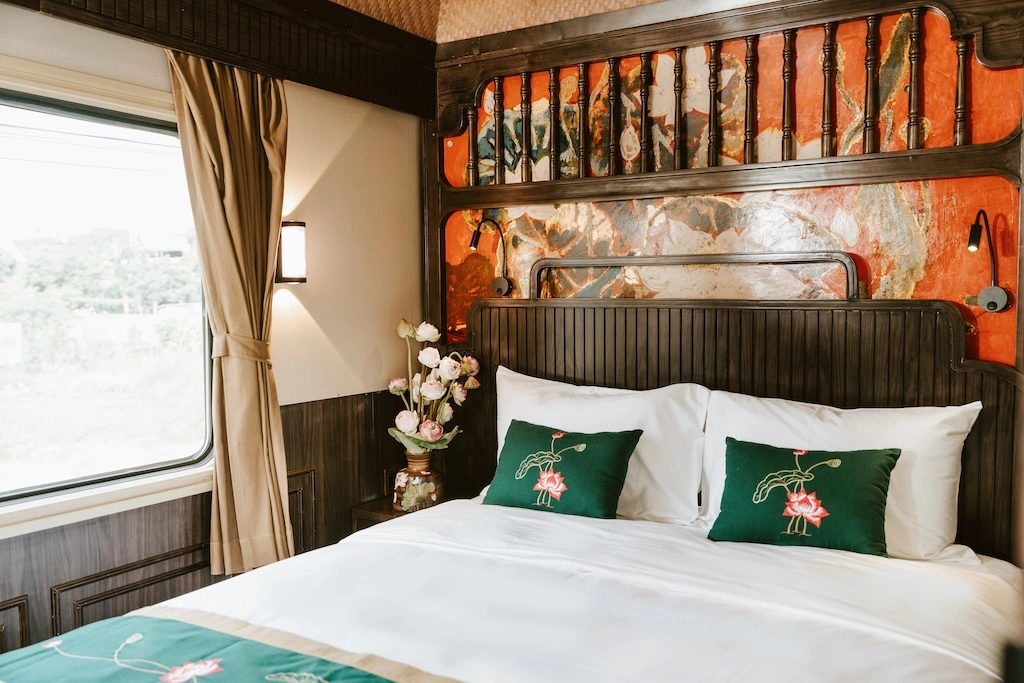
Private cabins are finished with quality bedding, blackout curtains for restful nights, en-suite bathrooms and thoughtfully designed storage that balances elegance with genuine day-to-day functionality across the week-long journey, an important detail on a route this long. Cabins are configured for couples or small groups, with attentive onboard staff assigned to each carriage to handle requests throughout the trip.
Dining
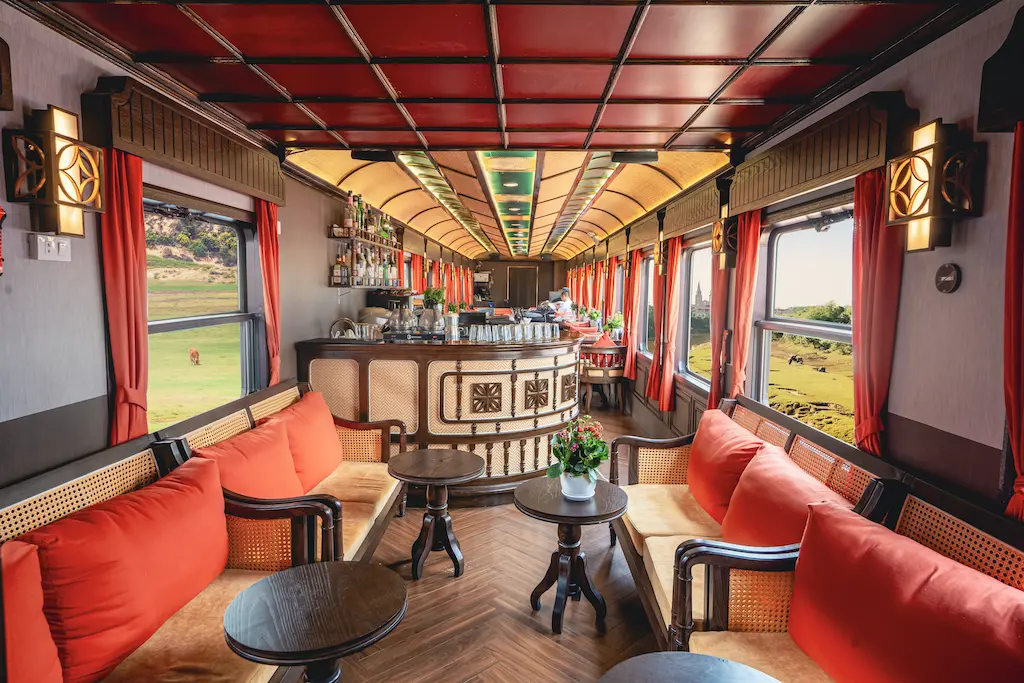
Onboard chefs prepare a rotating mix of refined Vietnamese and international dishes, drawing on regional specialities and fresh local produce sourced as the train moves between provinces, from northern staples like pho and fresh spring rolls to southern, Mekong Delta-influenced dishes later in the journey. Meals are typically served in a communal dining carriage designed to encourage conversation among fellow guests.
Activities
Guided excursions and genuine cultural immersion are built into each of the journey’s “majestic stops,” including temple visits, local craft workshops, and interactions with communities along the route led by knowledgeable local guides. Evenings on board often feature themed entertainment, from live music to storytelling, adding a layer of celebration to what is designed as a milestone, once-in-a-lifetime journey.
Seasonality: Operates year-round, with weather varying significantly between Vietnam’s cooler north and tropical south.
7. The Blue Train

Route: Pretoria to Cape Town, 1,593 kilometres over roughly 31 hours, with a seasonal extension to Kruger National Park, operated by The Blue Train.
Dating to the 1920s and relaunched in its current form in 1997, The Blue Train, South Africa’s other luxury train adventure, is affectionately known as “the Blue Jewel,” its Royal Blue and cream livery among the most recognisable in the world of rail. Wood-panelled cabins, brass fittings and panoramic windows frame a route through semi-desert, winelands and savannah that’s been enjoyed by everyone from Nelson Mandela, Elton John, Kylie Minogue and Naomi Campbell to Mia Farrow, Earl & Lady Spencer, Danny Glover, Neil Young, Paul Simon and Sir Peter Ustinov.

Accommodations
Luxury and Deluxe suites both come with a private en-suite bathroom, individually controlled air conditioning, a personal butler on call throughout the journey and large panoramic windows; a select number of Luxury Suites go a step further with a full-length bathtub finished in gold and marble fittings, among the most opulent bathrooms found on any train in the world.
By day, the sitting area converts into a private lounge; by night, staff discreetly convert it into a made-up bed while guests dine.

Dining
A formal dining car, dressed with white linen and fine crystal, serves gourmet South African cuisine drawing on regional specialities like Karoo lamb, ostrich fillet and fresh Knysna oysters, each course paired with an award-winning South African wine.
In-suite dining is also available on request for guests preferring a more private evening, and breakfast can be taken at leisure either in the dining car or delivered directly to the suite.
Activities
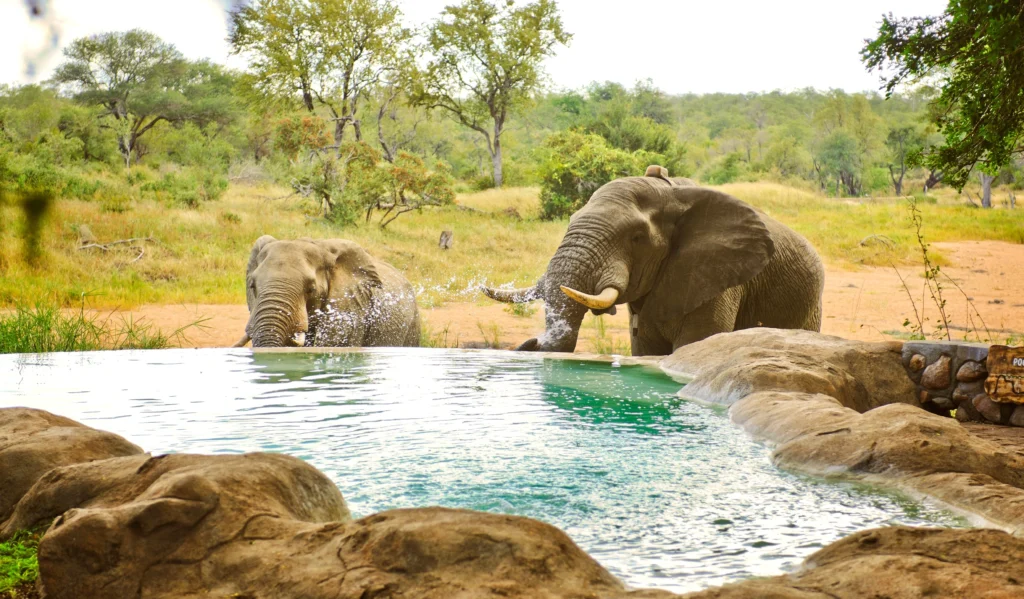
The wood-panelled Club Car, styled after a gentleman’s club, offers Cuban cigars, backgammon and a well-stocked bar for evening drinks. This art-lined lounge bar also hosts afternoon high tea with views of the passing winelands and savannah; and an annual extension links the core Pretoria-to-Cape-Town route to a two-night safari experience at Kruger National Park for guests wanting to combine rail travel with a wildlife encounter.
Seasonality: Runs year-round on its core route, with the Kruger extension typically offered once a year.
8. Maharajas’ Express

Route: Four signature circuits across Rajasthan and Central India, starting and ending in Delhi, operated by Maharajas’ Express.
Custom-built and launched in 2010 by India’s rail authority, the Maharajas’ Express has been voted the World’s Leading Luxury Train eight times (it’s also one of the best trips of my career). This glorious train styles itself as the “Orient Express of the East” thanks to its blend of royal Rajasthani heritage and contemporary five-star service, right down to a red-carpet welcome and traditional greeting at every station along its route.
Accommodations
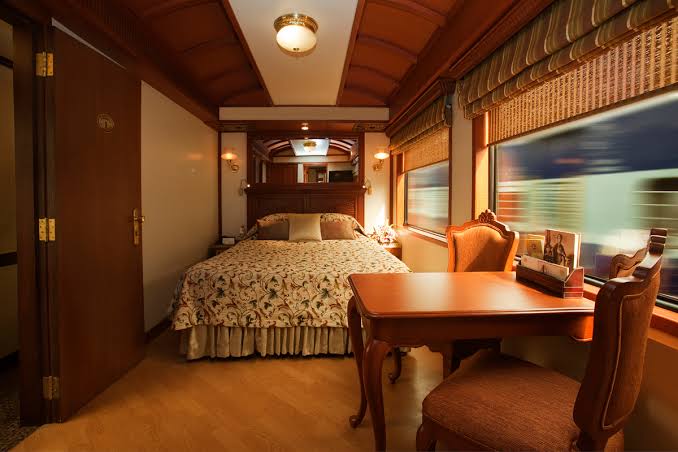
Deluxe Cabins offer a comfortable double or twin bed with a private en-suite bathroom while Junior Suites and full Suites deliver a step up in size and finish with richer furnishings drawn from Rajasthani royal aesthetics. If you’re looking to splurge, the Presidential Suite occupies an entire carriage, complete with its own separate living room, bedroom, dining area and a dedicated round-the-clock butler for the duration of the trip. Every cabin is fitted with individually controlled climate systems and satellite connectivity.

Dining
Two dining cars, Rang Mahal, styled after a maharaja’s banquet hall, and the peacock-themed Mayur Mahal, anchor the onboard experience, with both serving elaborate Indian and international menus prepared fresh by onboard chefs and presented with white-glove service. The Rajah Club, a dedicated bar carriage with a multilingual library, and the Safari Lounge stay open for evening drinks, cigars, and conversation among guests.

Activities
Depending on the chosen 3-7 day itinerary, guided excursions include a sunrise visit to the Taj Mahal in Agra, a tiger safari through Ranthambore National Park, exploration of Jaipur’s Amber Fort and City Palace, and time along the sacred ghats of Varanasi at dusk. Each excursion is accompanied by knowledgeable local guides, and on arrival, a traditional red-carpet reception welcomes guests back aboard before they race to the next destination.
Seasonality: Operates October through April only, avoiding India’s intense pre-monsoon summer heat.
9. Belmond Andean Explorer
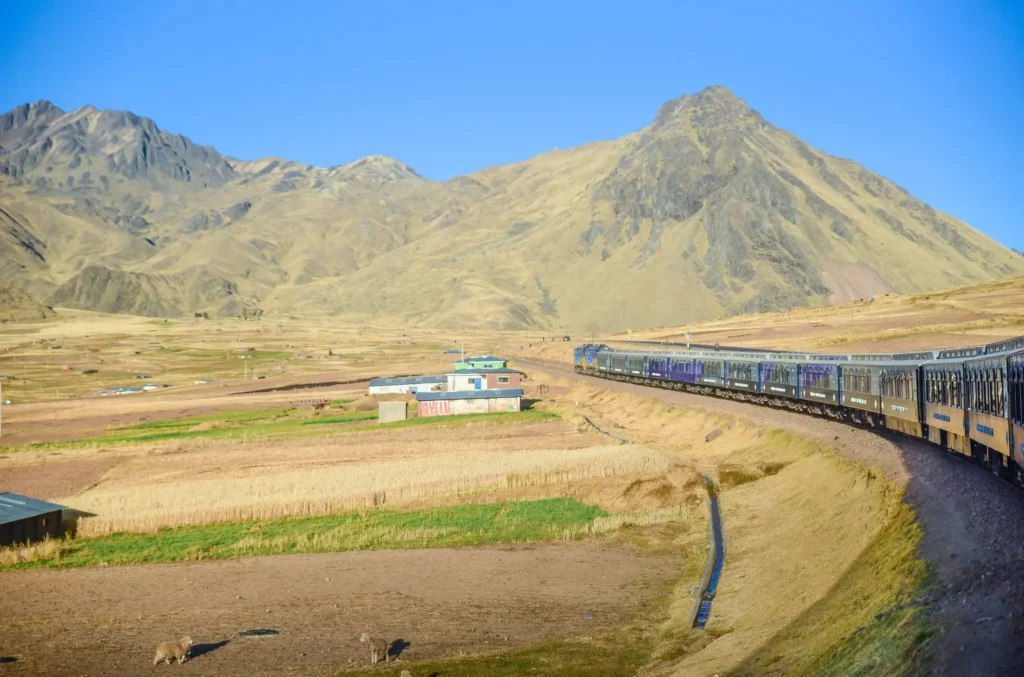
Route: Cusco to Puno on Lake Titicaca and on to Arequipa, southern Peru, operated by Belmond.
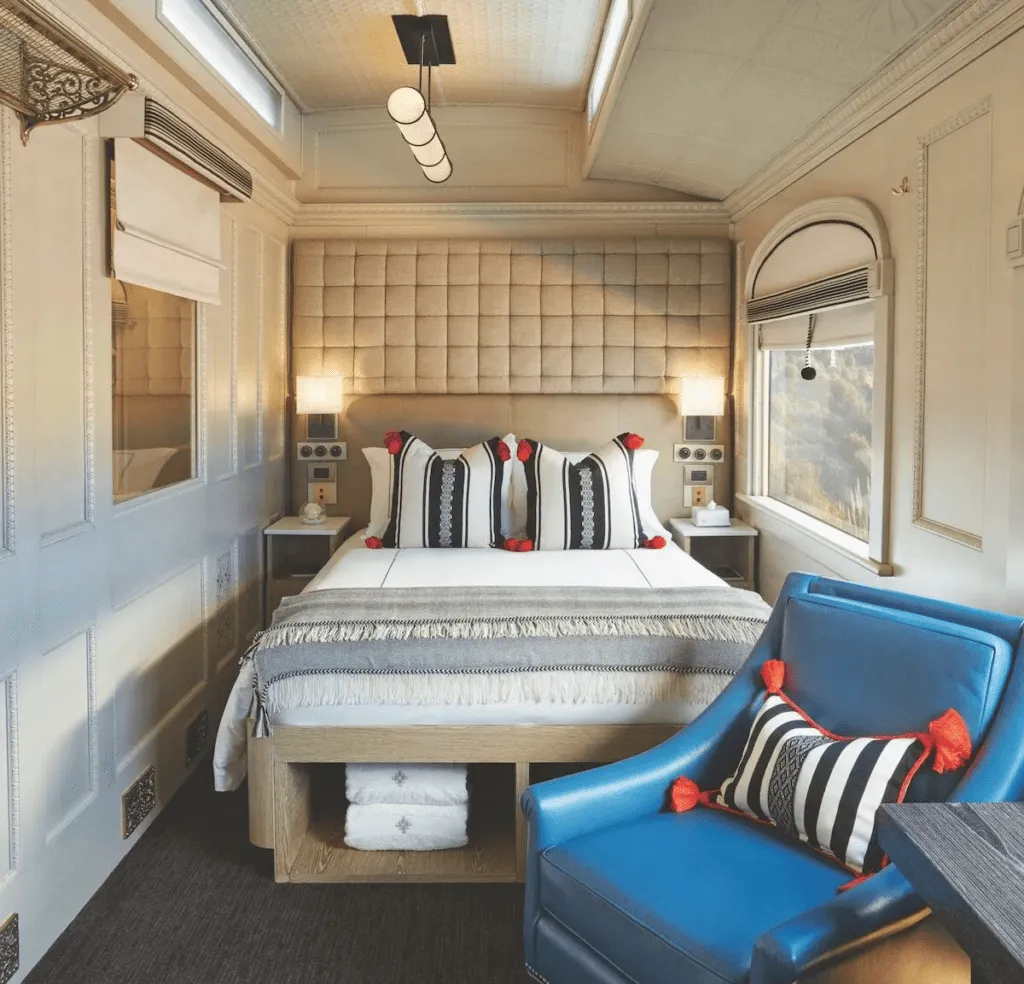
Launched in 2017 as South America’s first luxury sleeper train (another of my favourite train adventures), the Andean Explorer climbs to nearly 4,800 metres across the Altiplano, its contemporary design — alpaca wool, hand-finished leather, Inca chakana motifs — a deliberate departure from the vintage styling of most luxury trains elsewhere in the world. Its carriages carry the names of Andean flora and fauna, from the dining car Muña to the spa car Picaflor.
Accommodations
Suite, Twin and Bunk cabins all come with a private en-suite bathroom and shower, plus a built-in oxygen supply piped directly into the cabin to ease the effects of sleeping at high altitude. Interiors favour contemporary earthen tones, textured leather and alpaca wool over the vintage styling found on most other luxury trains and with capacity for just 48 guests across the entire train, the atmosphere stays intimate throughout the journey.

Dining
Two dining cars — Muña, named for a soothing Andean herb, and Llama, which showcases regional ingredients from producers along the route — serve a menu built around Peruvian terroir, changing daily to reflect the altitude and region the train is passing through. The bar car pours pisco sours to the sound of a live baby grand piano each evening before dinner, a signature ritual of the journey.

Activities
The train’s dedicated spa car, Picaflor — named for the hummingbird — offers Andean-inspired massages and wellness rituals mid-journey, a rare amenity on a train of this size.
Off-train excursions include a visit to Lake Titicaca‘s floating Uros islands, built entirely from buoyant reeds, a stop at the colourful La Raya highland market, and, on selected departures, access to Collata, an exclusive stretch of sand on Taquile Island nearly 4,000 metres above sea level.
Seasonality: Runs March through December, pausing during Peru’s rainy season in January and February.
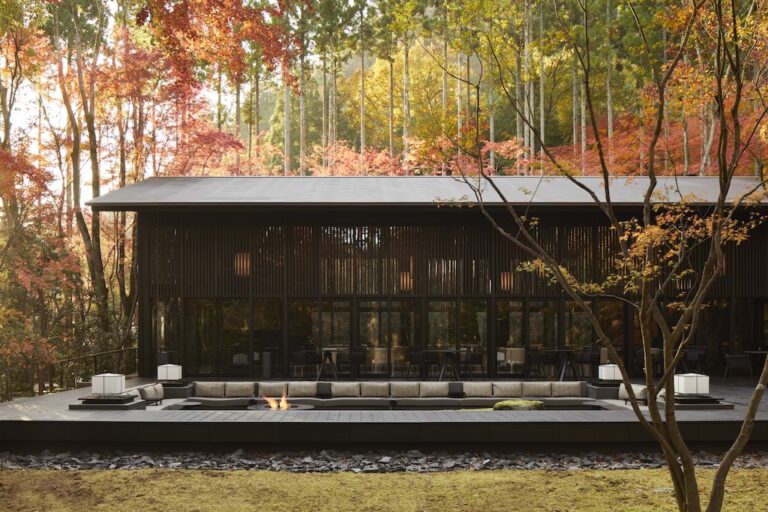
10. Kyushu Seven Stars

Route: Two-day and four-day round trips from Hakata Station in Fukuoka, looping through Kyushu, Japan’s southernmost main island, operated by JR Kyushu.
Japan’s first luxury sleeper train, Seven Stars in Kyushu has been running since October 2013 and set off the wave of “cruise trains” that followed across the country. The name is a play on numbers: seven carriages, Kyushu’s seven prefectures, and seven attractions the island is known for, from nature, history and food to hot springs, “power spots”, its people and its trains. It remains so sought-after that cabins are allocated by lottery, often with far more applications than places.
In 2022, for its ninth anniversary, JR Kyushu reduced the number of guest rooms to raise service levels and added a traditional tea room and an upgraded bar. Traditional artisans crafted much of the interior, from hand-shaped ceramicsto intricate wooden lattice screens, blending railway engineering with genuine Japanese craft.

Accommodations
The refit left ten rooms in total: eight twin-bedded Suites and two Deluxe Suites with twin or double beds, so no more than twenty guests travel on any departure. Both Deluxe Suites share the rear carriage, and observation windows at the end of that carriage give the end suite a view straight back down the line.
Suites are finished in warm wood panelling and washi paper details, each individually decorated by regional artisans. Every room has its own toilet and shower, with porcelain fittings designed by the late master potter Sakaida Kakiemon XIV.

Dining
Kaiseki-inspired multi-course menus showcase Kyushu’s regional ingredients, served course by course in a dining car finished with local ceramics and lacquerware. The front car is the lounge car, with a piano, bar counter and observation area.
Since the refit, guests can also visit a tea room pouring Kyushu-grown teas and a gallery shop selling art and fashion pieces by Kyushu craftspeople. A jacket or elegant evening wear is the norm at dinner.

Activities
The four-day journeys pair nights on board with a ryokan stay. On the Unzen course, guests spend their second night in the mountain hot-spring town of Unzen in Nagasaki Prefecture, with visits to Hodaiji and Taishoji temples.
On the way they cross by ferry from Kumamoto to Shimabara and lunch at Kasei, a restaurant built on the platform at Aso Station that serves vegetables grown around Aso. Elsewhere, stops include walks through traditional mountain villages and visits to local artisans practising centuries-old crafts.
This level of exclusivity doesn’t come cheap. At the 2022 relaunch, the Kirishima course cost US$7,900-$10,744 per person with two guests required per room, while the shorter round trip came in at US$4,108–$5,688 per person.
Seasonality: Operates year-round, though demand in the booking lottery peaks around Japan’s spring blossom and autumn foliage seasons. The two Deluxe Suites are balloted together with domestic applications and are especially hard to win.
11. Britannic Explorer
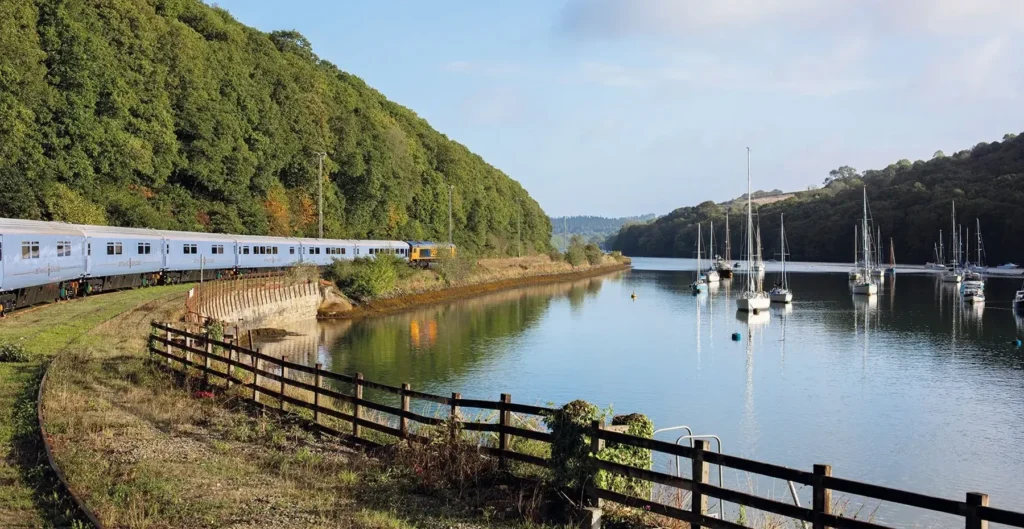
Route: Three-night round trips from London Victoria to Cornwall, the Lake District or Wales, operated by Belmond.
Launched on 21 July 2025 as the first luxury sleeper train to operate entirely within England and Wales, the Britannic Explorer offers a deliberately unhurried way to see the British countryside beyond London.
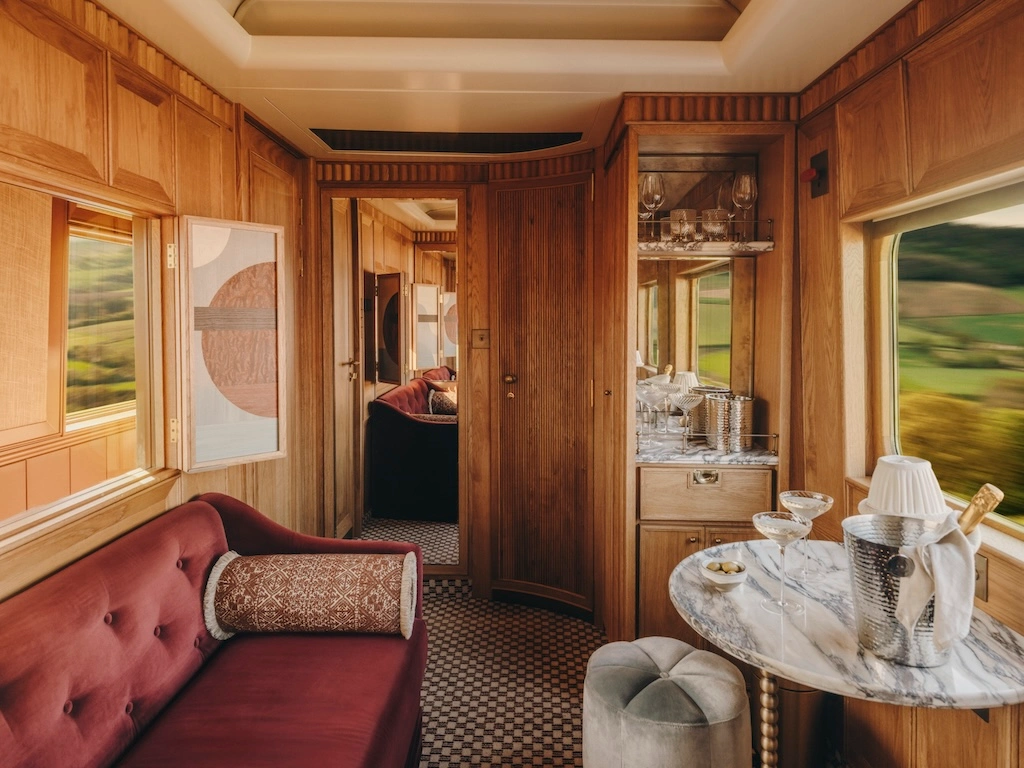
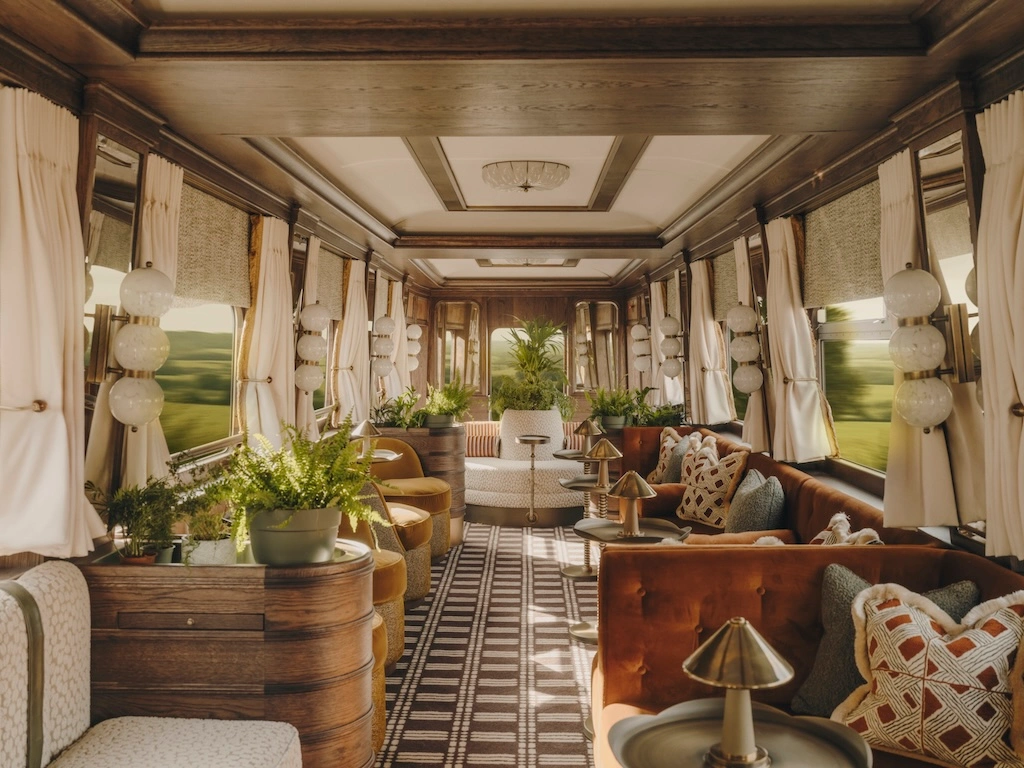
Its carriages began life in the 1970s as InterCity Mark 3 stock. The interiors, by Albion Nord in collaboration with Luke Edward Hall, Mel Campion and Olly Fathers, combine natural materials and British-crafted antiques, with each carriage inspired by the landscapes along the route. As well as sleeping cars, the train carries a restaurant, a wellness suite and a spa.
Accommodations
The 18 cabins break down into 11 Double Suites, four Twin Suites and three Grand Suites, for a total of 36 guests. Each palette reflects a different landscape: countryside greens in the Double Suites, coastal blues in the Twins and English garden tones in the Grand Suites. Double and twin Suites work as daytime lounges with banquette seating, then convert to bedrooms at night.
The three Grand Suites, Juniper, Valerian and Elder, add fixed double beds, a separate living area with dining table and sofa, marble-clad ensuite bathrooms and a personal butler. Grand Suite guests also get in-cabin dining on request, complimentary private transfers and a complimentary spa treatment, which other guests can book on board.
There are no single cabins, so solo travellers should expect to book a full suite. The train is family-friendly, with twin and double suites available.

Dining
Menus are curated by three-Michelin-starred chef Simon Rogan with Executive Head Chef Sven-Hanson Britt. Each route has its own breakfast, lunch, afternoon tea and dinner menus built around regional specialities, with a strong emphasis on seasonal, locally sourced British produce.
Meals are served in two dining cars, Malva and Samphire, each seating up to 18 guests and styled with a botanical theme inspired by potting sheds and wildflower meadows.

Activities
Each route has its own off-train programme: sailing and yoga in Cornwall, wild swimming and paddleboarding in the Lake District, and hikes and art classes in Wales. The Welsh journey runs from the mountains of Snowdonia to the beaches of Pembrokeshire. The Lake District route detours through the Cotswolds for a gala dinner at Raymond Blanc’s two-Michelin-starred Le Manoir aux Quat’Saisons, Belmond’s hotel in Oxfordshire.
For a pre- or post-journey stay in London, Belmond pairs the train with The Cadogan in Chelsea. The whole train can also be chartered for private journeys.
A three-night journey, including excursions, meals, wine and other drinks, starts at US$8,300 based on a double cabin.
Seasonality: The Cornwall and Lake District routes run Friday to Monday and the Wales route Monday to Thursday, so two routes can be combined into a single six-night trip
12. Golden Eagle Silk Road Express
Route: Journeys across China, from Beijing, Xi’an and Dunhuang to Kashgar, Urumqi, Lhasa and Hong Kong, with the Grand Silk Road continuing into Central Asia as far as Tashkent. Operated by Golden Eagle Luxury Trains.
The newest addition to the Golden Eagle fleet marks the British company’s return to China. Golden Eagle last ran journeys there before 2019, aboard the Shangri-La Express. This private train was built to bring its style of expedition rail travel to the Chinese stretch of the ancient Silk Road. The inaugural journey, Undiscovered Horizons of China, departed on 12 September, running from Urumqi to Lhasa. Demand has been strong: the company says every 2026 departure sold out, with 2027 already close to capacity.
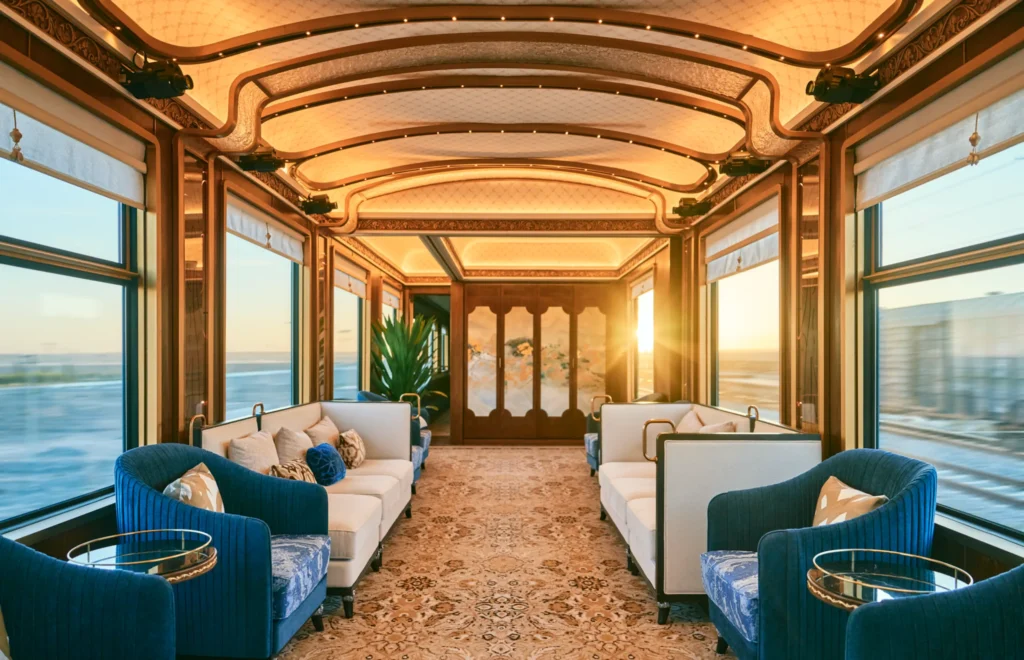
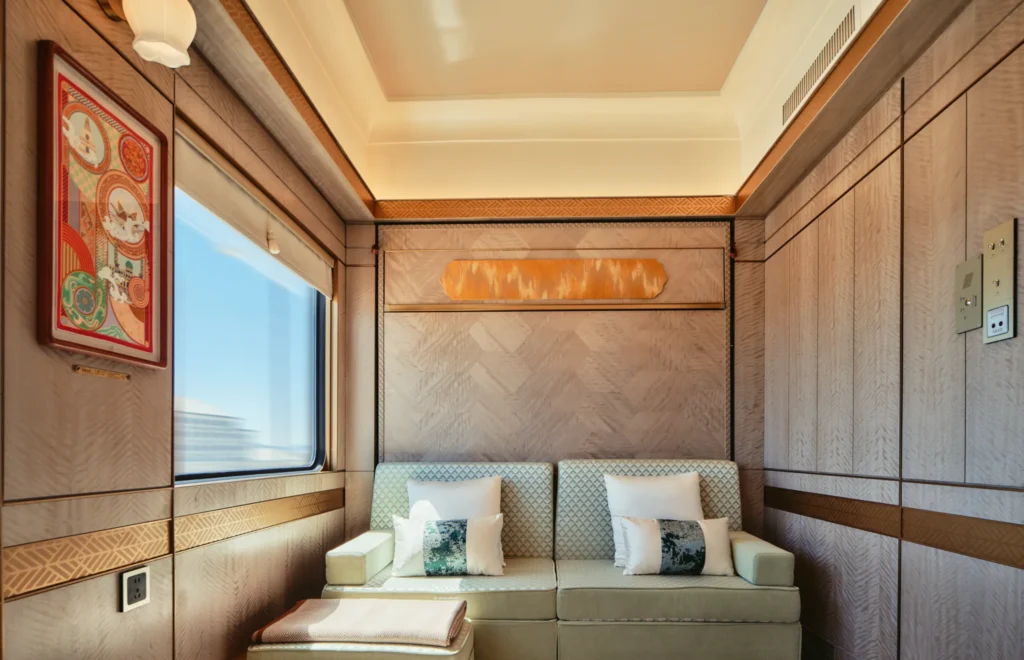
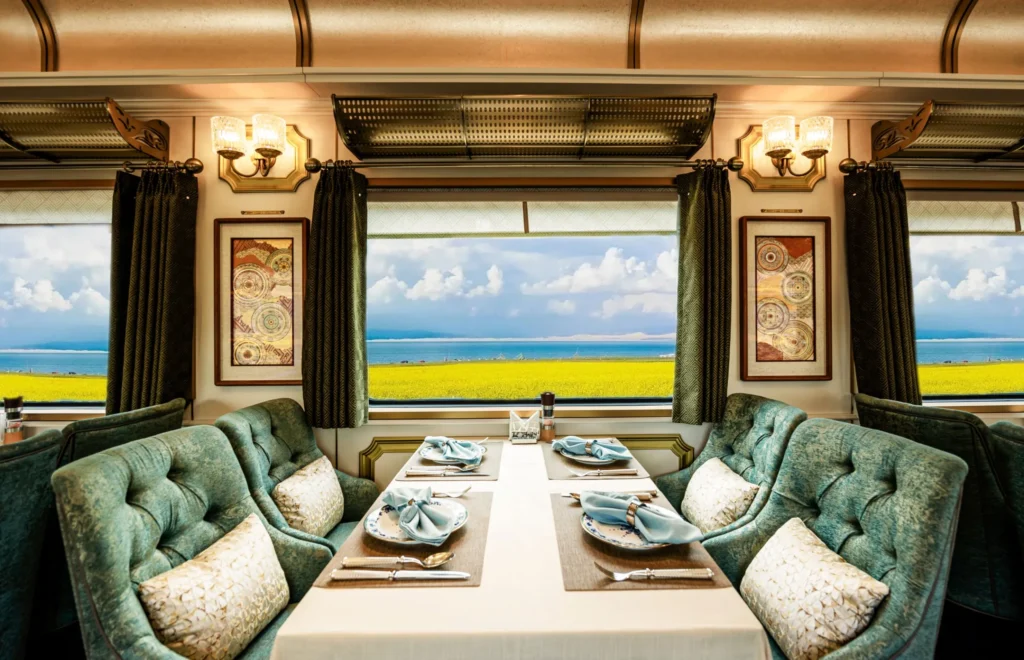
Inside, the décor draws on the grandeur of China’s imperial courts, with wood panelling and panoramic windows, while the restaurant and bar cars are styled after the Ming and Qing dynasties.
Accommodations
Cabins come in two categories, Superior Cabins and the larger Han Dynasty Suites. Every cabin is ensuite with a marble-finished bathroom, and the Han Dynasty Suite adds a private bathtub. Details are thoroughly considered, down to Dyson hairdryers in every cabin and complimentary laundry on board. The train also carries a dedicated observation car for the long desert and plateau crossings.
Dining
Menus reflect the flavours of each Silk Road destination, alongside a wide range of continental dishes, served across two restaurant cars. The social centre is the Bar Lounge Car, finished in mahogany and deep crimson around a Bösendorfer piano.

Activities
There are five China itineraries, each with a different focus:
- Undiscovered Horizons of China (13 days, Urumqi to Lhasa) includes an exclusive evening tour of the UNESCO-listed Jiaohe Ancient City, a night tour of Yotkan, the ancient Buddhist kingdom of Khotan, and the Miran ruins.
- Ancient China (12 days, Beijing to Urumqi) features the Terracotta Warriors in Xi’an followed by a Tang dynasty dinner with traditional music and dance. It also takes in the Mogao Caves of Dunhuang, the Apak Khoja Tomb, regarded as Xinjiang’s holiest Muslim site, and the silk and carpet workshops of Hotan.
- Voyage to the Roof of the World (13 days, Beijing to Lhasa) climbs the Qinghai–Tibet line over the Tanggula Pass, the railway’s highest point at 16,640 feet (about 5,070 metres).
- Imperial China (12 days, Xi’an to Hong Kong) adds the Longmen Grottoes, the Chengdu panda breeding base, Sichuan opera face-changing and a private cruise on the Li River.
- The Grand Silk Road (22 to 25 days, Beijing to Tashkent) is the headline journey. Guests switch to the flagship Golden Eagle for the Central Asian leg through Kazakhstan, Kyrgyzstan, Tajikistan and Uzbekistan. Highlights include an eagle-hunting demonstration at Lake Issyk-Kul, the Silk Road cities of Khiva, Bukhara and Samarkand, and a ceramics demonstration in Rishtan.
On the Silk Road routes, a lecture on board puts the history of the trade routes in context as the train climbs onto the Qinghai plateau, with a choice of the Chaerhan Salt Lake or a Golmud city tour. Top suites on the longest journeys reach US$49,900 per person.
Seasonality: Departures began in September 2026. All 2026 departures are sold out, and 2027 dates are now on sale.
13. Deccan Odyssey

Route: Mostly circular seven-night journeys from Mumbai, plus routes between Mumbai and Delhi through Maharashtra, Gujarat and Rajasthan. Operated by the Maharashtra Tourism Development Corporation (MTDC).
Launched in 2004, the Deccan Odyssey was built to put Maharashtra on the luxury rail map, and it still reaches places India’s other palace trains skip. Alongside its Rajasthan itinerary, it ventures into Gujarat, Nashik and Hyderabad. The deep blue livery with gold detailing makes it one of the most recognisable trains in India.
After a pandemic pause of more than three years, it returned to service refurbished as “Deccan Odyssey 2.0”, with bio-toilets, an induction-powered pantry in place of gas cylinders, and updated fire-safety systems.
Accommodations
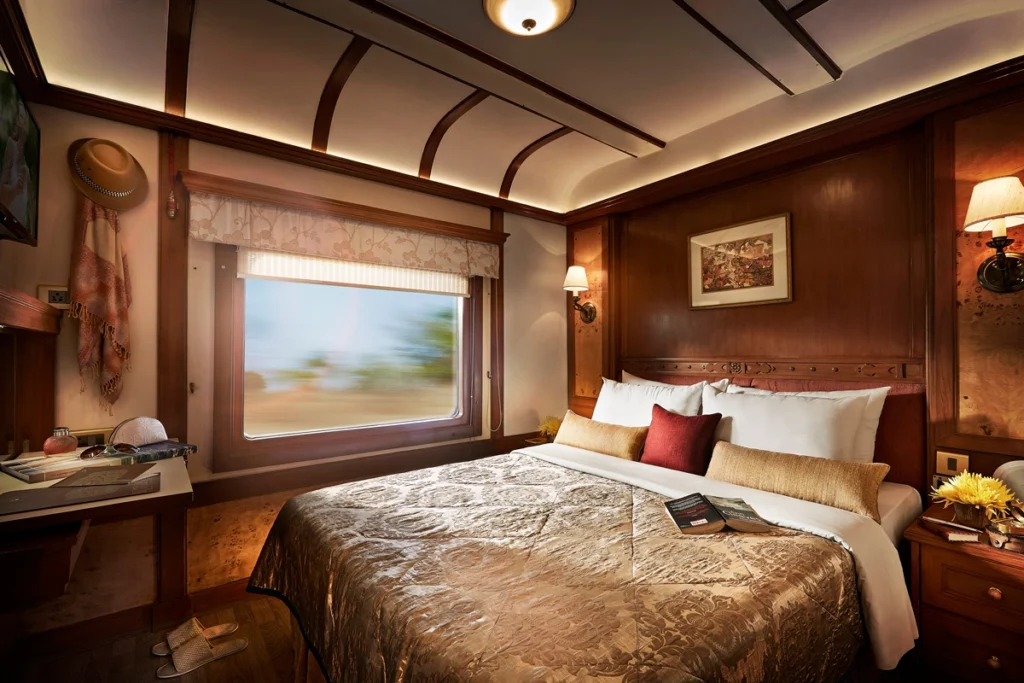
The 21-coach train has 40 Deluxe cabins and two Presidential Suites. Deluxe cabins measure around nine square metres, with twin or double beds and an ensuite shower, four cabins to a carriage.
Presidential Suites each occupy half a carriage, with a large double bed, a separate sitting room and two ensuite bathrooms with showers. They also come with private touring, a personal valet and full room service.

Dining
Two multi-cuisine restaurants, Peshwa I and Peshwa II, are staffed by stewards in traditional Maharashtrian dress. Each seats 34, and menus move between regional Indian dishes and international fare.
Beyond the dining cars, the train has a lounge, a conference hall, a health spa, a gym and a library. A bar car hosts evenings back on board.

Activities
The train runs a deep roster of itineraries. Its circuits include Maharashtra Splendour, Indian Odyssey, Jewels of the Deccan, Maharashtra Wild Trail, Hidden Treasures of Gujarat and Indian Sojourn, plus two short trips to Shirdi. The seven-night Indian Sojourn runs from Mumbai to Delhi and includes the Ajanta and Ellora caves near Aurangabad.
On the Indian Odyssey route, guests stop at Ranthambore, Agra and Jaipur before continuing to Udaipur, Vadodara and Aurangabad. Wildlife lovers can opt for the eight-day Maharashtra Wild Trail through the state’s tiger and forest reserves.
The train is also used by international operators. Golden Eagle Luxury Trains has chartered it for two 15-day journeys. The “Madras Mail” loops between Mumbai and Hyderabad via Goa, Kochi, Trivandrum, Pondicherry and Chennai, and the “Darjeeling Mail” runs between Mumbai and Darjeeling.
Seasonality: Runs through the cooler months, roughly September to May, pausing for the summer heat and monsoon.
14. La Dolce Vita Orient Express

Route: One- and two-night journeys from Rome to Venice, Portofino, Tuscany and Sicily, plus a five-day Rome–Istanbul journey, operated by Orient Express.
Italy’s first homegrown luxury train is a tribute to the 1950s and ’60s, the era of Fellini and Valentino. It made its inaugural journey in April 2025 as a partnership between Orient Express and Italy’s Arsenale Group, and crosses 14 Italian regions. Two 12-car trainsets run its programme of Italian itineraries. In September 2026, the same group bought into Vietnam’s SJourney, a sign of its ambitions beyond Italy.
The Rome–Istanbul route is a deliberate nod to the original Orient Express. The first departure leaves on 22 October 2026, a five-day, four-night journey with fares starting at US$24,700. Guests reach Venice the morning after leaving Rome and spend the day there before rejoining the train; the following day brings Budapest. The train then crosses the Carpathians, stopping in the Romanian towns of Brașov and Sinaia, and arrives in Istanbul on day five.

Accommodations
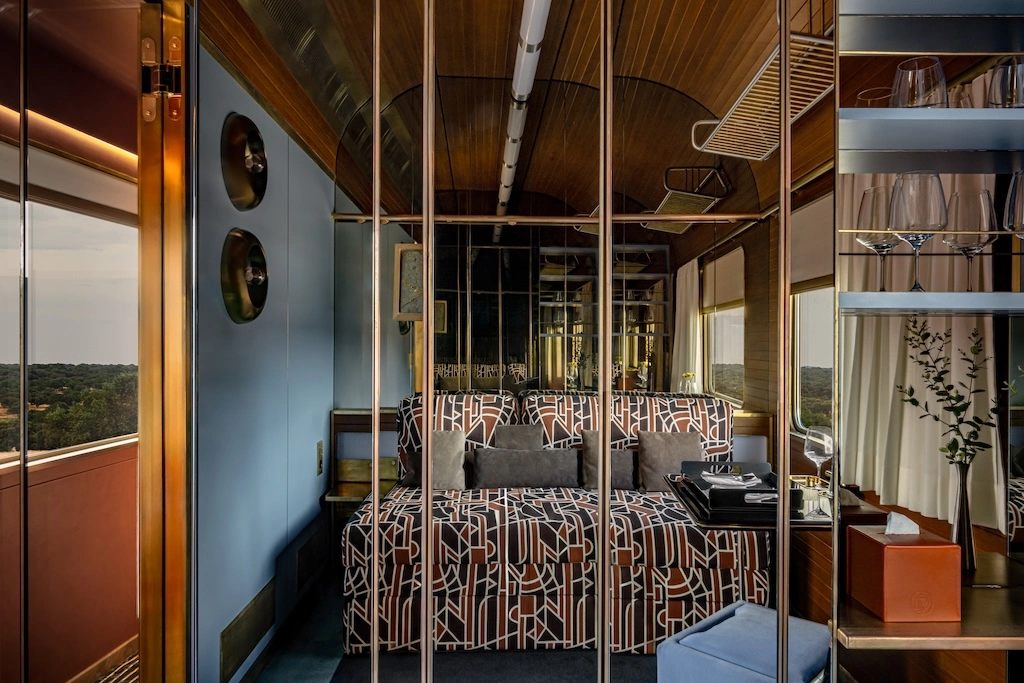
There are 31 cabins, including 18 suites, 12 deluxe cabins and the signature La Dolce Vita Suite. Milan’s Dimorestudio designed the interiors around 1960s Italian optimism, with jewel-toned velvet, walnut panelling and mirrored details.

Dining
The menus are by Heinz Beck of La Pergola, Rome’s three-Michelin-starred restaurant, and are inspired by the regions the train passes through. Mornings start with a Grand Tour of Italy breakfast of Sicilian brioche and artisanal jams; at night, the lights dim, a pianist plays in the bar car and the sommelier pours Italian wines and cocktails.
Activities
Guests board at Roma Ostiense, where a private Orient Express lounge designed by architect Hugo Toro serves as a pre-departure bar. For a night in Rome before or after the trip, the brand’s own hotel, Orient Express La Minerva, makes a natural pairing.
On the Rome, Portofino and Venice route, the train reaches Santa Margherita Ligure by early evening for a night in Portofino, then arrives in Venice the next morning. Other itineraries visit Montalcino’s vineyards, Siena and Taormina, and a four-day golf itinerary is also offered.
Seasonality: Departures follow a set calendar through the year. The Istanbul and longer Grand Tour journeys run on limited dates only.
15. British Pullman
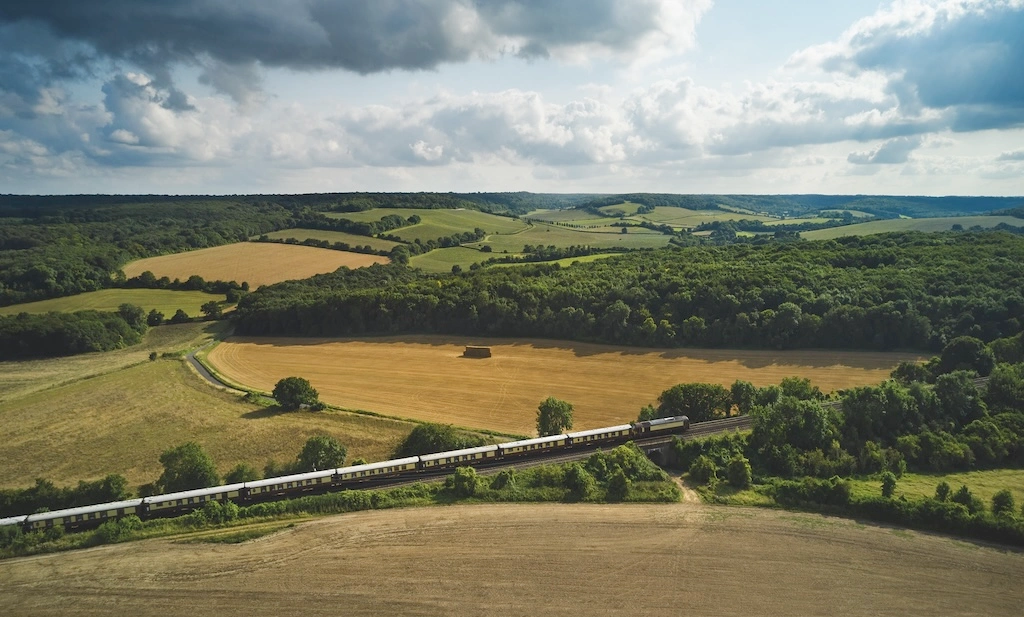
Route: Day trips and short breaks from London Victoria to destinations including Bath, Canterbury, Oxford and York, operated by Belmond.
Sister train to the Venice Simplon-Orient-Express, the British Pullman recalls the 1920s and ’30s. Founded in 1982 by American businessman James Sherwood, it runs carriages that once served the Bournemouth Belle, Brighton Belle, Queen of Scots and Golden Arrow.
For four decades it also carried Orient Express passengers to the coast. That ended in 2024 when Belmond dropped the London–Folkestone leg ahead of new biometric border checks, though it has said it hopes to reinstate it. Today it operates purely as a daytime experience.
Carriages
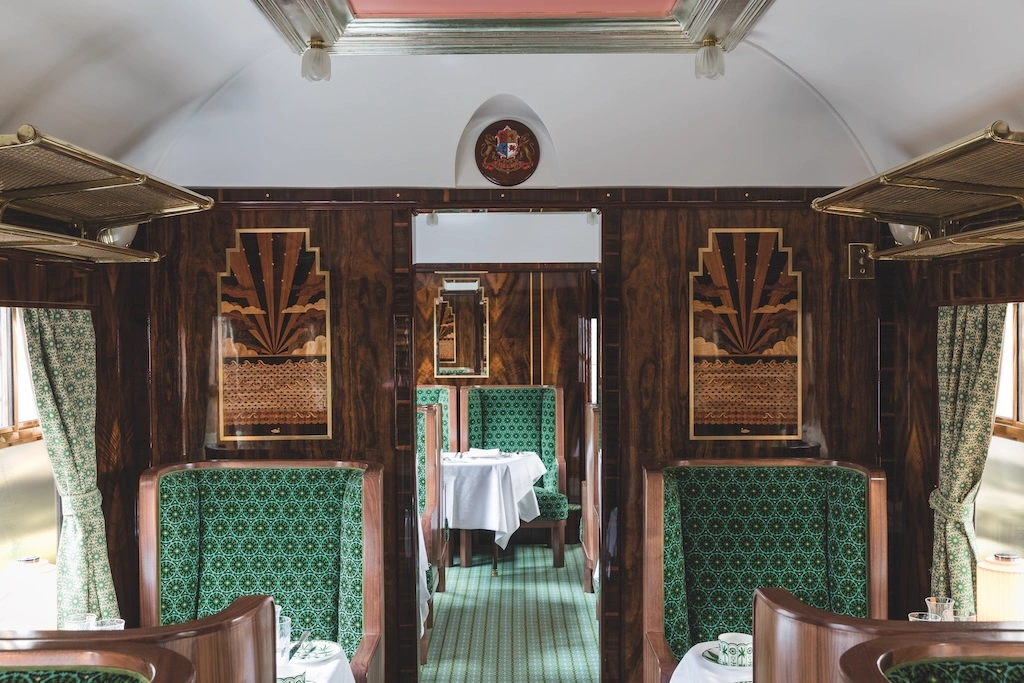
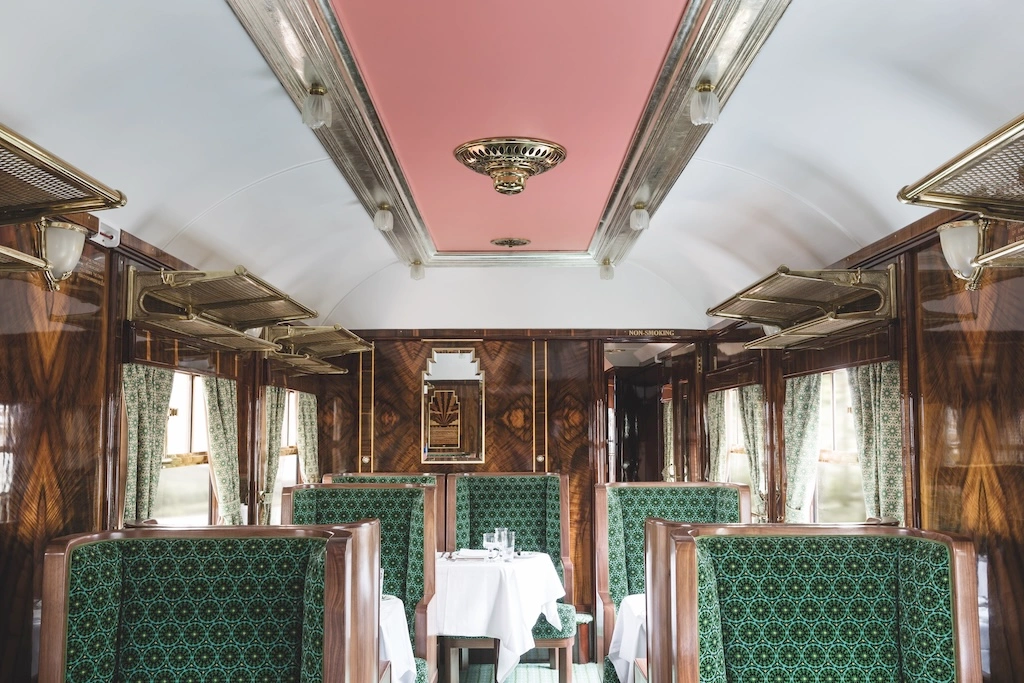
There are no sleeping cabins. Eleven restored carriages each seat 20 to 26, for a total of 226 guests, mostly at tables for two or four, with a few singles and tables for three.
Every carriage has its own history. For instance, Minerva and Perseus brought foreign dignitaries to Queen Elizabeth II’s coronation in 1953, while Phoenix was a favourite of the Queen Mother, and Audrey was regularly used by the Royal Family between 1951 and 1964. Perseus also formed part of Winston Churchill’s funeral train in 1965 and made the Golden Arrow’s last run in 1972 while Cygnus was reimagined by filmmaker Wes Anderson in 2021.
Inside, expect marquetry, mosaic floors, crystal and Art Deco detailing
Dining
Fine dining is included on every trip, and special chef dinners are held throughout the year. Service comes from liveried stewards. Belmond says its crew have around 200 years of experience between them, and many began their careers at the original Pullman Training School. On day trips such as Blenheim Palace, guests board with a Bellini and return to a three-course dinner with wine.
Activities
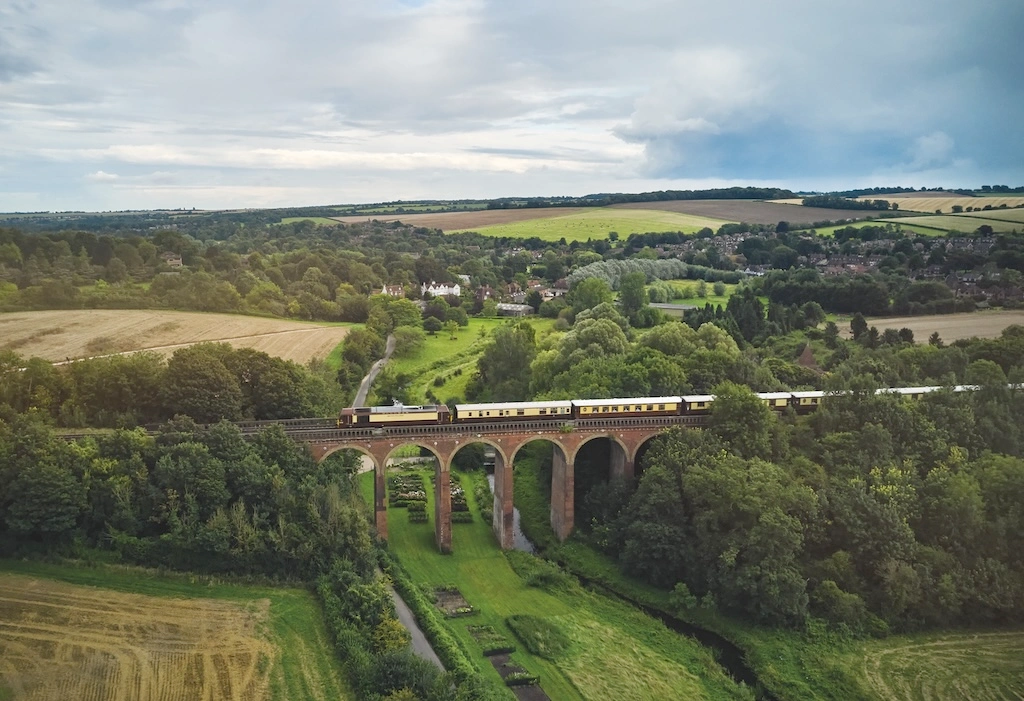
Day trips include Historic Bath, Historic York, Blenheim Palace, Historic Oxford and a murder mystery lunch. Some journeys are hauled by steam, and others are built around horse racing or major maritime events. Valentine’s Day, Mother’s Day and other celebratory trips make it a popular gift.
Seasonality: Day trips run from March to December, with festive journeys in the run-up to Christmas.
16. Royal Scotsman

Route: Round trips from Edinburgh Waverley into the Scottish Highlands, ranging from two-night loops via Boat of Garten and Dundee to longer journeys west to Kyle of Lochalsh, plus a seven-night Grand Tour of Scotland reaching the Orkney Islands, the Isle of Skye and Loch Lomond, operated by Belmond.
If there was any train adventure that should be on your travel radar, it should be Belmond’s Royal Scotsman (one that’s long been on my to-do list), which is as intimate a luxury train journey as you can find, catering to just 36 lucky souls.
Journeys begin with afternoon tea as the train pulls out of Edinburgh. Most cross the Forth Railway Bridge before heading north through Perthshire and the Cairngorms. The most scenic itineraries take the line west to Kyle of Lochalsh, then return via Speyside whisky country and Royal Deeside.
Accommodations
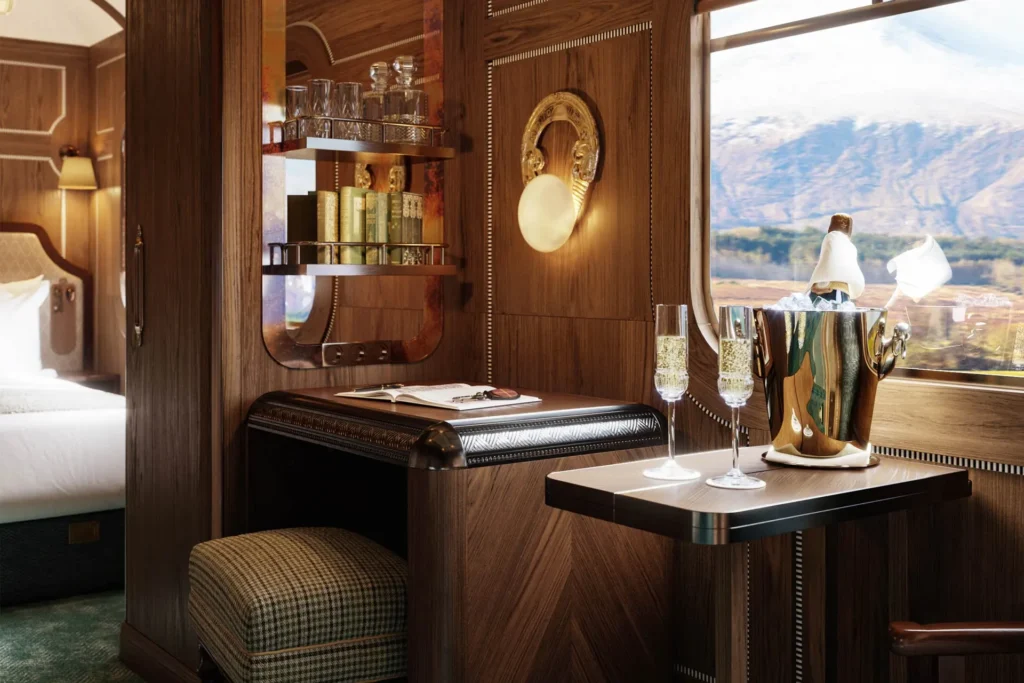
Cabins come in single, twin and double configurations, along with a handful of Grand Suites, all with en-suite bathrooms, wood panelling and tartan trim. Interconnecting cabins suit families or friends travelling together, and the twin cabin in the spa car is adapted for guests with reduced mobility.
Space is limited, as on any heritage train. Twin cabins have under-bed storage of roughly 71 cm by 23 cm, so soft luggage is essential, and the narrow corridors make the train unsuitable for wheelchair users.
Dining
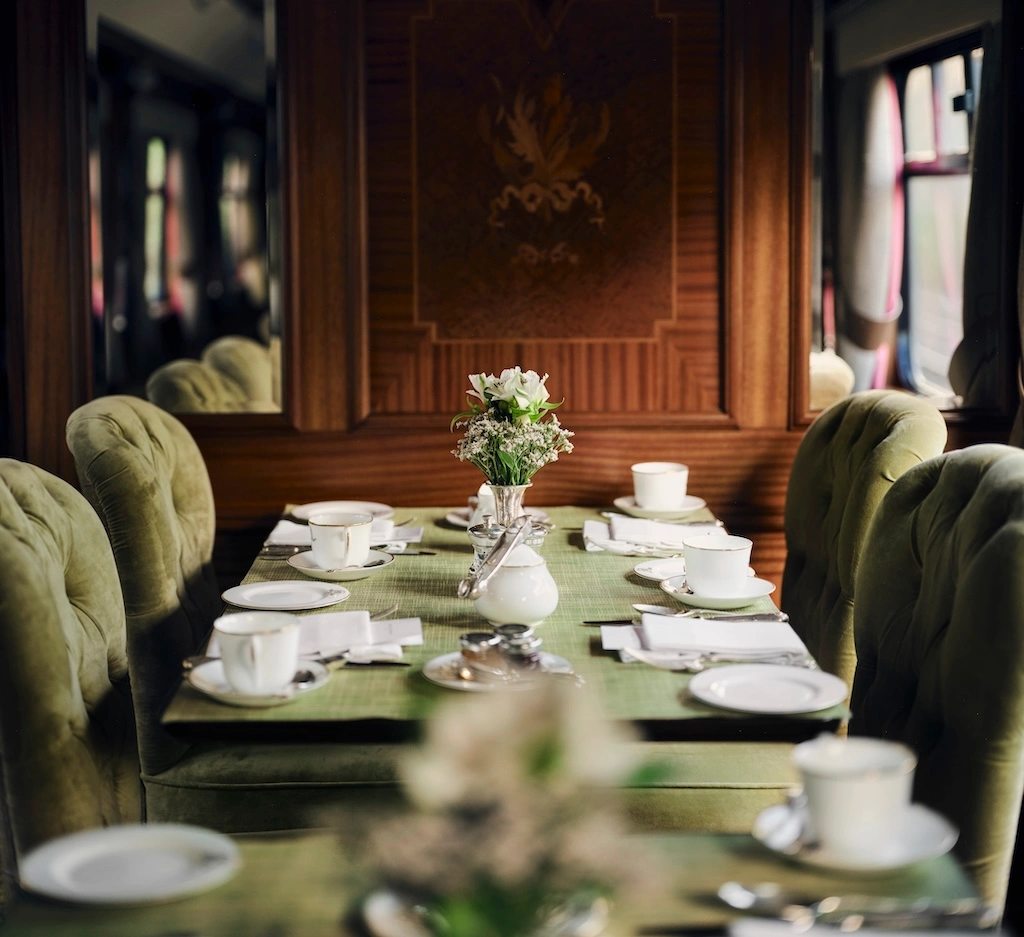
Meals are served in two vintage dining cars, Raven and Swift, with open seating at tables for four, six and eight. Menus are built around seasonal Scottish produce, from local scallops to Highland game, and paired with fine wines and rare malts. Formal and informal dinners usually alternate, and evenings start with cocktails and canapés in the bar.
Activities
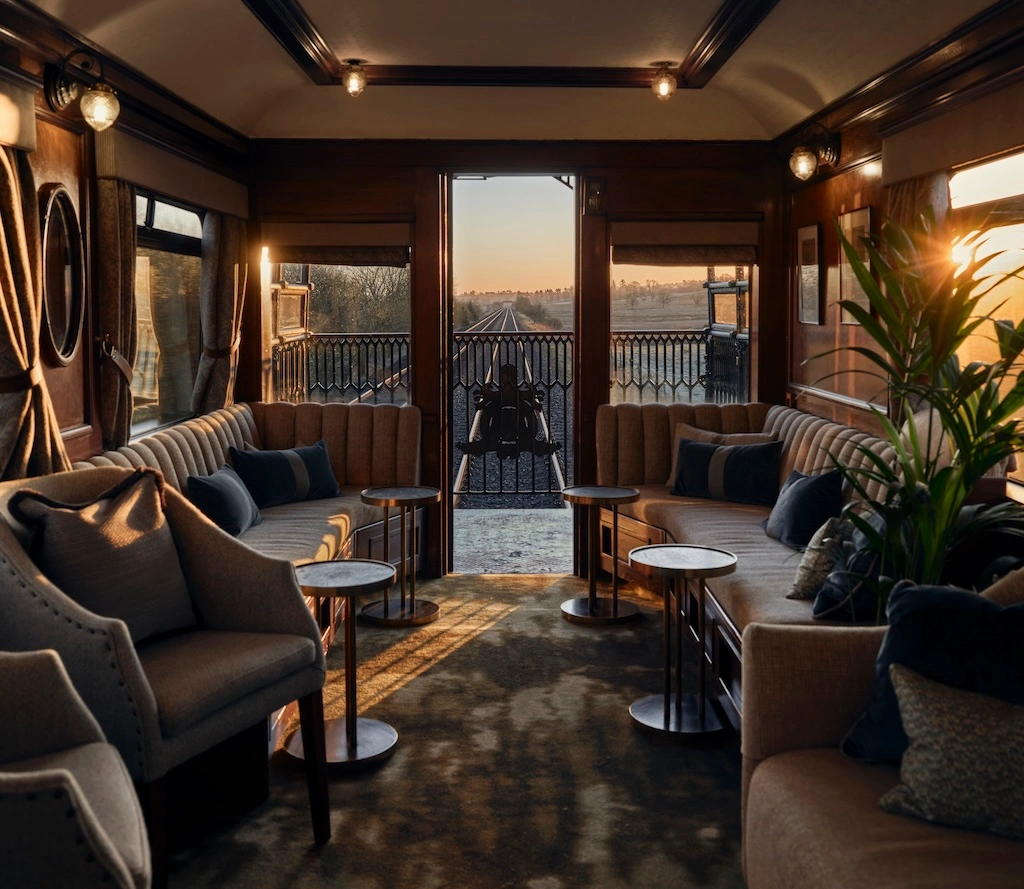
At the rear of the train is the Observation Car, the social heart of the journey. It was built in 1960 by Metropolitan-Cammell and entered service the following year as a first-class kitchen car. After dinner, it hosts traditional Scottish entertainment, from a clansman’s storytelling to fiddlers and impromptu reels on the platform.
The spa car first launched with Bamford and became a Dior Spa in 2023. It’s a rare way to unwind after a day of off-train excursions, which include distillery visits, castle tours and Highland walks. On the five-day Classic Splendours journey, those include privately owned Ballindalloch Castle and Glamis, birthplace of the Queen Mother.
Seasonality: Runs roughly April to October; the train does not operate through the Scottish winter.
17: The Eastern & Oriental Express
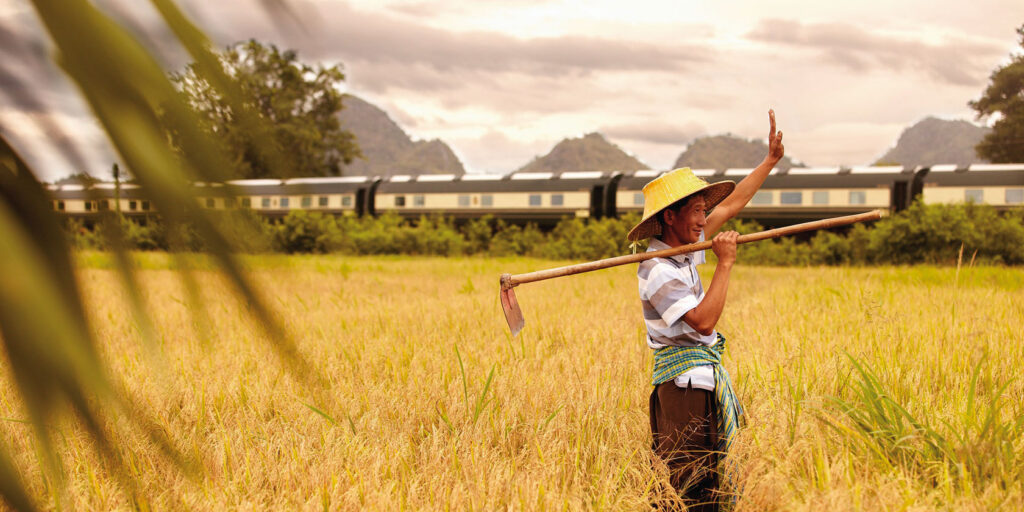
Route: Three-night round trips from Singapore’s Woodlands Station through Malaysia, on the Wild Malaysia and Essence of Malaysia itineraries, with Malaysia Celebration and Festive Malaysia departures in December. Essence of Malaysia takes in Kuala Lumpur, Langkawi and Penang, while Wild Malaysia follows the Jungle Railway, with a visit to Taman Negara National Park before Penang. Operated by Belmond.
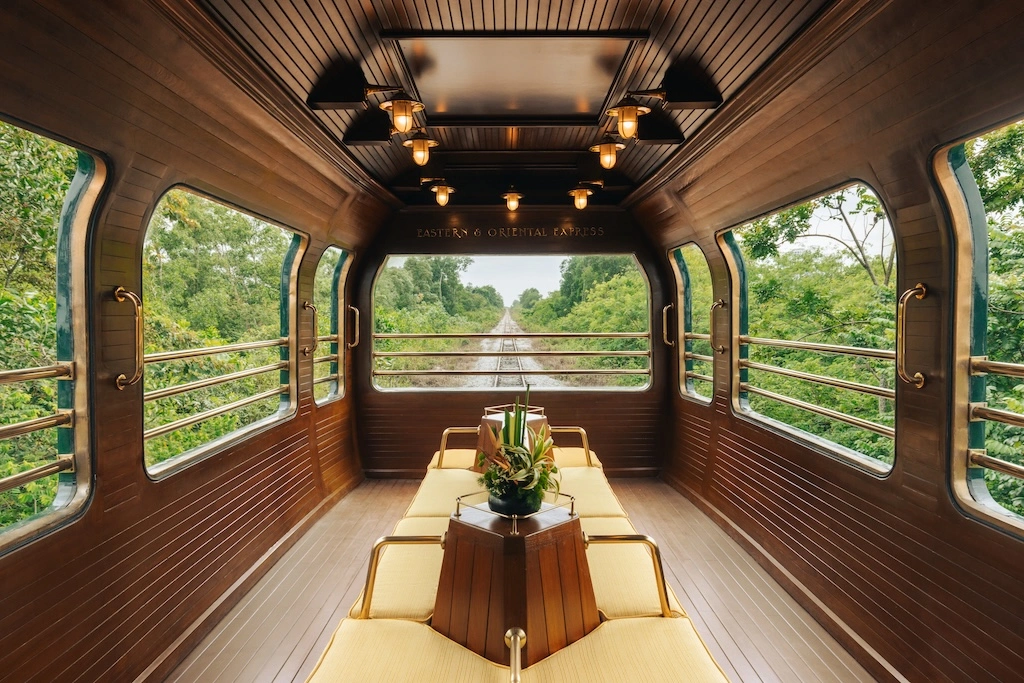
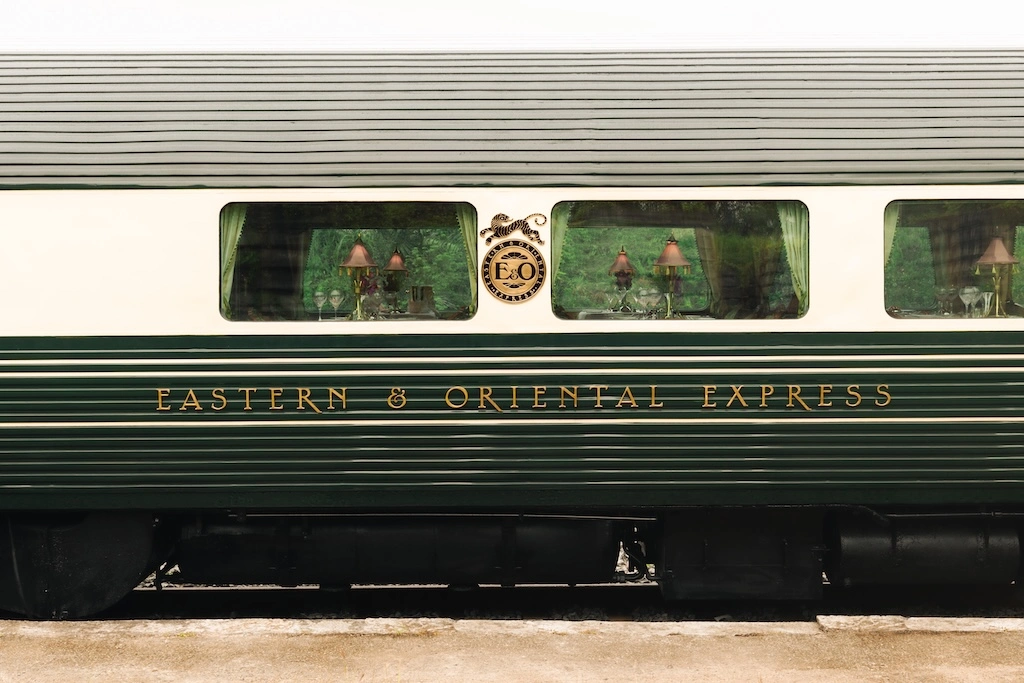
First launched in 1993, the Eastern & Oriental Express was long famous for its Singapore–Bangkok run. After a nearly four-year hiatus, it returned in February 2024 with a new focus on Malaysia and 15 restyled carriages. These include eight sleeping cars, two restaurant cars, a Piano Bar car and the train’s signature open-air Observation Car. Its green-and-cream carriages remain the only luxury sleeper in Southeast Asia.
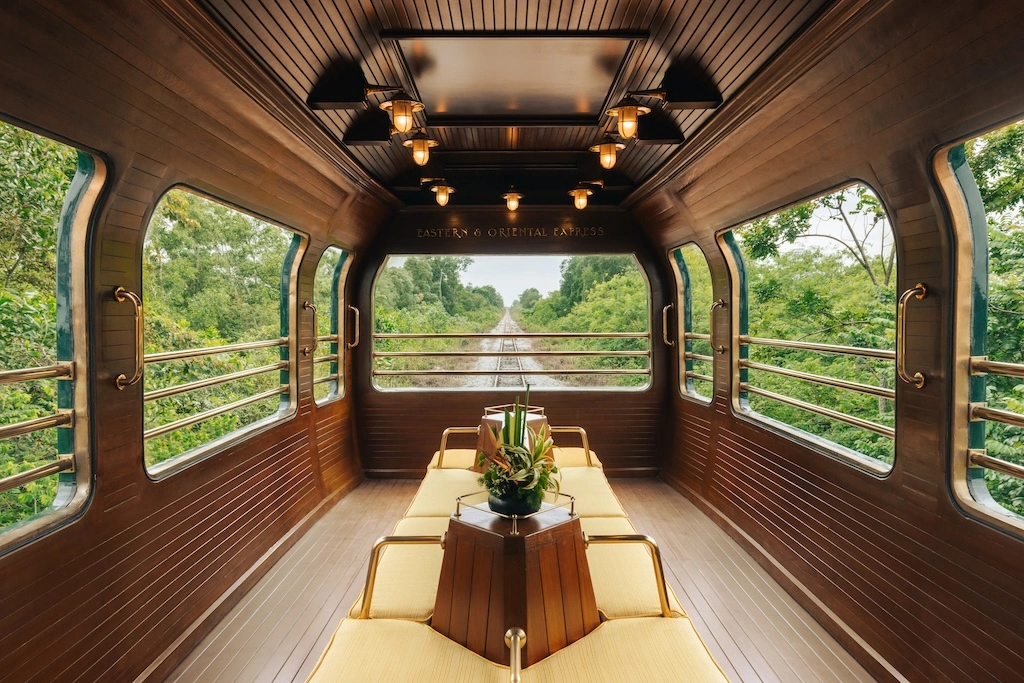
Accommodations
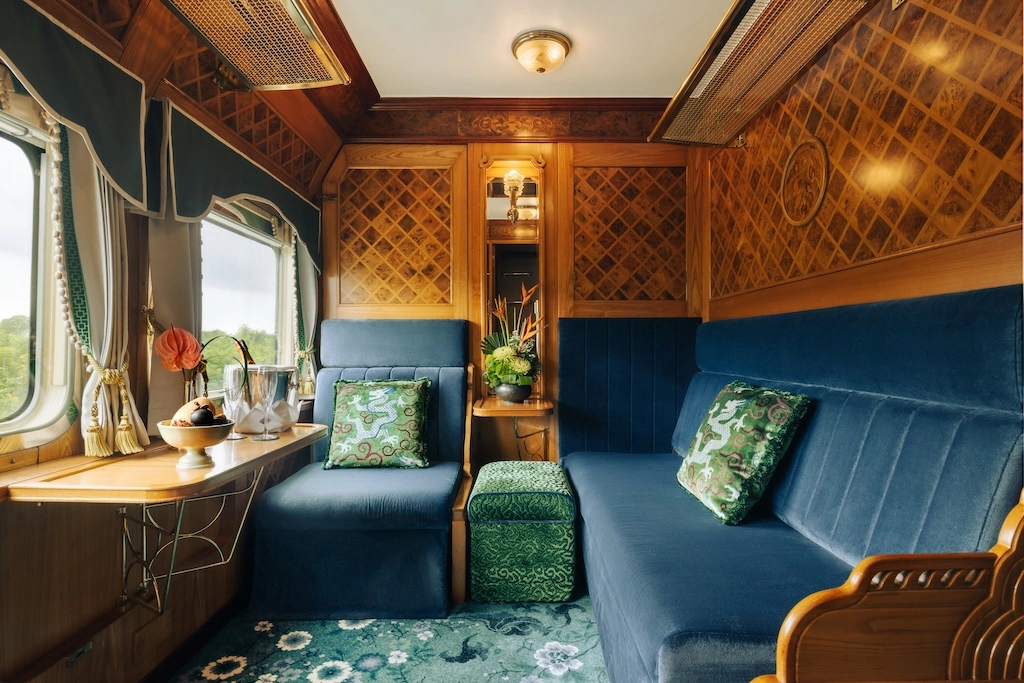
There are 32 cabins in three categories: ten Pullman Cabins, 20 State Cabins and two Presidential Suites. All are air-conditioned and panelled in cherry wood, and each category takes its palette from the places the train passes through. The Pullman Cabins pick up red and blue accents from the Kuala Lumpur skyline, the State Cabins borrow Penang’s marine blues and greens, and the Presidential Suites are finished in gold with embroidered details.
Pullman Cabins have two large windows, with sofa seating by day and upper and lower berths at night, while State Cabins add space and two beds at floor level. Presidential Suite guests receive free-flowing champagne, caviar on boarding and a complimentary 45-minute treatment in the onboard Dior Spa.
Dining
Dining is curated by two-Michelin-starred chef André Chiang, whose menus reflect the region’s biodiversity and mix of cultures with dishes such as laksa bouillabaisse, black-bone chicken consommé and a jungle-spiced cacao ganache. On select 2026 “Tastes of Tomorrow” departures, Chiang hosts invited Michelin-starred guest chefs, the obvious pick for food lovers.
Activities
The wellness carriage houses the first Dior Spa in Southeast Asia, with two treatment cabins dressed in Dior’s Toile de Jouy motif and tropical hardwoods. Off the train, Essence of Malaysia offers snorkelling in Pulau Payar Marine Park, the UNESCO-listed streets of George Town, and a cooking class and tea ceremony at a private hillside residence in Penang.
Wild Malaysia was created with tiger conservation organisation Save Wild Tigers. It heads into Taman Negara, one of the world’s oldest tropical rainforests, for activities ranging from jungle foraging to photography masterclasses.
Three-night journeys start around US$4,650 per person in a Pullman Cabin, US$6,550 in a State Cabin and US$11,850 in a Presidential Suite, based on two sharing.
Seasonality: Wild Malaysia runs from March to October, while Essence of Malaysia runs through the rest of the year. Festive departures are added in December.
18. Twilight Express Mizukaze
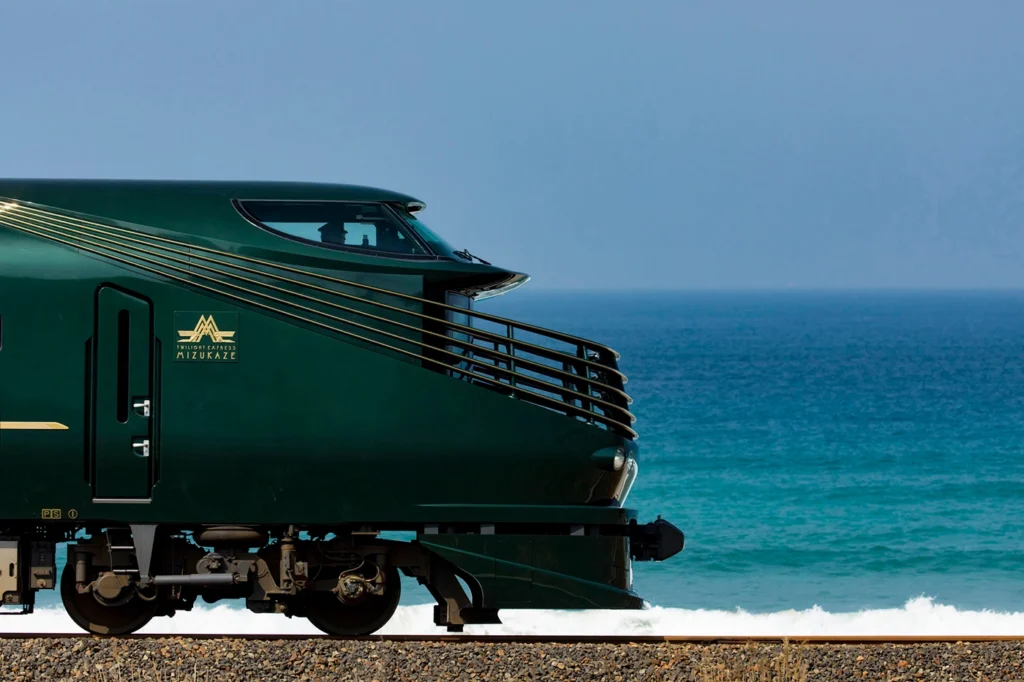
Route: One-night journeys between Kyoto/Osaka and Shimonoseki, via either the Sanyo Main Line or the San’in Main Line. There is also a two-night circular tour from Kyoto and Osaka. From spring 2026, a new Lake Biwa and Setouchi course was added, with stops at Kinomoto and Omi-Hachiman. Operated by JR West.
JR West’s flagship cruise train entered service in 2017, the Twilight Express Mizukaze carries on the name of the original Twilight Express, the legendary Osaka–Sapporo sleeper famed for its food. The name Mizukaze draws on Mizuho, an ancient name for Japan, and evokes a train that sweeps through the country like the wind.
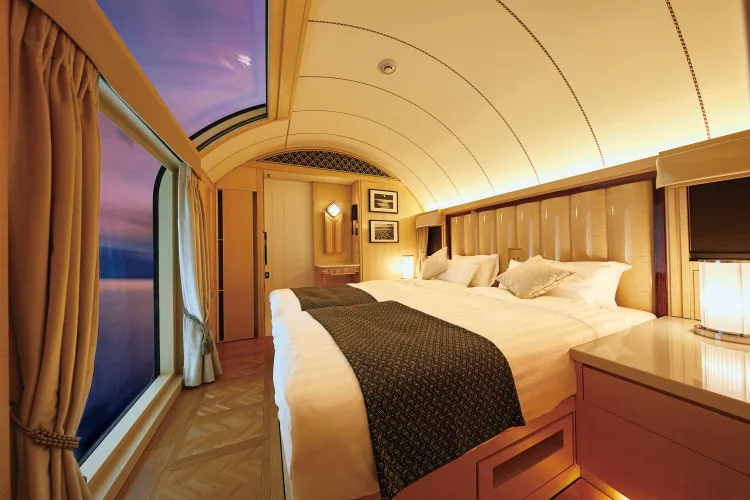
The design is billed as “nostalgia modern”: Art Deco-inspired interiors behind a sleek dark green exterior, with an old-fashioned driver’s compartment at the head of the train.
Accommodations
The ten-car train has six sleeping cars, a dining car, a lounge car, and an observation car at each end with an open-air deck. Royal Single and Royal Twin rooms work as private sitting rooms by day, with beds that fold away to free up space. Capacity is tiny, at around 30 guests.
The pinnacle is The Suite, which occupies the whole of Car No. 7. It has a private entrance, a twin bedroom, a large living and dining room, and its own bathroom with a bathtub and marble basins.

Dining
The dining car has tables along the windows and an open kitchen. Its original menu was created by food columnist Takeshi Kadokami, and dishes draw on regional ingredients along each course. The Salon de l’Ouest lounge car (Car No. 5) serves sake, cocktails and tea to a soundtrack of live chamber music.

Activities
Each course includes a daily off-train stop. On arrival, guests are given a personalised platform welcome, often with local musicians and dancers. Stops have included Miyajimaguchi and Onomichi on the outbound Sanyo course, Kinosaki Onsen and Higashi-Hagi on the outbound San’in course, and Kurashiki, Iwakuni, Izumoshi and Tottori on the return legs. Some of these stops will have changed with the spring 2026 course revisions.
The new Lake Biwa course stops at Kinomoto heading west and Omi-Hachiman heading east. On board, its menu is supervised by Shiga Prefecture’s first designated “food master”, and the train displays traditional crafts from the region. Throughout the journey, guests can step onto the open-air observation decks, a rarity on modern Japanese trains.
Seasonality: Departures run through much of the year, but places are extremely limited and sell out far in advance. Overseas travellers generally book through specialist agents, many of which bundle the train with hotel nights in Kyoto.
19. Costa Verde Express
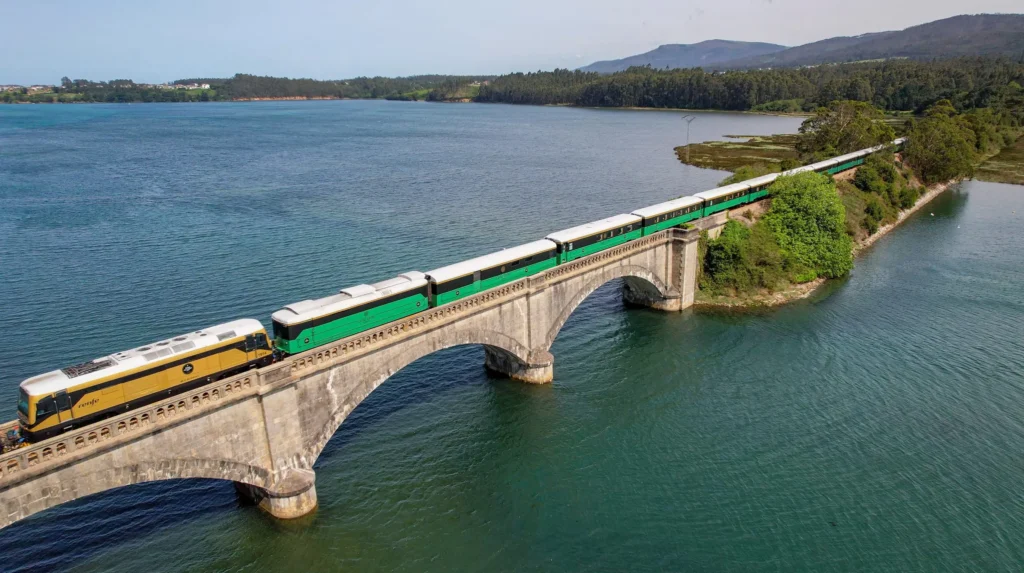
Route: Bilbao to Santiago de Compostela (or the reverse) over six days and five nights, through the Basque Country, Cantabria, Asturias and Galicia via Santander, Llanes, Oviedo, Luarca and Viveiro. A shorter three-day, two-night version runs between Santiago de Compostela and Oviedo. Operated by Renfe.
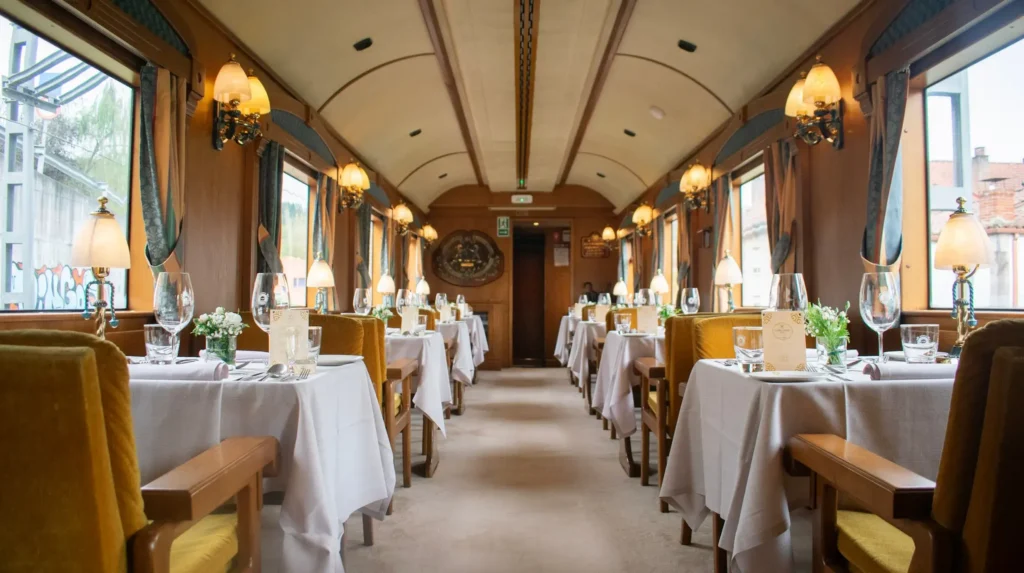
Spain’s answer to the grand European sleeper, the Costa Verde Express began life as the classic version of the famous Transcantábrico. When Renfe split the train into two products, the Gran Lujo version kept the original name and the Clásico became the Costa Verde Express. The name comes from the nickname for Asturias’s coastline, and the train now wears an all-green livery in honour of “Green Spain”, the four northern regions it crosses.
It is anything but an express. The Belle Époque-style train ambles along at around 50 km/h, at times only metres from the Bay of Biscay, taking six days to cover roughly 600 km.
Accommodations
There are 24 Gran Clase suites, each with a full private bathroom, individually controlled heating and air-conditioning, a minibar and a safe. Each suite can take two large suitcases, and staff help with loading.
The train parks at stations overnight, so guests sleep undisturbed.

Dining
Four lounge cars serve as the social spaces, with bars, a dance floor, a library, a digital newsstand and internet access. Chefs prepare breakfast, lunch and dinner on board, and some meals are taken ashore in well-chosen local restaurants, with wine, coffee and spirits included. The mood on board is relaxed, though many guests dress up for dinner.

Activities
A luxury coach shadows the train throughout, linking each station to the day’s excursions, and the crew is on hand around the clock with multilingual service.
Highlights on the full route include the Guggenheim Museum and the Portugalete suspension bridge in Bilbao; the Neocave of Altamira, a high-tech replica of the prehistoric cave paintings, the medieval Santillana del Mar; the Covadonga Sanctuary and Lake Enol in the Picos de Europa. On the final day, the train reaches Ferrol, and guests continue by coach to Santiago de Compostela.
Fares start from around US$6,660 per person.
Seasonality: Departures run between May and October, roughly fortnightly in each direction, pausing in late July and August.
20. The Ghan
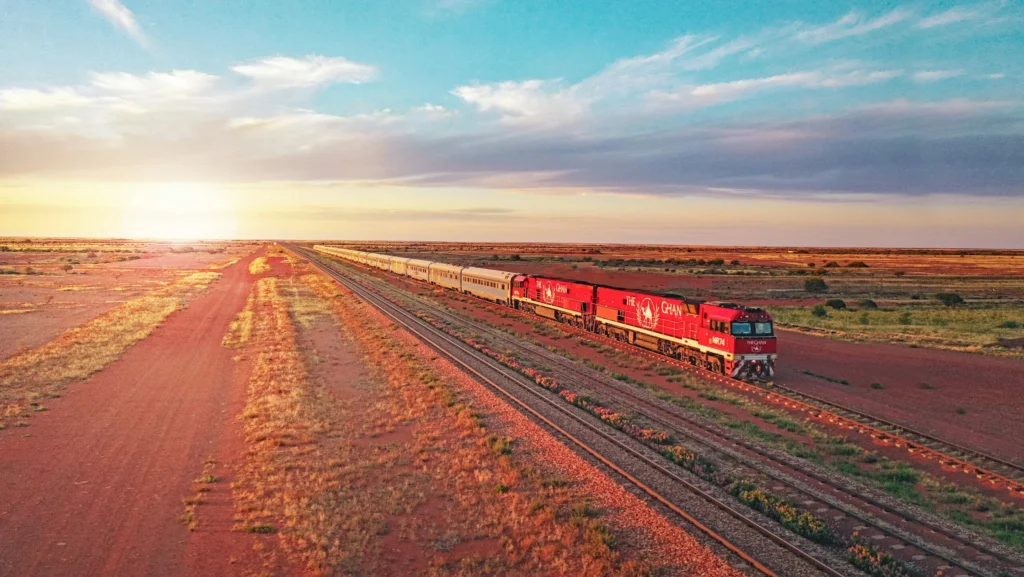
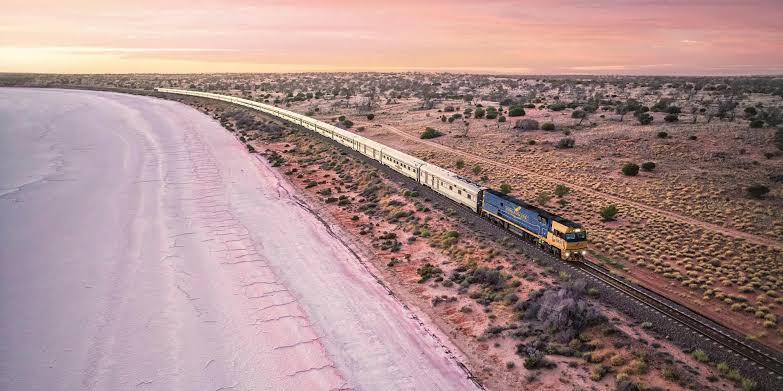
Route: Adelaide to Darwin (or the reverse), 2,979 km through the heart of Australia via Alice Springs and Katherine, as a three-day, two-night journey or the four-day, three-night Ghan Expedition, operated by Journey Beyond.
Australia’s most famous train takes its name from the pioneering cameleers who carried supplies through the outback long before the railway arrived. The Ghan is short for its old nickname, “The Afghan Express”, and its emblem is still a camel and handler.
The first service left Adelaide on 4 August 1929, but for 75 years the line ended at Alice Springs. Only in January 2004 did the extension to Darwin open, finally linking Australia’s south and north coasts by rail. Today, the journey runs from Adelaide’s temperate coast through the red heart of the continent to the tropical Top End.

Accommodations
Gold Twin and Gold Single cabins offer compact comfort, with lounge seating by day that converts to beds at night. Gold Premium adds a little more space, while Platinum Service steps up to larger cabins with double or twin beds, a private ensuite and access to the exclusive Platinum Club.
In 2026, Journey Beyond added a dedicated carriage of Aurora and Australis Suites to The Ghan, its first new accommodation tier in years. Designed by Woods Bagot, the Aurora Suite is twice the size of a Platinum cabin and the Australis three times. Both have a separate bedroom, living area, in-suite bar and ensuite bathroom.
Suite guests also get butler service, in-room dining and unlimited Bollinger, with fares on a three-day Ghan journey starting at US$5,570 per person for the Aurora and US$8,280 for the Australis.
Dining
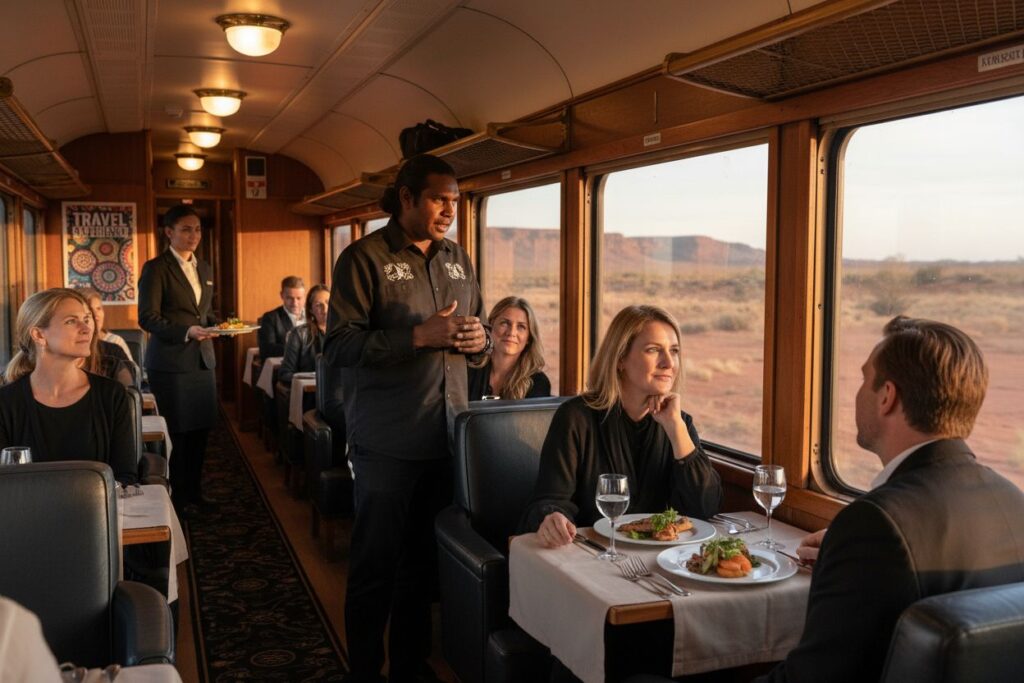
All meals and drinks are included. Gold guests dine in the Queen Adelaide Restaurant, where menus showcase regional Australian produce and native ingredients, and gather for drinks and conversation in the Outback Explorer Lounge. Platinum and suite guests have their own Platinum Club lounge and dining carriage.
The standout meal happens off the train. On the Ghan Expedition, guests dine under the stars at the historic Alice Springs Telegraph Station, with red earth underfoot and white tablecloths on the tables, the journey’s signature evening.

Activities
Off Train Experiences are included at every major stop and range from a cruise through the Nitmiluk Gorge in Katherine, and visits to local homes in the opal mining town of Cooper Pedy, to optional scenic flights over the Red Centre.
Southbound Expedition guests finish with a leisurely brunch as the train passes through the Flinders Ranges before arriving in Adelaide. Special departures add extras, such as a Darwin Cup package that includes marquee entry to the Darwin Cup Carnival.
Seasonality: Runs from roughly March to November. Over the hottest months and the Top End’s wet season, The Ghan pauses and its carriages are redeployed as the Great Southern on Australia’s east coast.
Your Luxury Train Questions, Answered
Thinking about booking a luxury train journey? Here are clear answers to the questions travellers most often ask before choosing a route and cabin.
What is the most luxurious train in the world?
This is always a sticky point among train travellers. Rovos Rail and the Venice Simplon-Orient-Express are generally considered the two benchmark trains for vintage opulence, while Maharajas’ Express and Kyushu Seven Stars represent the most lavish modern-built options in India and Japan, respectively. Each has repeatedly topped industry awards in its own category, and personal taste — vintage romance versus contemporary design — often decides the winner more than any objective ranking.
Newer entrants like the Belmond Andean Explorer and SJourney are steadily building their own reputations within this same top tier.
How much does a luxury train journey cost?
Prices vary enormously by route, season and cabin grade, from roughly US$1,000 per night on entry-level cabins to US$10,000 or more per night for top suites on trains like Japan’s Shiki-Shima or Rovos Rail’s Royal Suite. Most fares are genuinely all-inclusive, covering meals, drinks, off-train excursions and, on some trains, hotel transfers, so the headline price usually reflects the true total cost far more closely than a typical hotel stay.
Multi-day journeys like Rovos Rail’s longer routes or SJourney’s eight-day itinerary naturally command a higher total, even though the nightly rate may be comparable to a shorter trip.
What should I pack for a luxury train trip?
Most trains, including the Venice Simplon-Orient-Express, Rovos Rail and Maharajas’ Express, enforce a smart or formal dress code for dinner, so pack at least one evening outfit alongside comfortable daywear for off-train excursions. Cabin space is limited on most trains, so soft-sided luggage is generally preferred over hard suitcases, and a few operators offer luggage storage at the departure station for anything not needed onboard during the journey.
Do luxury trains have private bathrooms?
Almost all modern luxury trains do, though it varies by cabin grade. In keeping with its vintage styling, the Venice Simplon-Orient-Express’ cabins (except L’Observatoire) feature shared bathrooms and instead have in-cabin wash basins. However, all other sleeper trains above feature en-suites (albeit compact ones) from entry-level cabins and up. Some, including premier suites on the Rovos Rail and the Blue Train, even have bathtubs.
What’s the difference between a luxury train and a regular sleeper train?
A regular sleeper train is primarily transportation with a bed attached; a luxury train treats the journey itself as the destination, with fine dining, curated off-train excursions, all-inclusive drinks and, often, entertainment or educational programming built into every day. Luxury trains also typically run far fewer departures and carry a fraction of the passengers of a standard overnight service, with a correspondingly higher staff-to-guest ratio throughout.
Which luxury train is best for a first-time traveller?
The Venice Simplon-Orient-Express and Rocky Mountaineer are both considered accessible entry points, offering shorter, well-known routes with flexible cabin grades and strong name recognition. Travellers wanting a fully immersive, multi-day experience often start instead with Rovos Rail or the Indian Pacific, both of which combine comfortable pacing with extensive off-train excursions and a genuinely gentle introduction to longer luxury rail travel.

Do I need to book luxury train journeys far in advance?
Yes, particularly for trains with limited seasons or lottery systems. Kyushu Seven Stars allocates cabins by lottery months ahead due to overwhelming demand, while seasonal trains like Great Southern, which runs only from December to February, and Maharajas’ Express, which operates from October through April, can sell out key departures a year or more in advance.
Even year-round trains like Rovos Rail and the Blue Train benefit from booking six to twelve months ahead for peak-season travel, particularly for top-tier suites or specific cabin configurations that only exist in limited numbers per train.
If you’re interested in a luxury train journey, check out our guide to the best luxury trains in Australia and New Zealand, and our take on what it’s like to travel through the Peruvian Andes on the Andean Explorer, across New Zealand’s South Island on the TranzAlpine, and through India aboard the magnificent Maharajas’ Express.