

Nick Walton explores the temples, stately palaces and mountain forts of northern India aboard one of the world’s most luxurious trains, the Maharajas’ Express.
With a blast of trumpets and a cacophony of colour, we step down onto freshly rolled red carpets and into the blazing, mid-morning light of Jaipur, to a welcome reception that will last a lifetime. Dancers and musicians in shimmering blue and gold costumes twirl and sway to the music while a pint-sized, bearded ring master in frangipani pink dances guests onto the platform and towards a line of waiting coaches, the musical troupe following on their heels.

It’s our first day aboard the majestic Maharajas’ Express, widely billed as the world’s most expensive train, and its seven-day Indian Panorama journey, which visits some of northern India’s most beautiful and important locales, including Jaipur, Agra and Varanasi. The Maharajas’ Express isn’t India’s first luxury train, but it’s widely regarded as its best, offering a lavishly simple way to explore the rich heritage and breathtaking landscapes of this fascinating, often challenging destination.
I admit I was a little sceptical when Hong Kong-based luxury travel gurus Lightfoot Travel recommended a luxury train journey through India. I’d visited many times, and the impression I’d got of the nation’s rail experience was more pauper than prince. However, Lightfoot was right on the money, and my fellow guests and I had slept like babies on the 260-kilometre overnight journey from Delhi’s Safdarjung Railway Station, arriving with the dawn at Jaipur, the capital of the state of Rajasthan.
Jaipur: The Pink City and the Amber Fort

Jaipur, a key component of the popular Golden Triangle tourist route, makes for a captivating first stop on this whirlwind tour of the north. The Pink City takes its name from the extensive use of red and pink sandstone in its ornate palaces and residences, including the sprawling Amber Fort, which dominates the horizon from its lofty position atop a rocky peak.
We curl around mirror-like Maota Lake and climb the mountain in a convoy of rumbling jeeps, passing lumbering painted elephants and stalls selling bamboo puppets that dance in the morning breeze. Spice and coffee scent the air as we climb to the fort’s entrance, where the stone path is worn to a polish.
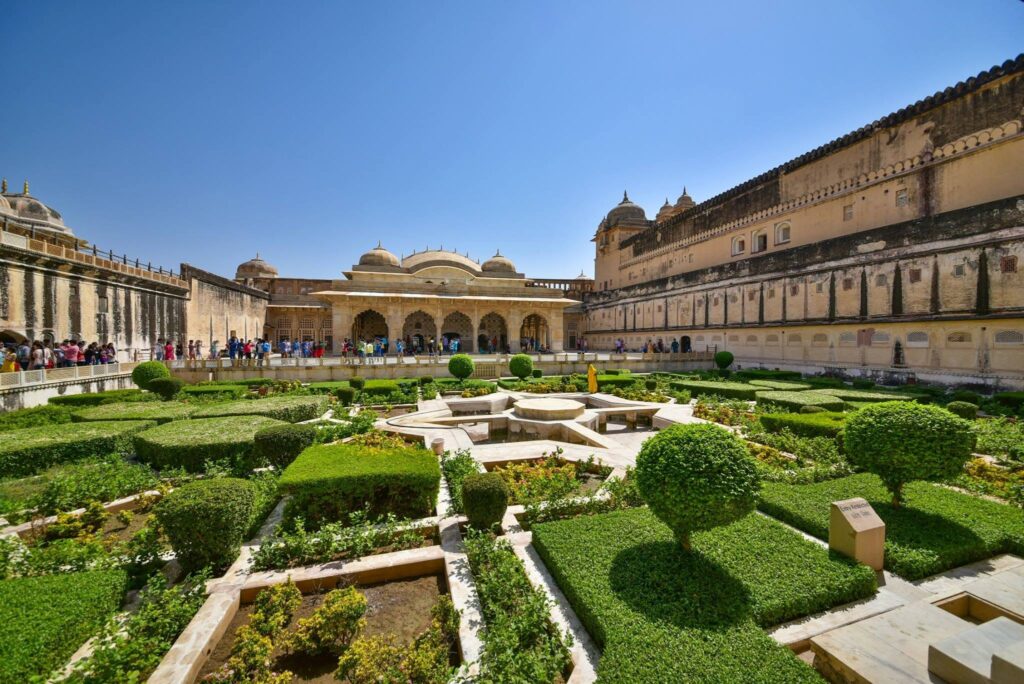
The Amber Fort, also known as the Amber Palace, was once home to the Rajput Maharajas and now receives more than 5,000 visitors a day. We join the crowds, emerging into a vast courtyard, one of four, ringed by exquisite Mughal and Rajput architecture in pale yellow. Ancient fortifications cling to the surrounding mountain slopes like scales as they lead up to the Jaigarh Fort, built atop Cheel ka Teela, the Hill of Eagles, to protect the royal residence below.
From the ramparts above the Amber Palace’s Diwan-e-Khas, the Hall of Private Audience, children peek through the stone latticing, while women in vibrant red and yellow saris sweep the courtyards and water the verdant gardens below.
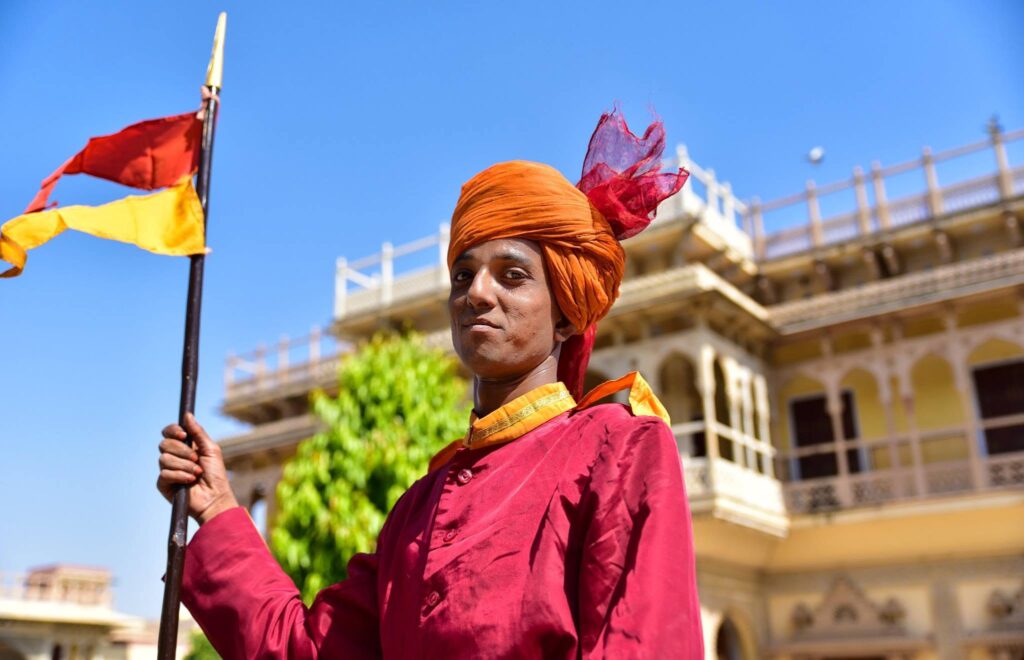
The legacy of Rajasthan’s kings continues back in Jaipur at the stunning City Palace, where we’re welcomed with the same spectacular pageantry, palace guards on horseback towering proudly above the dancing musicians.
Built between 1729 and 1732 for the royal family of Jaipur, one wing of the palace is now a museum, but as Maharajas’ Express passengers, we’re guided away from the tour groups waiting to enter, passing instead through towering iron-clad doors into the royal residence as women wrapped in pink silk rain rose petals from the arches above. It’s very easy to feel like royalty making a triumphant return to an ancestral home.
Far from the tourist throngs, we sip champagne in a sumptuous reception room where gilded chandeliers shimmer in the afternoon sunlight, before passing down long corridors, ever deeper into the palace, finally reaching sun-kissed gardens where a herd of elephants and two curious camels, dressed in regal attire, graze.
Life Aboard the Train: Cabins, Butlers and Two Restaurant Cars

Unique encounters like this are part and parcel of life onboard the Maharajas’ Express, making the journey feel more like a cruise than a train trip. Each day during the week-long itinerary, we assemble on the platform where the train’s complement of butlers, resplendent in their golden coats, form an honour guard, before being escorted down blossom-lined paths to waiting coaches to depart on fascinating excursions executed with military-like precision.
At crowded city stations and on remote rural platforms, those same butlers are dutifully assembled again upon our return, with guests passing through their ranks as they enter the gleaming train through the Rajah Club, one of two luxurious leather-clad lounges, where barman Vijay Singh, a true highlight of the trip, is always waiting with cold towels and freshly shaken cocktails.

The Maharajas’ Express boasts two lounge bars: the Rajah Club is the de facto heart of the train, while the Safari Club is a tranquil space that waits to be discovered. There are also two restaurant cars — one dressed in warm burgundy and gold, the other in blue silk and silver — where Old World silver service is married with the regional creations of ever-smiling, always-charming chef John Stone, a native of Goa.
Despite the bars and dining cars being conveniently located at the centre of the train, it can still be a hike to get to your cabin, thanks to some of the largest staterooms on two rails. The almost kilometre-long train boasts 14 guest carriages, named for precious stones, with a total of four cabin categories, including Navratna, the two-room Presidential Suite, which occupies an entire carriage all of its own.
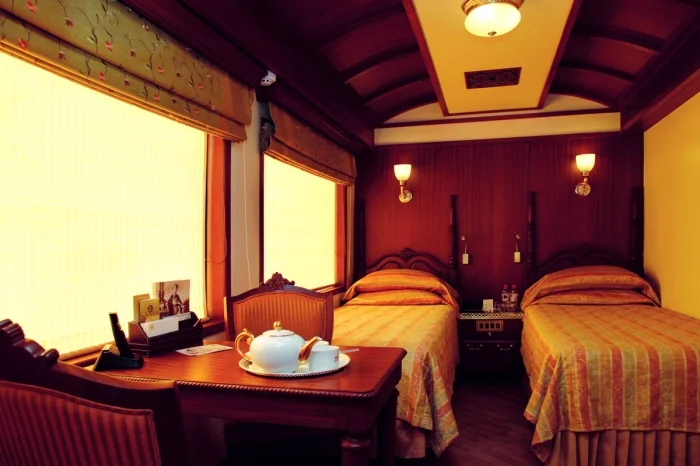
My double cabin, configured with two single beds, is spacious and elegant, with gleaming woodwork, plenty of storage, a large picture window, an LCD television, complimentary wifi and an ample-sized bathroom with a walk-in shower.
This is the domain of Vishnu, our ever-attentive butler, who appears, genie-like, room key in hand, a shy smile on his face, every time we enter the carriage — no matter the hour. First thing in the morning he’s there with piping hot coffee, and as my mother and I retire, he’s present, with a personalised briefing of the day’s adventures to come. It would be rare to find this level of service in a conventional luxury hotel, but in the close confines of an ever-moving train, it’s truly impressive.
Ranthambore, Fatehpur Sikri and the Temples of Madhya Pradesh

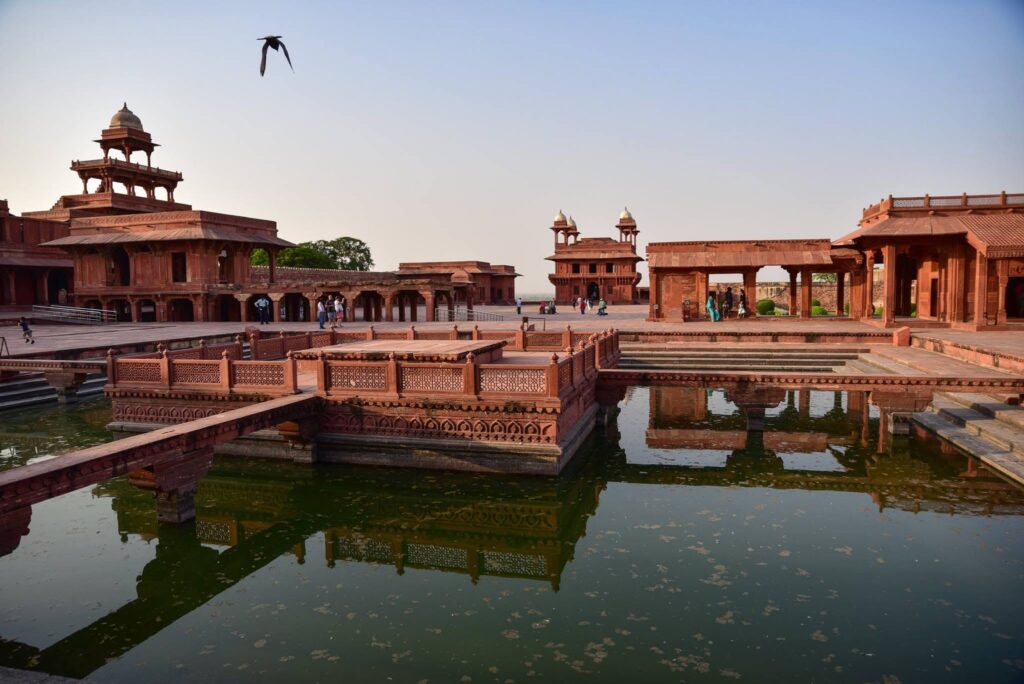
Each day is a different adventure and a new chance to delve into the ancient history of northern India. We chase the dawn from deep within Ranthambore National Park, passing the ruins of its ancient fortress, the hunting grounds of which have become one of India’s most important tiger sanctuaries. We linger as the sunset captures the red stonework of ancient Fatehpur Sikri, the shadows of the abandoned city’s beautifully preserved towers reaching across its expansive ceremonial courtyards.
In Madhya Pradesh, we decipher the intricate carvings of the UNESCO-listed Hindu and Jain temples of Khajuraho with an experienced guide, and in Gwalior we explore the city’s 8th-century hilltop fort, late-afternoon sunshine streaking between its brilliant mosaicked turrets. At the nearby Saas Bahu Temple, built in 1092 by King Mahipala for his mother and wife, flocks of swallows dance in indigo skies, taking turns to dart through the temple’s stone chambers as they hunt dragonflies.
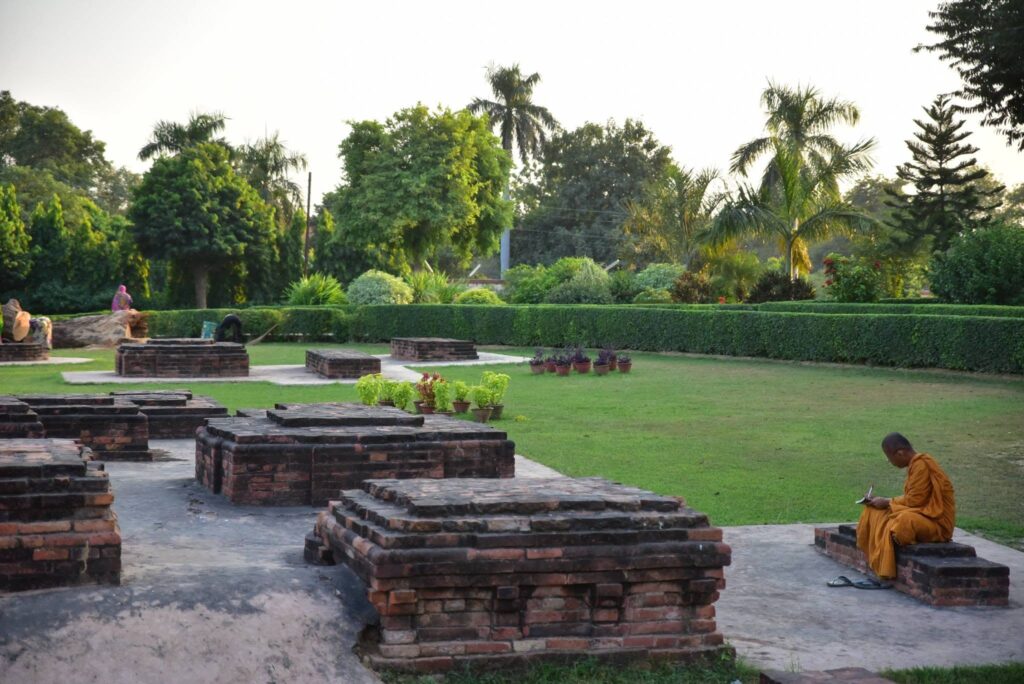
There’s no shortage of new-found friends on the train. During the excursions, and on afternoons when the train races across the landscape of northern India like a burgundy streak, there’s a chance to socialise with guests from around the world. We’re joined on our journey by a former model from London, travelling with her daughter and a rather eccentric actress-turned-photographer friend; a Jain couple from Toronto guiding their young grandson through his first visit to India; and a well-travelled Mexican duo who have perfected the art of the selfie.
The Taj Mahal at Dawn and an Evening on the Ganges

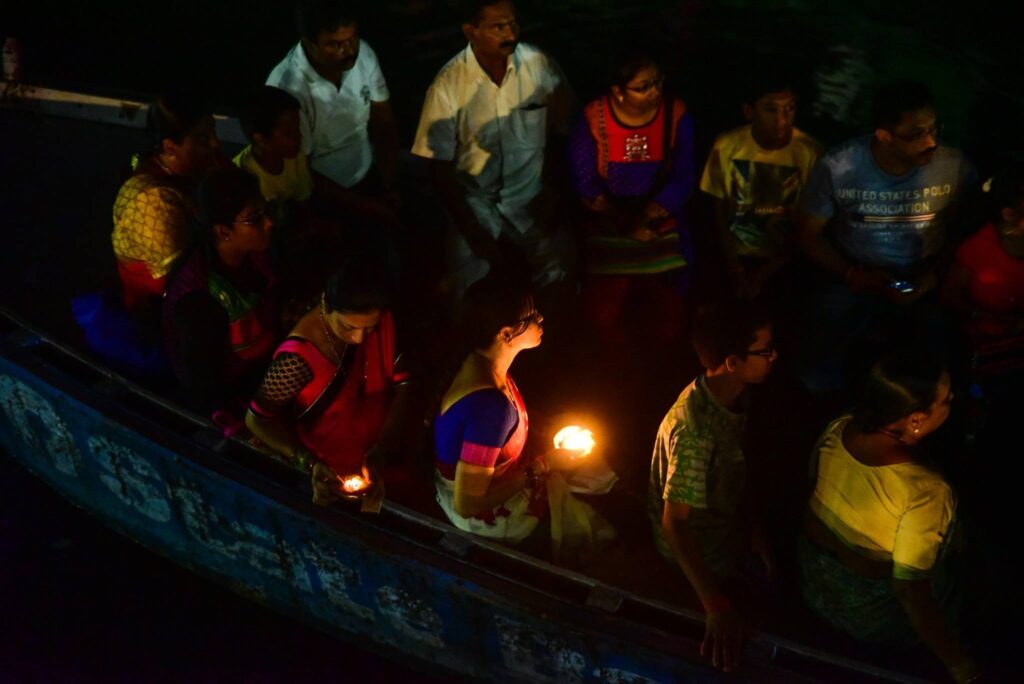
My mother and I explore the manicured gardens and tranquil ponds of the Taj Mahal at first light with Alice and François Levy, a South African couple who now call Dallas home, and on an unforgettable evening cruise down the Ganges, join Indian couples from the US and UK in casting candles into the sacred waters while the mesmerising aarti prayers take place on the banks beyond.
On our last night, as the Maharajas’ Express sprints towards Delhi once more, the train’s crew lead guests, now dressed in pressed sherwanis and vibrant saris, to an impromptu Safari Club dance floor for the itinerary’s “India Night“, a brilliant, music-filled party to end our mesmerising Indian odyssey in a celebratory fashion of which we’re sure the Maharajas of the north would approve.
The Maharajas’ Express: Your Questions Answered

Thinking about booking India’s most celebrated luxury train? Here are the answers to the questions travellers most commonly search before riding the Maharajas’ Express, from cost to the best time to go.
How much does the Maharajas’ Express cost?
Fares generally start from around US$4,900 to US$8,400 per person for a Deluxe Cabin on a six- or seven-night itinerary, twin share, rising to roughly US$26,000 per person for the two-room Presidential Suite. Fares are all-inclusive, covering accommodation, meals, beverages, butler service and most off-train excursions.
What itineraries does the Maharajas’ Express offer?
The train runs several pan-Indian itineraries of six nights/seven days, including the Indian Panorama (Delhi, Jaipur, Ranthambore, Fatehpur Sikri, Agra, Orchha, Khajuraho and Varanasi) and the Heritage of India (Mumbai, Udaipur, Jodhpur, Bikaner, Jaipur, Ranthambore, Fatehpur Sikri, Agra and Delhi), alongside a shorter three-night Golden Triangle itinerary covering Delhi, Agra and Jaipur.

What is the best time of year to ride the Maharajas’ Express?
The train operates from October to April, avoiding the monsoon and the most intense summer heat. This window offers the clearest skies and most comfortable conditions for off-train excursions like Ranthambore’s tiger safaris and the walking tours of Jaipur and Khajuraho.
How far in advance should I book the Maharajas’ Express?
Booking well ahead is strongly recommended, particularly for peak season departures, as cabins — especially the Presidential and Suite categories — sell out months in advance. Final travel documents and meeting-point details are typically sent around two weeks before departure.
What are the cabins like on the Maharajas’ Express?
The train has 14 guest carriages featuring compartments that range from Deluxe Cabins to the two-room Presidential Suite, which occupies an entire carriage. All cabins are ensuite, with wood-panelled interiors, picture windows and a dedicated butler assigned to each carriage throughout the journey.
Is the Maharajas’ Express suitable for families or solo travellers?
Yes to both, although it’s most commonly booked by couples and small groups. Families travel with children on select itineraries, and solo travellers are well looked after thanks to the train’s small guest numbers, communal dining seatings and social excursions, which make it easy to meet fellow passengers from the first day.
How does the Maharajas’ Express compare to other luxury trains in India?
The Maharajas’ Express is widely regarded as India’s most luxurious train, distinguished by its scale — at nearly a kilometre long, it’s one of the largest luxury trains in the world — and its butler-per-carriage service model. Other Indian luxury trains, such as the Palace on Wheels and the Deccan Odyssey, offer similar heritage-focused itineraries at generally lower price points.
What should I pack for a Maharajas’ Express journey?
Pack smart-casual daywear for temple visits and fort excursions, including modest, breathable clothing and comfortable walking shoes for uneven stone steps, along with slightly more formal attire for dinner. During the onboard “India Night” celebration, guests are provided with sherwanis or saris that they can take home with them. Layers are useful, as air conditioning on the train can be strong even when it’s warm outside.
If you’re interesting in a luxury train journey, check out our guide to the world’s best luxury train journeys, the best luxury trains in Australia, and our take on what it’s like to travel through New Zealand’s South Island on the TranzAlpine, and through India aboard the magnificent Andean Explorer.