

A cruise through Australia’s dramatic Kimberley region is a chance to step back in time – albeit with some contemporary creature comforts.
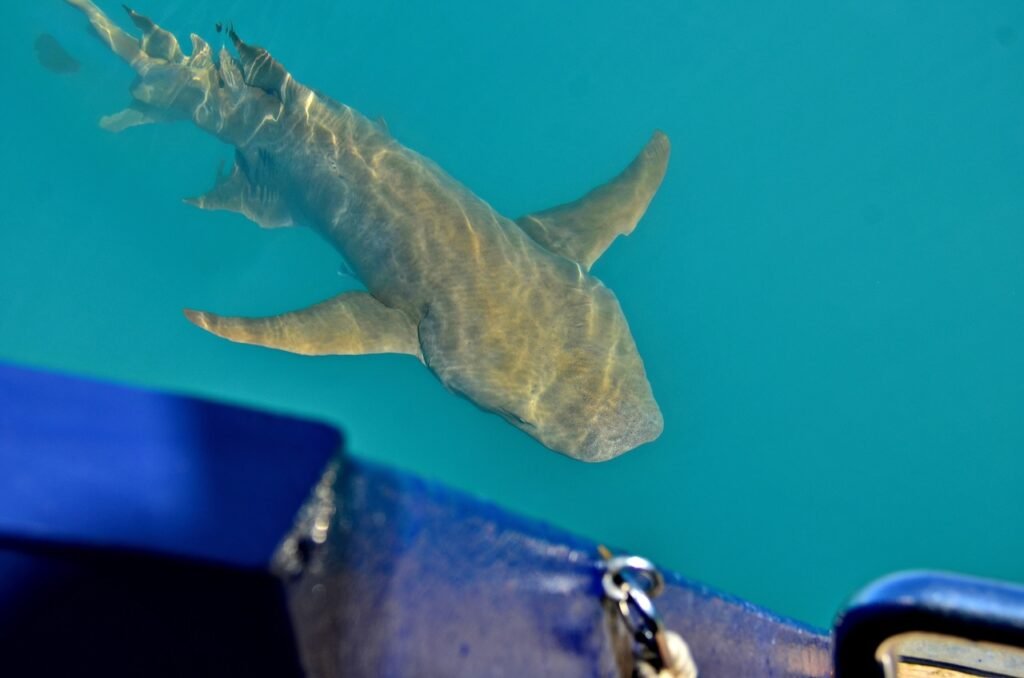
I’ve decided to call the shark Kenny. It’s as innocuous a name as I can manage while watching a giant predator samba slowly beneath the ship, only to emerge on the other side and circle back for another pass.
Kenny has been following us for the better part of two days — lazily dipping below the zodiacs as they launch from the stern of the National Geographic Orion, his elegant outline easily traced through crystal-clear water, cast in shadow by a beating outback sun. The crew tell me he’s harmless, a nurse shark, but they can’t quite meet my eye as they say it, and no one is volunteering to jump in and pet our new companion.
The Kimberley is a wild place filled with wild inhabitants — which is precisely what makes it one of Australia’s most compelling destinations for adventure cruise passengers in search of extraordinary landscapes and genuinely close encounters with nature.
The Kimberley Coast: Australia’s Final Frontier
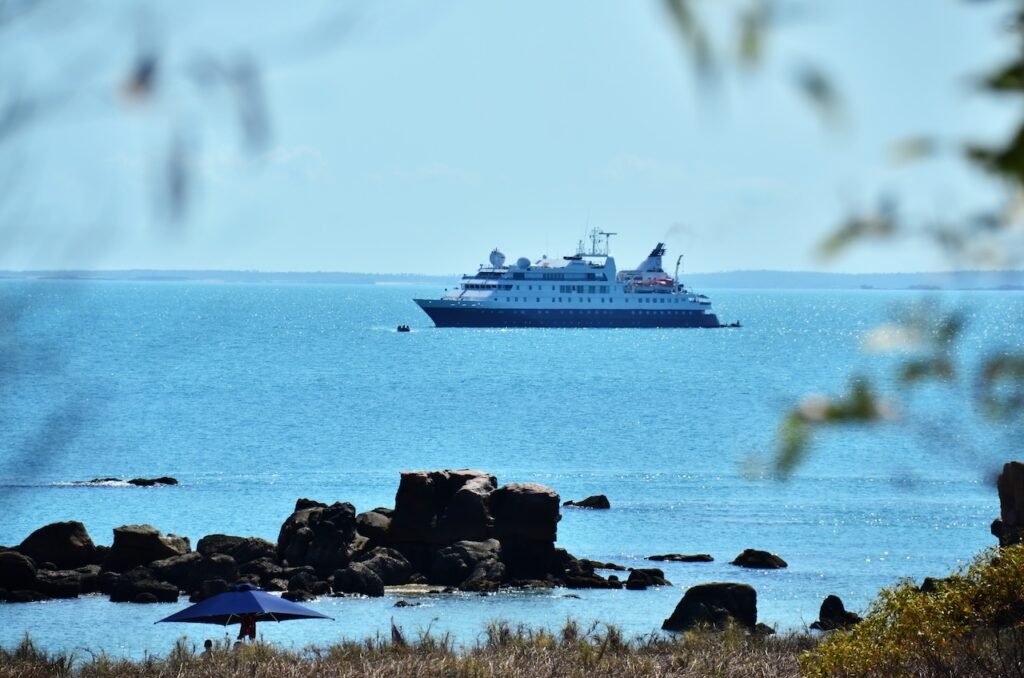
Located in the remote north of Western Australia, the Kimberley is one of the last great wilderness regions on earth: a vast, ancient landscape of red rock gorges, tidal waterfalls, Aboriginal rock art and some of the most biodiverse coastal waters in the southern hemisphere. It is also a point of fierce national pride for Australians, who make up the majority of the 90 passengers boarding the MV Orion in Darwin for this 11-day expedition cruise.
Australians are justifiably proud of their remarkable backyard, and many who have sailed with National Geographic-Lindblad Expeditions to the world’s furthest corners return to the Kimberley coast again and again.
Alongside the locals, however, this voyage carries Canadians, Americans, a scattering of Europeans, a couple from Hong Kong, and a lone Japanese grandmother who has sailed with Orion — a line that partners with Lindblad National Geographic from March — four times previously. It is a reassuringly well-travelled group of companions for the days ahead.
A quirk of local maritime law requires the National Geographic Orion to leave Australian waters at some point during each Kimberley cruise — on this occasion, a 15-minute late-night visit to the tip of East Timor. The result is that the first two days and nights are spent at sea, which proves unexpectedly useful: by the time we return to the blazing red rock and open skies of the Kimberley, everyone has their sea legs and a working knowledge of their shipmates.
Wyndham and the Ord River: Crocodiles and Kingfishers
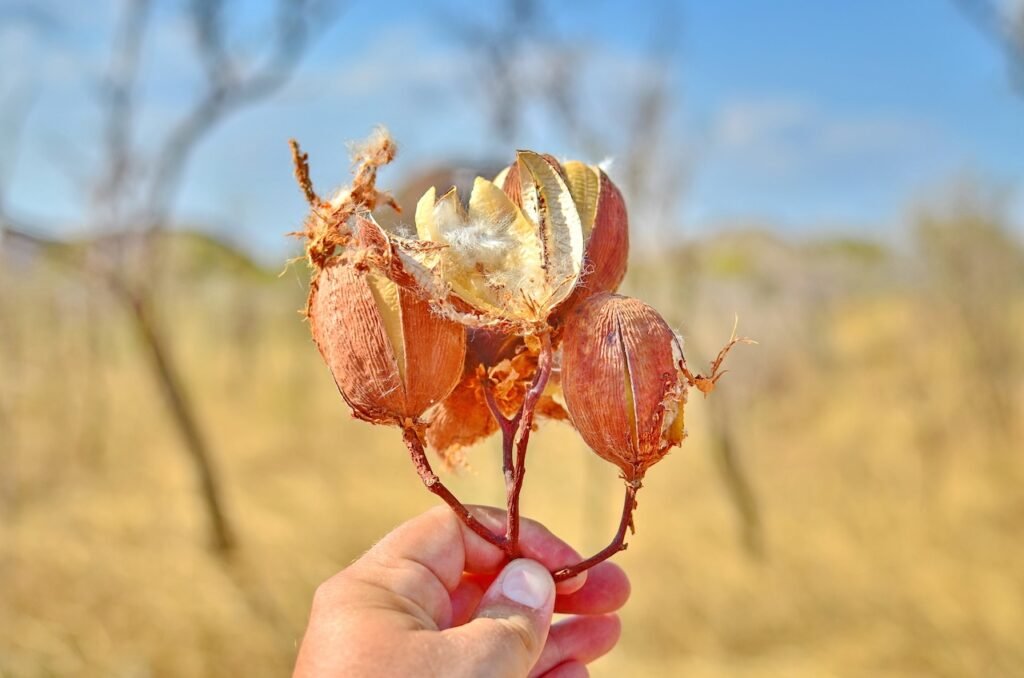
Our first port of call is Wyndham, a once-prosperous outback town that now serves as the gateway to the Kimberley’s interior. Here the ship’s 90 passengers divide: some take to the air to fly over the celebrated Bungle Bungle Range — the extraordinary beehive-shaped towers of Purnululu National Park — while others board buses past thundering iron ore road trains and take to the water.
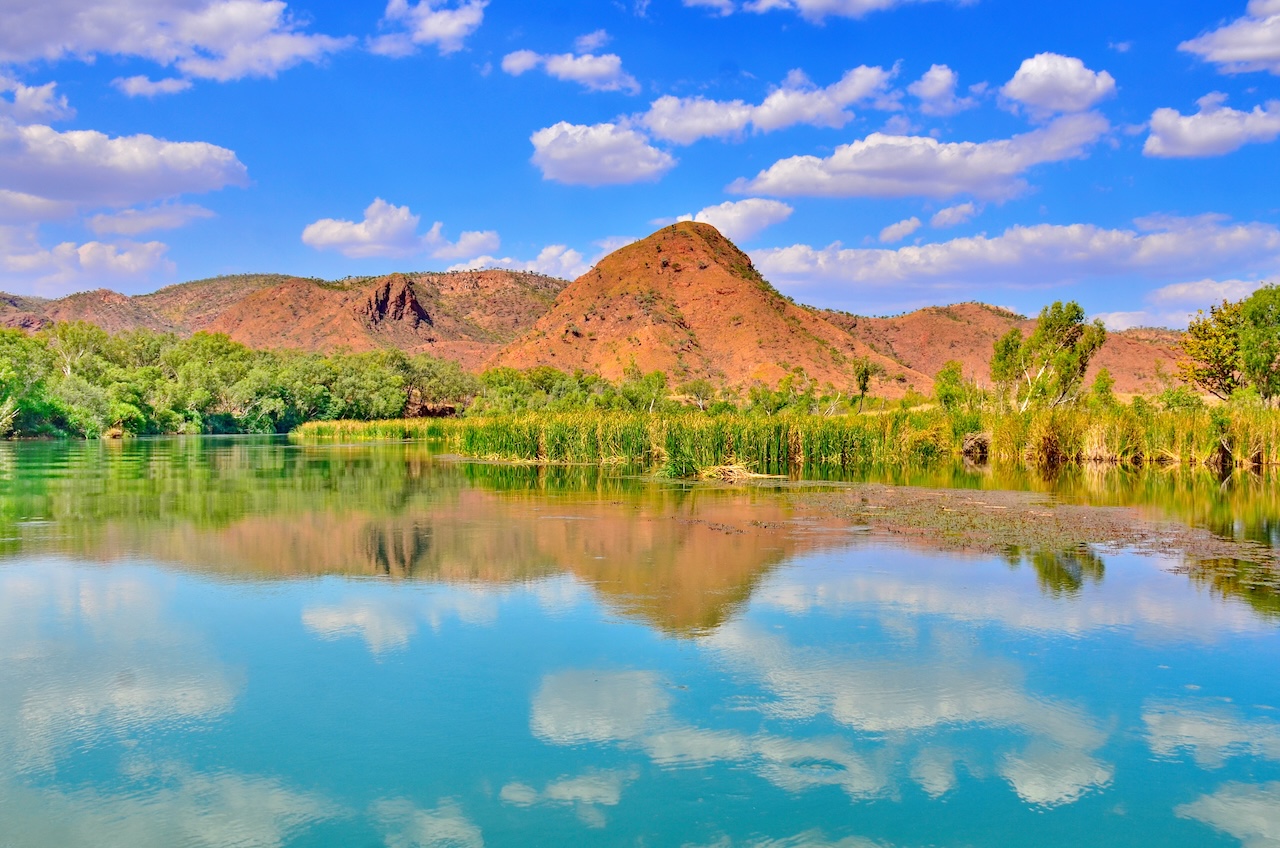
My father Rob and I — travelling together for the first time in decades — opt for the river, boarding high-speed open-sided tour boats to cruise the Ord River toward Lake Argyle, a vast manmade body of water that irrigates much of the surrounding farmland. The lake is tranquil and beautiful, its few clouds reflected perfectly in still water alongside grassy hillocks and red rock cliffs.
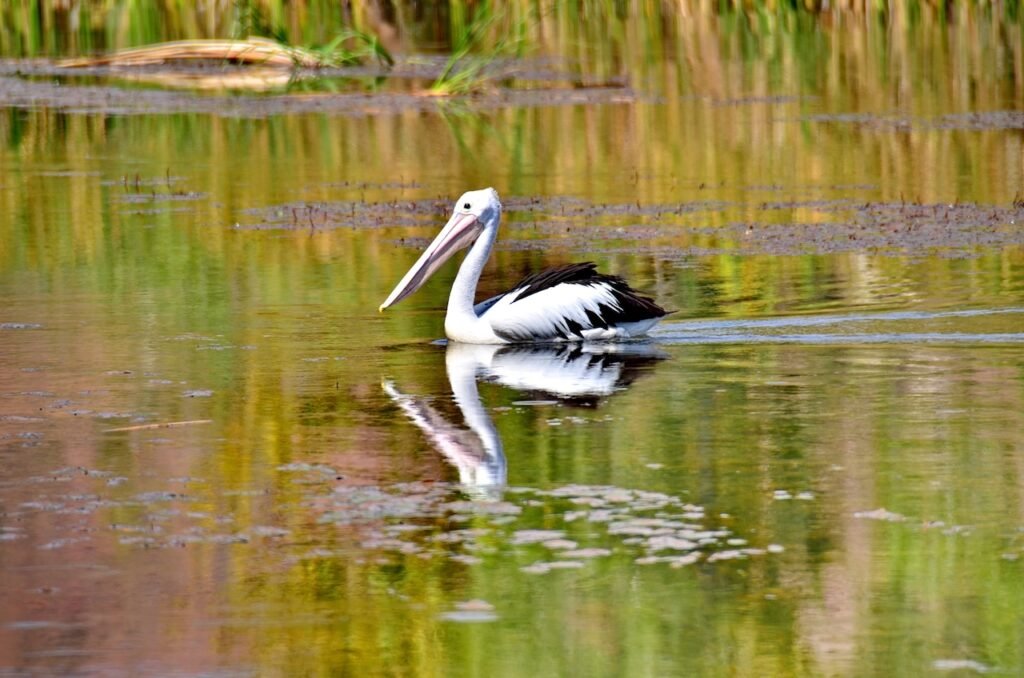
The birdlife along the Ord is extraordinary. We spot graceful egrets, rainbow bee-eaters, square-tailed kites, northern rosellas and delicate azure kingfishers threading through a canopy that arches over the river’s narrower tributaries.
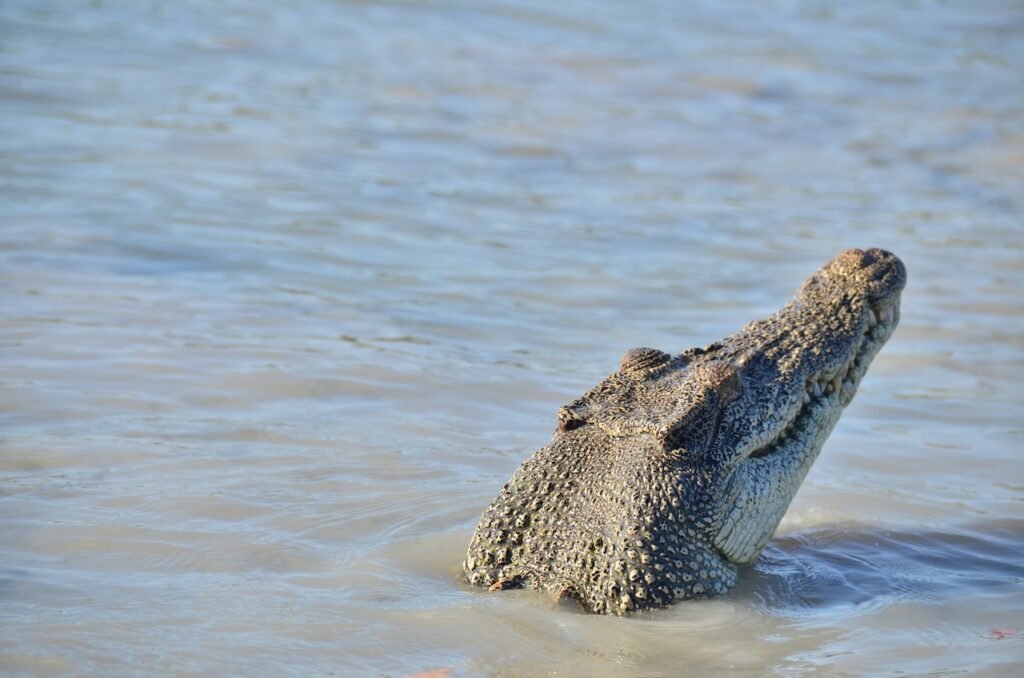
Some of the Ord’s estimated 25,000 freshwater crocodiles — smaller and more restrained than their saltwater cousins — bask on the banks in the midday sun, while nearby, gangs of pelicans work together in tight circles before diving as one, like synchronised swimmers after a shared target.
King George River and Falls: Zodiacs, Rock Art and Chilled Mimosas
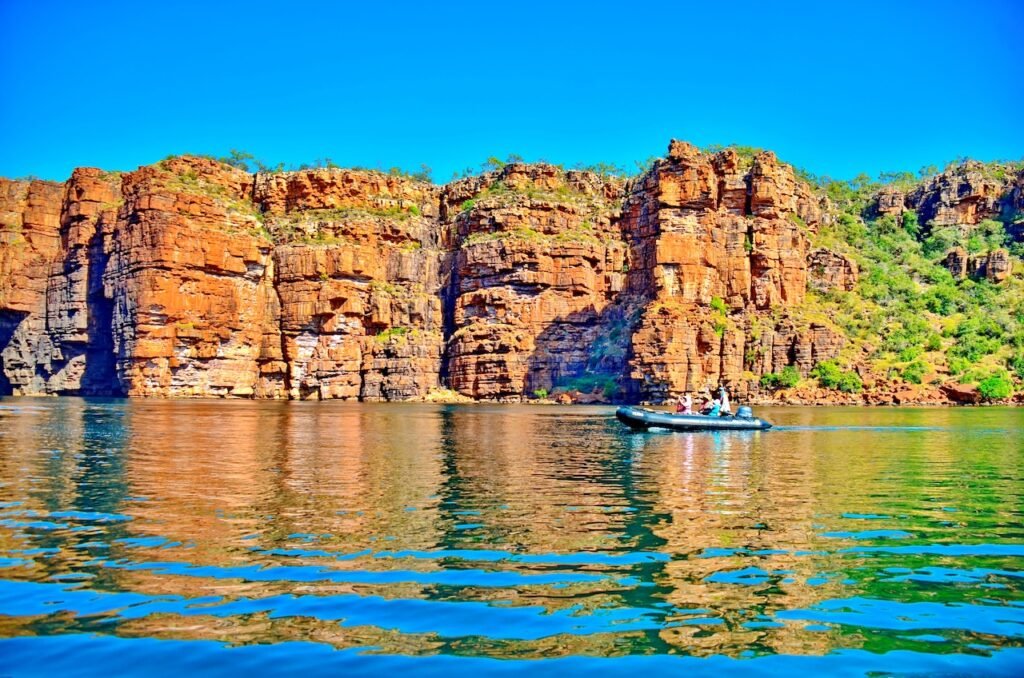
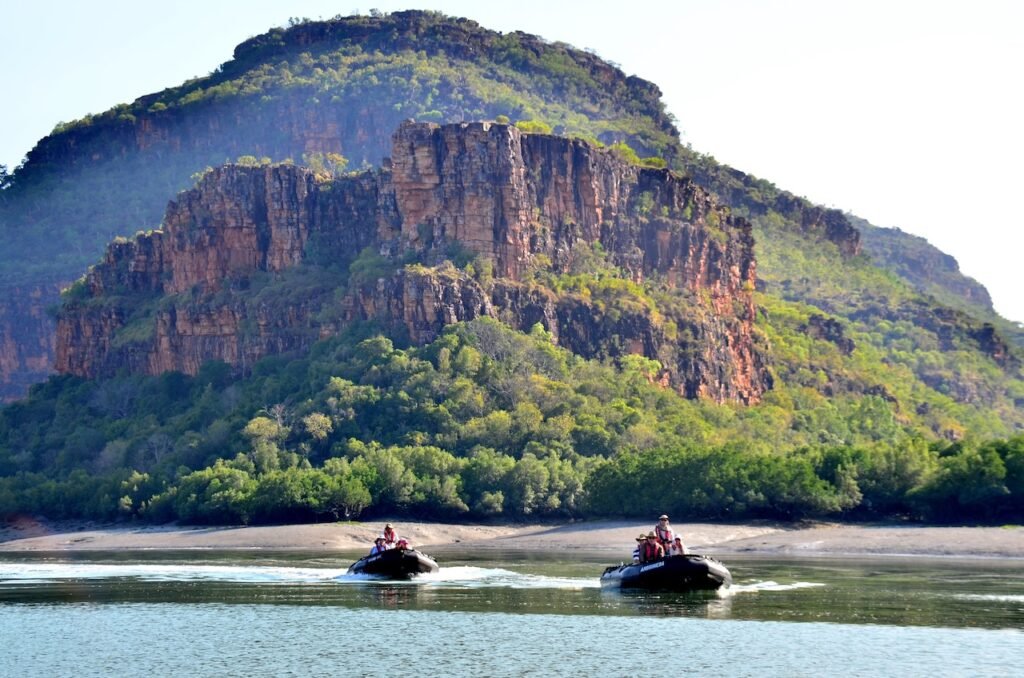
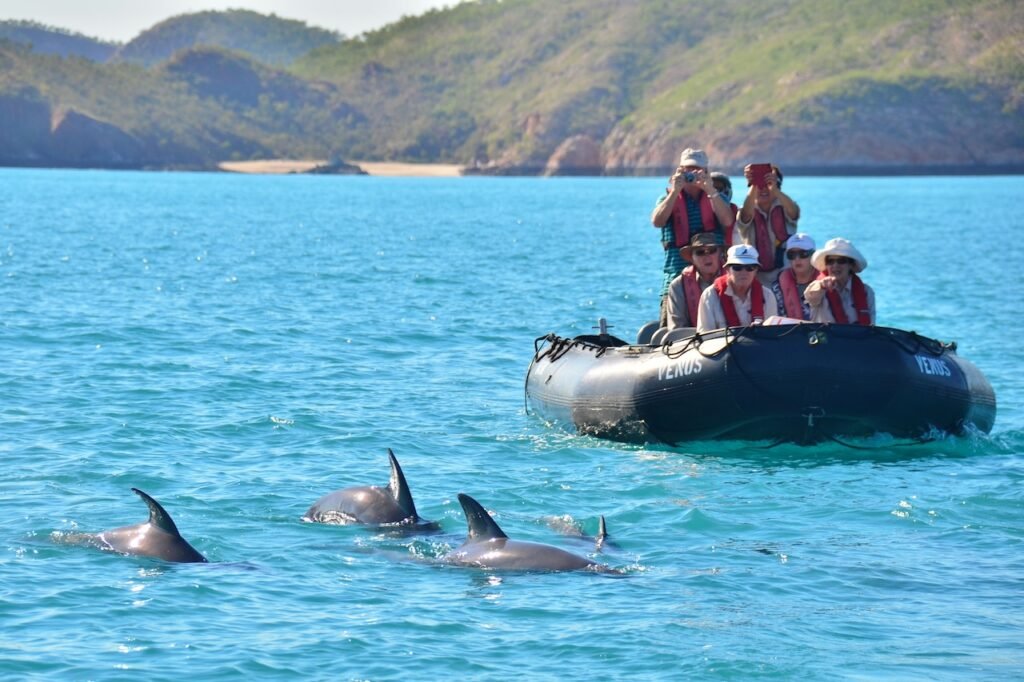
The next day brings our first zodiac excursion — and in the Kimberley, the zodiacs are everything. Each named for a different constellation, these versatile craft are the expedition’s lifeblood, carrying guests far up rivers and onto beaches that no larger vessel could ever reach.
We set out early for the King George River, red cliffs towering on either side, ancient black waterlines on the rock marking the passage of some of the world’s highest tides. Expedition staff point out snowy white ospreys and shy rock wallabies from the zodiacs as we push deeper into the gorge.
After a steep climb up a sheer rock face, we are rewarded with a staggering view from the rim of Australia’s highest waterfall — and even with the falls running dry in this season, we share a series of rock pools with gleaming water monitors, cooling our feet in captured rainwater while the Kimberley heat builds around us.
Back at the river, the ship’s maître d’, Clinton, materialises from behind a rocky outcrop bearing a tray of chilled mimosas. It is the first of several moments on this voyage where the Kimberley’s raw wildness and Orion’s quietly superb hospitality collide to magnificent effect.
Life Aboard the Orion
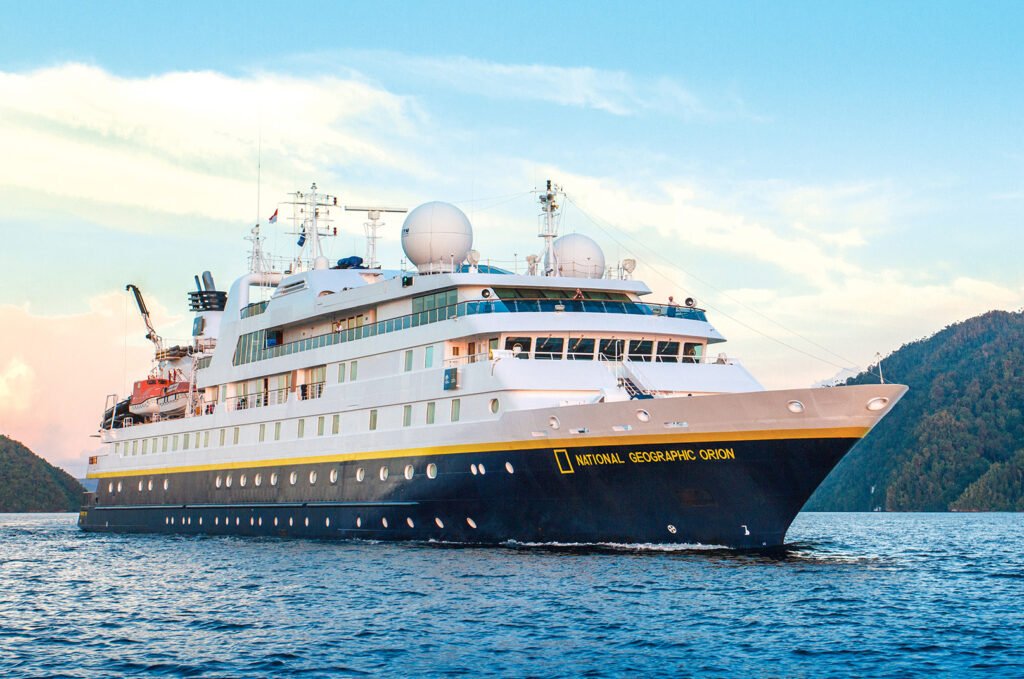
Between shore excursions, guests gather in the outdoor jacuzzi, take lunch on the back deck under a canopy of umbrellas, or attend lectures on local ecosystems, marine life, regional history and the Aboriginal peoples who have called the Kimberley home for tens of thousands of years. Each evening the group reconvenes for cocktail hour in the Leda Lounge — a debrief as entertaining as the day itself — followed by dinner in the main dining room or on the back deck beneath a canopy of stars dense enough to feel close enough to touch.
The ship is elegantly appointed throughout, with guest rooms that balance comfort with the practicalities of expedition life. For true pampering, the Owner’s Suite — with its separate living room and Juliet balcony — sets a standard you wouldn’t expect on a working expedition vessel.
Bradshaw Rock Art and a WWII Wreck: The Deep Kimberley
Passengers come to the Kimberley to explore, and Orion’s itinerary delivers consistently. At Vansittart Bay we stand before Bradshaw rock art — Gwion Gwion figures estimated to be 40,000 years old, among the oldest and most enigmatic artworks in the world, their origin and meaning still debated by archaeologists.
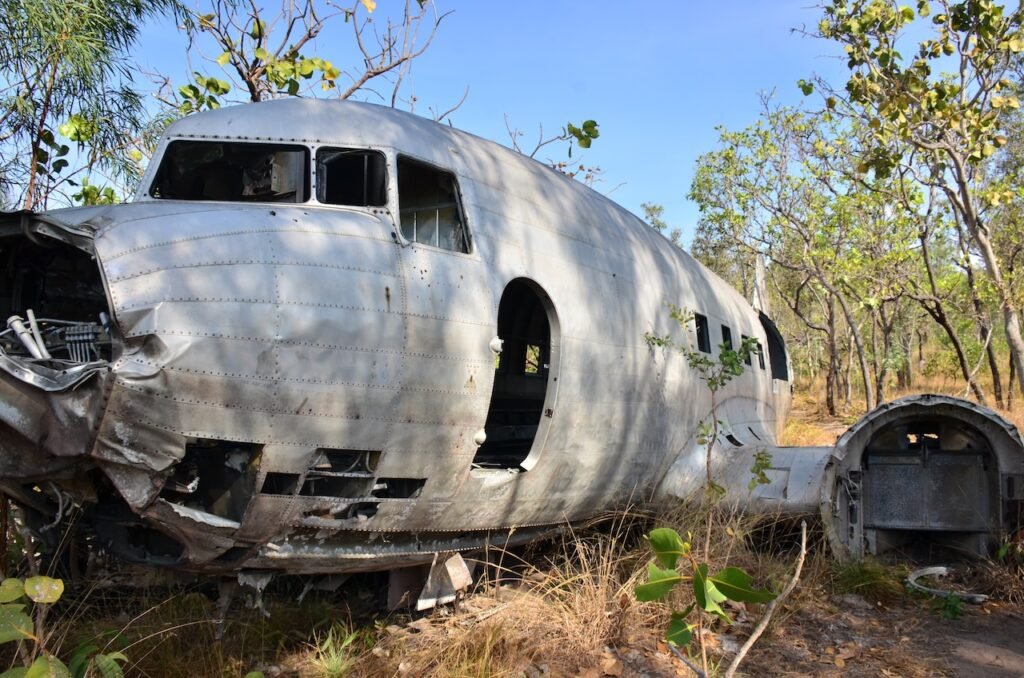
Elsewhere, we scramble through the fuselage of a WWII DC3 that came down on a sprawling mudflat, now home to millions of tiny scurrying orange and azure crabs that swarm across the wreckage like a living carpet.
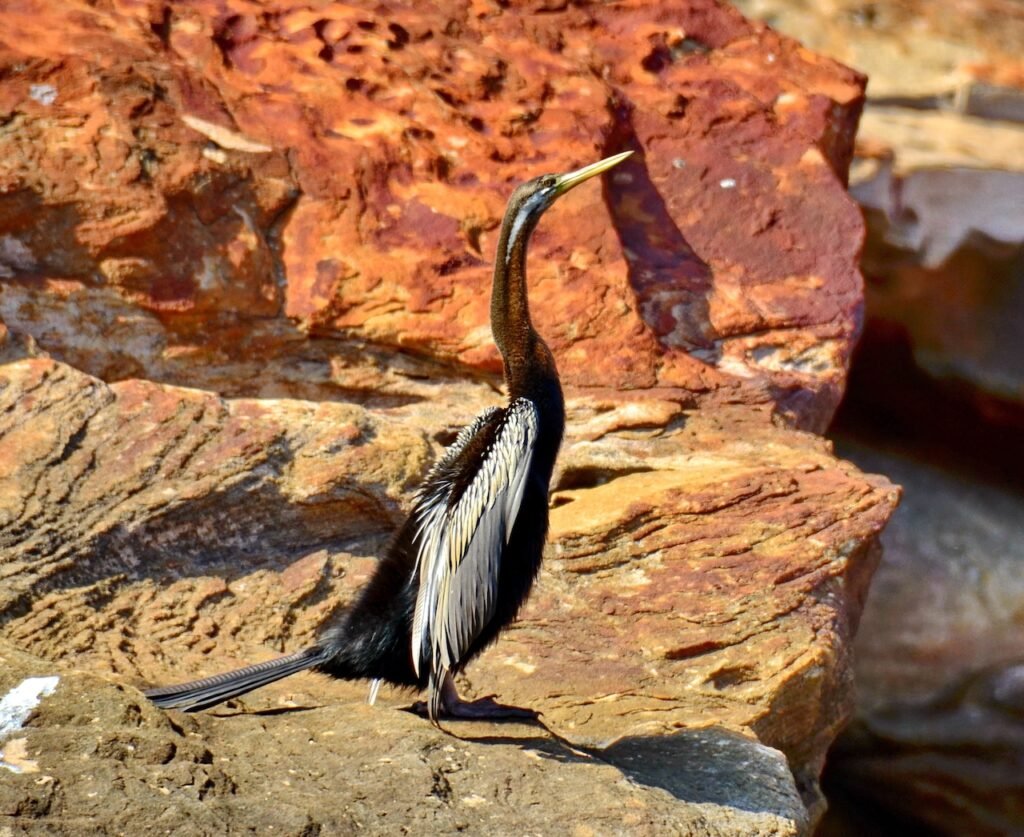
The Hunter River excursion begins at first light to catch the low tide. Expedition leader Darrin Bennett — whose infectious passion for the Kimberley has been forged from years exploring the region — leads our zodiac convoy up a river framed by whistling kites and white-bellied sea eagles perched on enormous cliffside nests.
Further upstream, beneath dense mangrove canopies, lazy saltwater crocodiles doze on the mud while white goshawks wheel in the thermals overhead, scanning for breakfast. Guests who prefer altitude take the helicopter option up to the Mitchell Falls, a spectacular four-tier cascade tumbling from an inland plateau.
Montgomery Reef: Where an Island Rises from the Sea
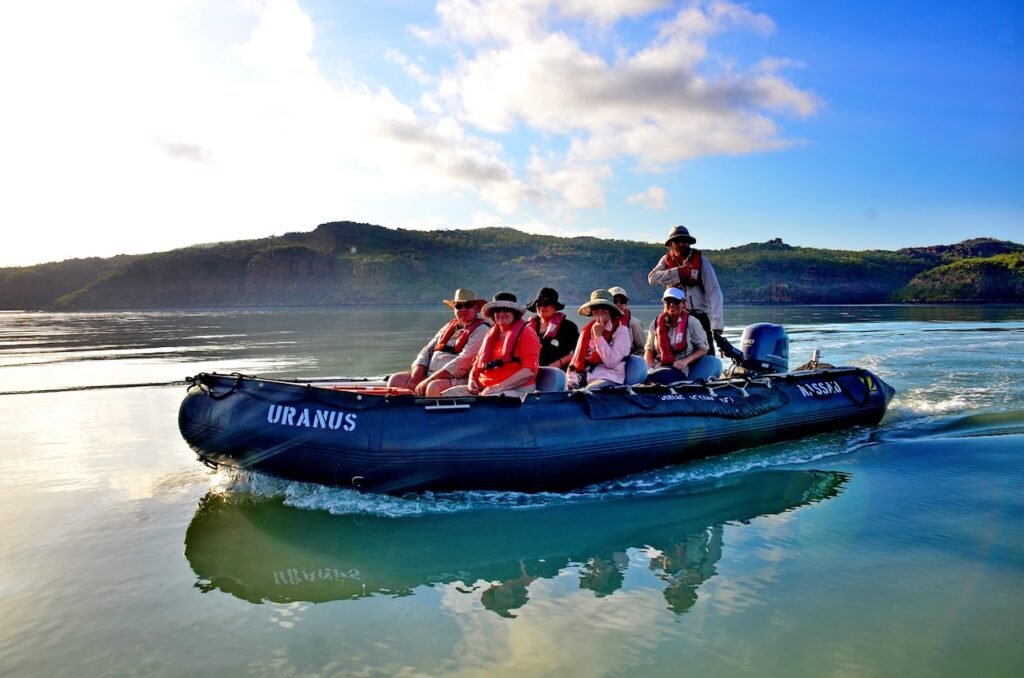
Located 20 kilometres off the coast of Doubtful Bay, Montgomery Reef is one of the Kimberley’s most extraordinary natural phenomena — and one of its least-known. We set out early under a pale blue sky, pausing briefly to watch a pod of humpback whales breaching nearby, their tails slapping at the calm water of the bay.
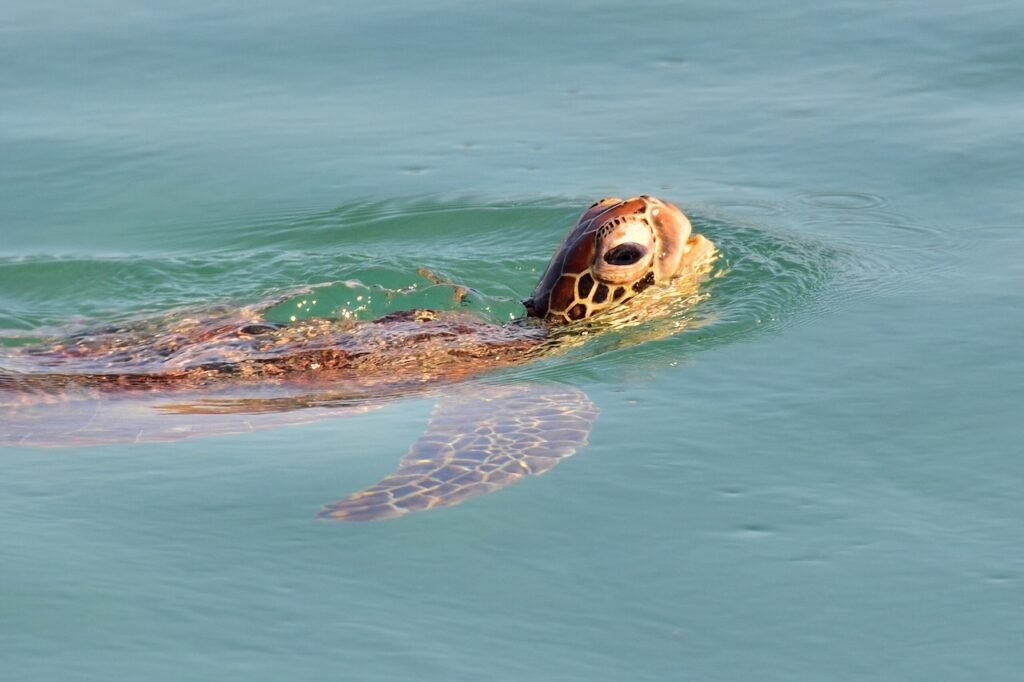
Then the tide shifts. Like a submerged spacecraft slowly surfacing, the reef begins to emerge from the depths. The movement of the ten-metre tidal range means this enormous stone platform rises quickly from the sea as we navigate newly formed rivers between coral outcrops, water torrenting from its flanks, turtles and reef sharks riding the shallows at its edges.
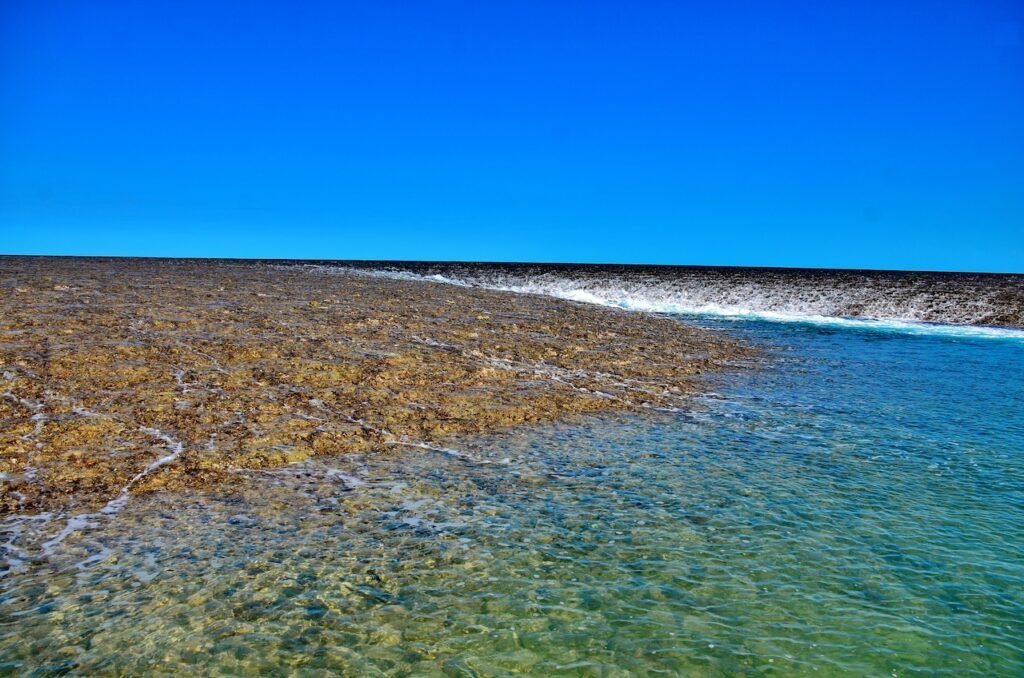
Clinton and his team, meanwhile, have set up camp on a sandbar and are waiting with chilled Bloody Marys and warm sausage rolls. The Kimberley, as ever, delivers on every front simultaneously.
The Horizontal Waterfalls: Nature’s Most Improbable Spectacle
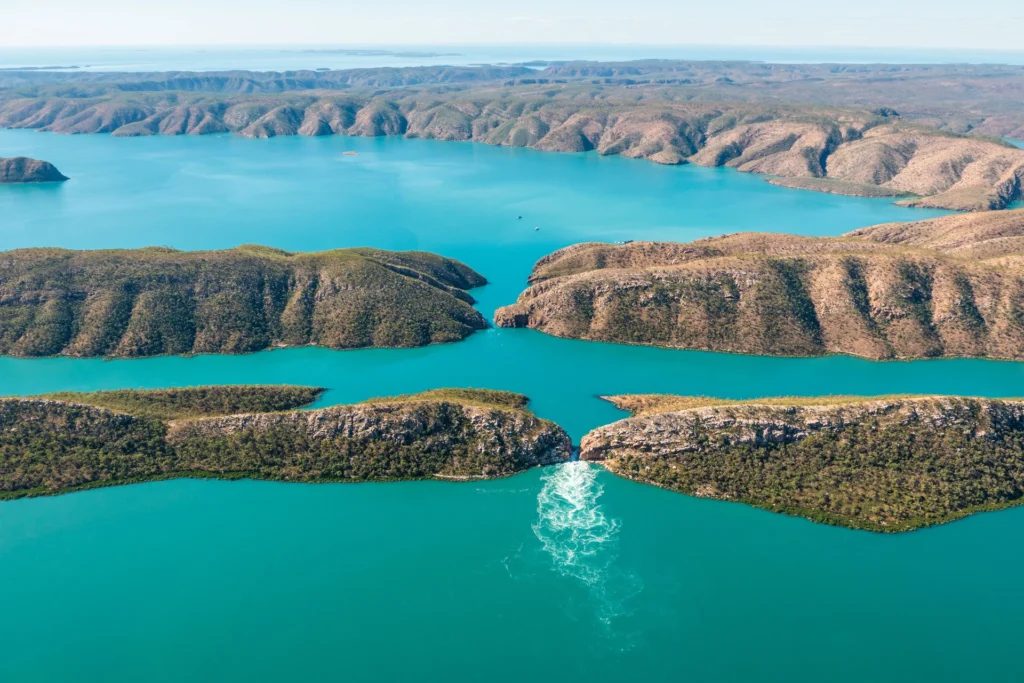
In Talbot Bay, captain Taillard Vincent navigates through the islands and narrow channels of the Buccaneer Archipelago toward the Horizontal Waterfalls — famously described by Sir David Attenborough as one of the greatest natural wonders he had ever witnessed. As the tides rise and fall, water forced through three narrow gaps between inland seas builds enormous pressure, creating a rushing wall of water that appears, improbably, to flow horizontally.
Orion’s military-grade zodiacs cannot pass through the gap at full flow, so guests transfer to the high-speed boats of a local operator and roar through it instead — lining up with the narrow opening before sprinting and bouncing their way up or down the ‘waterfall’ and out onto calmer water beyond. It is as exhilarating as it sounds.
Back at the ship, Kenny makes another pass beneath the transom as I step off the zodiac. A sea snake as thick as a fire hose — yellow and black stripes blazing in the afternoon sun — tangos past alongside him.
Crocodile Creek: A Perfect Kimberley Finale
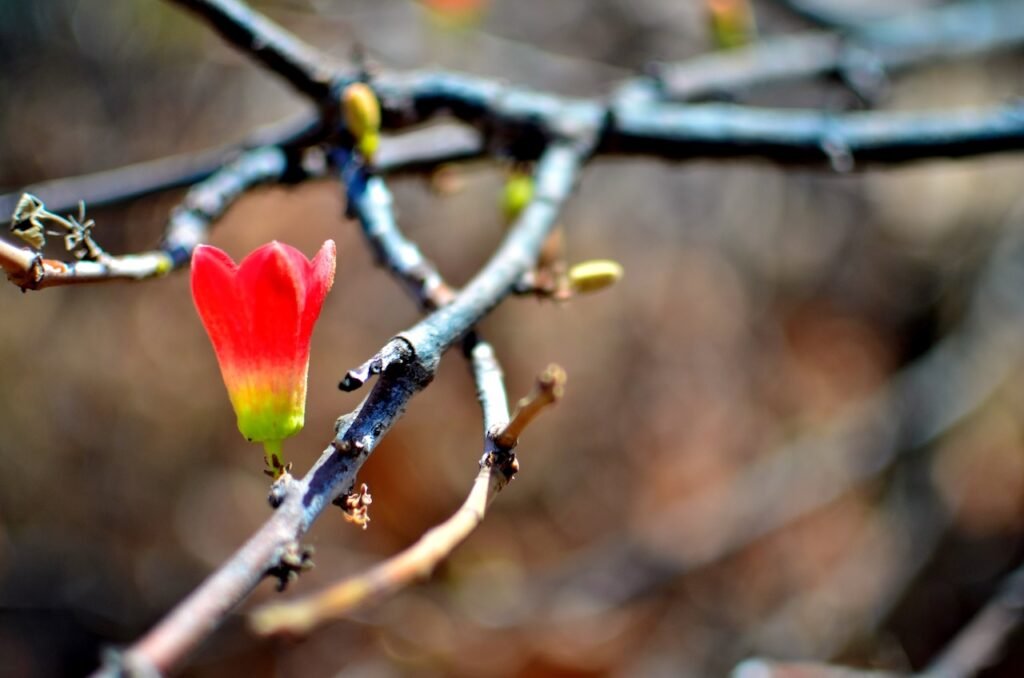
Our final day is spent at the ironically named Crocodile Creek — an idyllic, spring-fed rock pool protected from its reptilian namesake by a series of embankments, and wreathed by vivid red Kimberley Rose trees. It is the perfect setting for a last swim — and for the final instalment of Clinton’s signature surprises: margaritas served from a makeshift bar balanced on twin inflatable crocodiles.
The Kimberley demands a certain kind of traveller: curious, flexible, willing to rise before dawn and cover themselves in sunscreen before breakfast. In return, it offers landscapes, wildlife encounters and a sense of genuine remoteness that are available almost nowhere else on earth. National Geographic-Lindblad Expeditions, with its experienced crew, expert guides and quietly outstanding hospitality, remains the benchmark for how to experience it.
Travel Essentials
Getting There
Fly to Darwin or Broome via major Australian hubs. Qantas operates connections from Hong Kong via Brisbane.
Cruising
National Geographic-Lindblad Expeditions operates Kimberley expedition cruises aboard the National Geographic Orion, typically departing Darwin and sailing May through July. The 11-day itinerary includes all shore excursions, zodiac activities, meals, beverages and onboard lectures. In March, Orion joins the Lindblad National Geographic fleet.


