
From gilded cathedrals and bustling bazaars to a gleaming, futuristic skyline, Almaty and Astana reveal an ancient Silk Road nation boldly reinventing itself.
It’s mid-morning, and within the incense-laced confines of Almaty’s Ascension Cathedral, worshippers pray silently to gilded saints that tower high above. Resolute against Kazakhstan’s harsh winters and scorching summers, the cathedral, one of the tallest wooden buildings in the world, remains a beacon for the faithful of the nation’s former capital, an ancient trading city wreathed by jagged mountain ranges, with the emptiness of the Taukum Desert stretching away to the north.

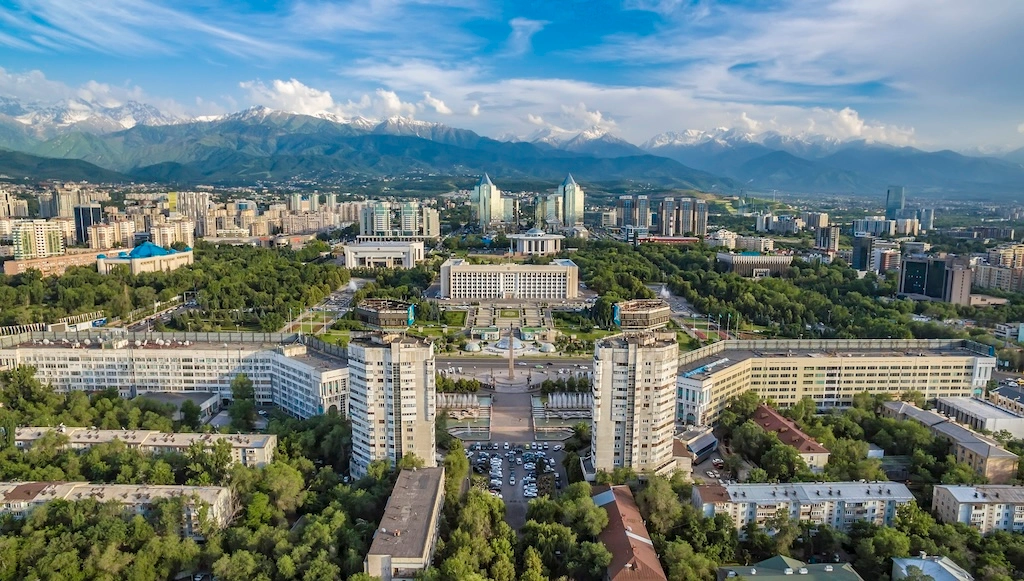
Almaty is a fascinating place. Kazakhstan’s largest city and home to almost 2.4 million of the country’s 20.6 million people, the commercial capital is a cultural melting pot like no other. A gateway between the “Stans” of Central Asia and the Far East, Almaty proudly preserves its rich legacy as a vital way station on the ancient Silk Road.
The tsarist-era church, also known as Zenkov Cathedral after its architect, Andrei Zenkov, is a multi-generational meeting place. Stooped babushkas, bundled in layers of brightly coloured fabric despite the last of the summer warmth, and young couples in jeans and T-shirts worship before a magnificent golden iconostasis adorned with paintings by Nikolai Khludov, lighting candles as a bushy-bearded Orthodox priest watches from a corner.

It’s a serene and timeless scene, save for the occasional chirp of an errant smartphone, as residents step through the entrance arch and make the sign of the cross, heads bowed solemnly, before finding a pew and some welcome respite from the bright morning sunshine outside.
It’s into that sunshine I wander, leaving the faithful to their prayers and emerging into the dazzling colours of Panfilov Park, one of Almaty’s many green belts. The park is popular with locals and visitors alike, who take selfies before the candy-coloured cathedral, wander the manicured gardens and visit the moving Soviet-era memorial to the Panfilov Heroes, the 28 guardsmen celebrated for their defence of Moscow against the advancing German army in 1941.
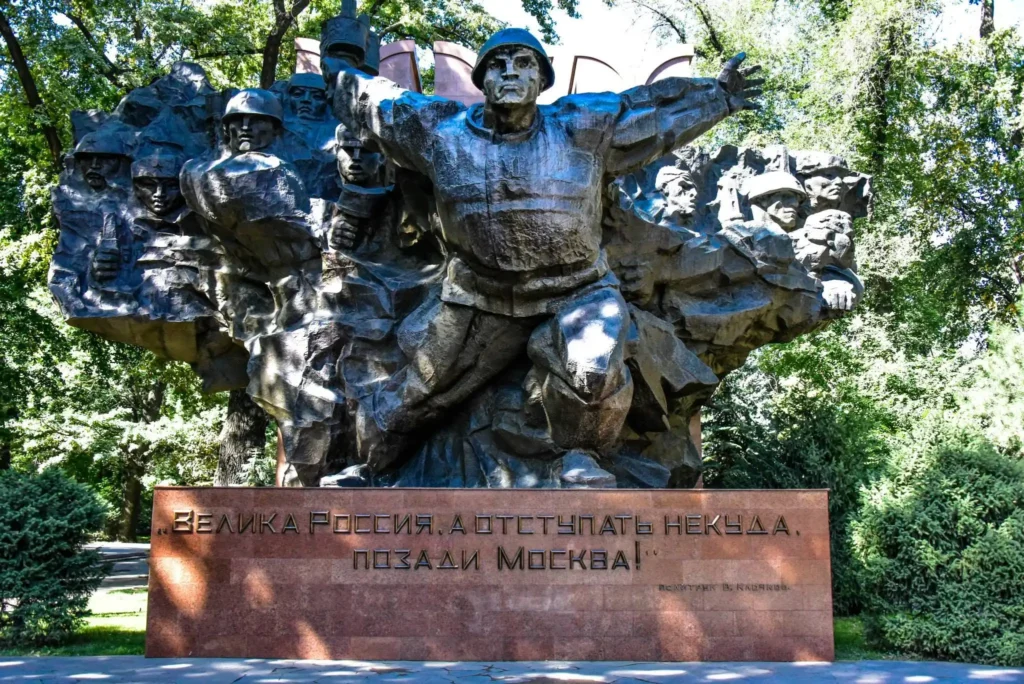
At the heart of the park, an eternal flame burns for the soldiers of past battles, their faces, rendered in dark, molasses-hued relief, illustrating in detail the myriad ethnicities that call Kazakhstan home.
A Nation Emerging Into the Light

In many ways, Kazakhstan, too, is emerging into the light of a bright future. A fascinating country of contrasts and contradictions, it has one foot in its rich and often turbulent past and the other stepping towards new prosperity, as its vast natural resources are tapped and hard currency chases away the shadows of the Soviet era.
This newfound prosperity can be seen all over Almaty, where commercial towers reach for pale blue skies and the streets are packed with Land Rover, Mercedes and Porsche SUVs. There are luxury country clubs and housing developments, and the Ritz-Carlton has been joined by a host of other international brands as investment flows in.
The new-look Kazakhstan can also be seen in its national carrier, Air Astana, which holds a coveted four-star Skytrax rating and in 2026 was named Best Airline in Central Asia and the CIS for the 15th consecutive year, opening the country up to the world beyond.
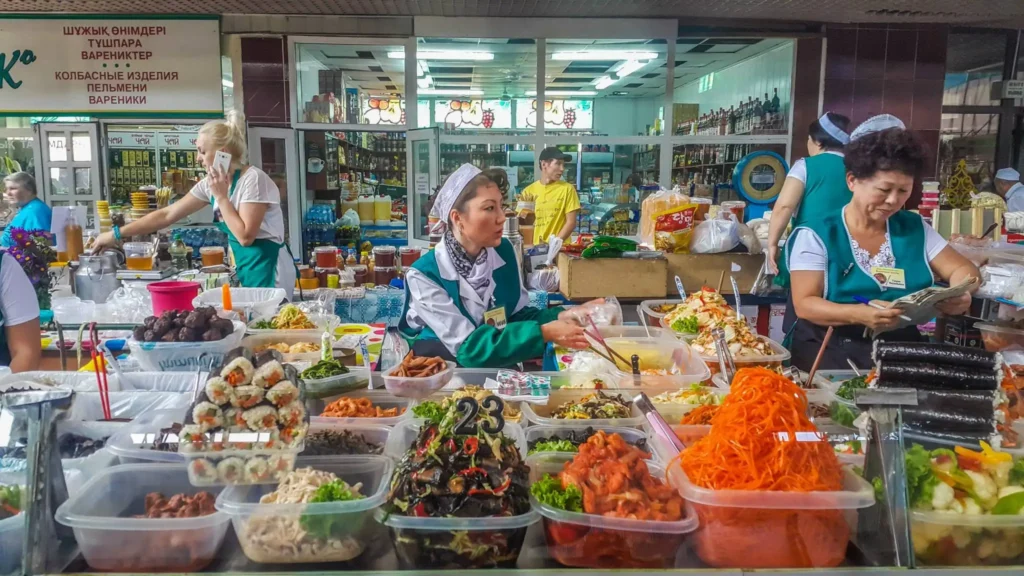
Not that Kazakhstan is a stranger to visitors, both voluntary and otherwise. From the days of the Silk Road to Stalin’s forced deportations, the country has absorbed people from across Asia and Europe, from ethnic Russians and Chinese to Ukrainians, Uyghurs, Bulgars and Tatars. Almaty’s diversity is best seen at its Green Bazaar, a fascinating food emporium at the heart of the city where the vital ingredients of many regional dishes are sourced directly from the producers.
A Feast at the Green Bazaar

Surrounded by stout Soviet-era apartment blocks and tree-lined boulevards (Almaty is one of the greenest cities in Central Asia, with expansive green spaces like the First President’s Park breaking up the urban sprawl), the bazaar has the architectural ambience of a Communist-era public swimming pool, with green-hued tiles and beams of bright afternoon sunshine reaching from high skylights to concrete floors polished by generations of hungry shoppers.
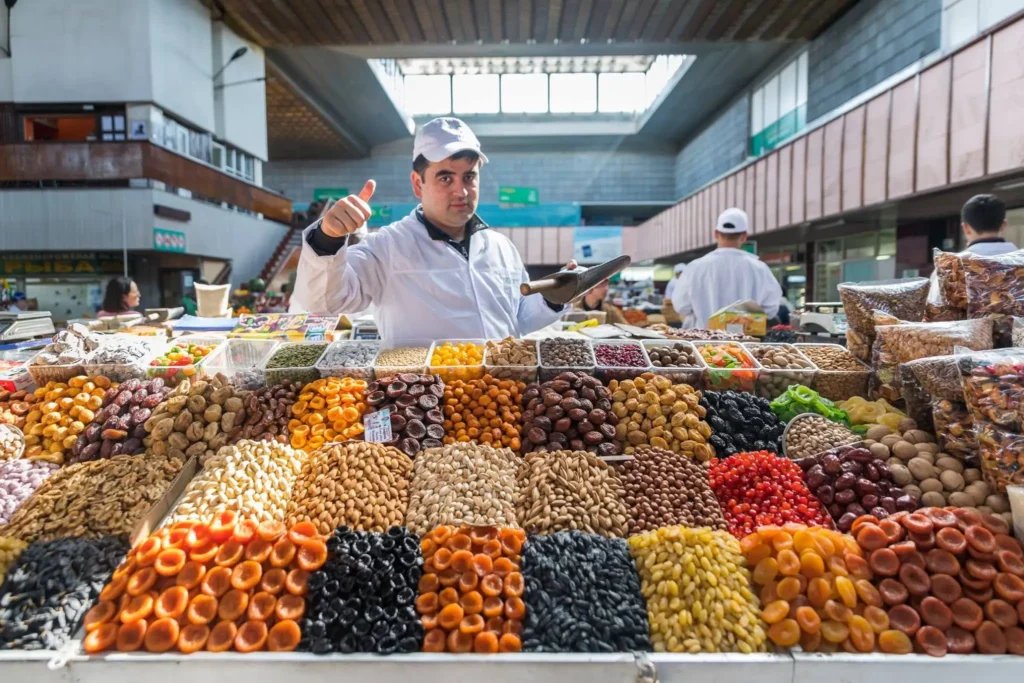
The sprawling market is divided into sections. There are butchers’ aisles where horse steaks, a national favourite, are prepared alongside fresh lamb sausages, and deli counters where cured meats and caviar are presented in towering piles. In the vegetable section, pomegranates and the largest apples I’ve ever seen gleam in the sunshine (Almaty is the ancestral home of the apple, and its old name, Alma-Ata, is often translated as “father of apples”), while in the dried goods corner, nuts from Persia and Afghanistan are piled high next to dried figs and apricots from the steppes.
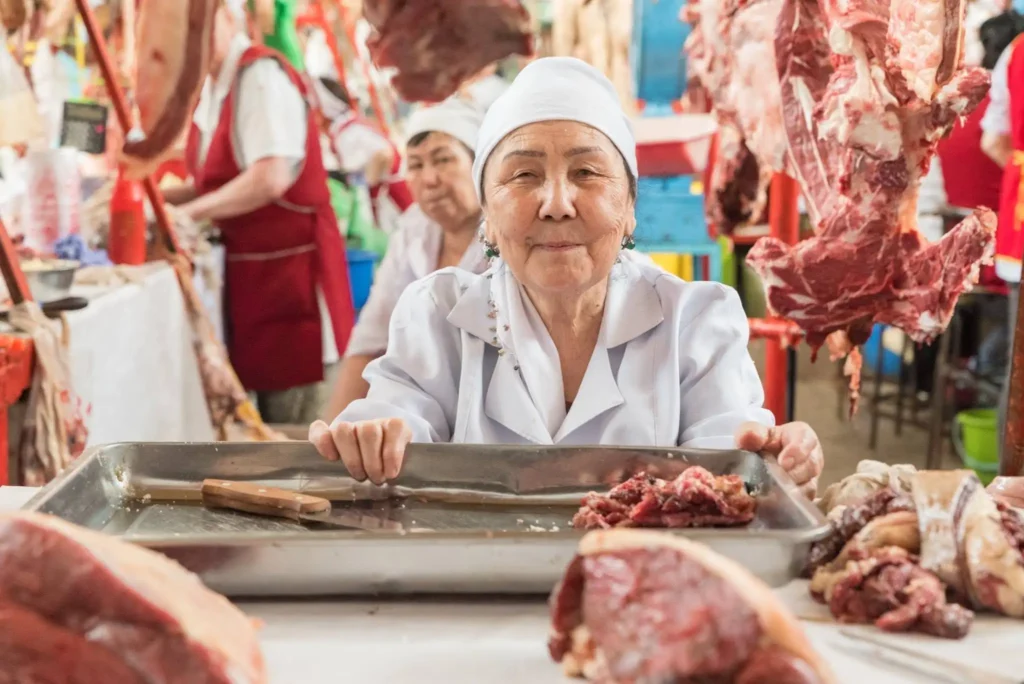
There is also a long line of Korean stalls selling authentic delicacies, from vibrant red kimchi to tteokbokki rice cakes, evidence of the many ethnic Koreans who have called Kazakhstan home for generations. Nearby, spice stalls are ablaze with colour as the flavours of the Far East continue to migrate west, just as they did on the Silk Road. For the intrepid, the Green Bazaar is also a great spot to try some of Kazakhstan’s more daring delicacies, from qymyz, fermented mare’s milk, to shubat, fermented camel’s milk.
As the sun begins to settle in the sky and the headlights of weathered Ladas and gleaming new Land Rovers flick on, I head to Gakku, one of the city’s leading Kazakh restaurants, to see how all that mouth-watering produce can be employed. Seated in a traditional Kazakh yurt, I’m protected from the evening winds that whip down from the mountains as the light drains from the sky.
It’s the perfect chance to feast on a host of authentic local dishes, from beshbarmak, the national dish of slow-cooked mutton and horse meat served over broad, silky sheets of noodle, to asip, a sausage of lamb offal and rice steamed in a Kazakh take on haggis, and cheburek, golden pastry parcels stuffed with minced meat that proved the perfect snack for ever-moving nomads.
Into the Mountains
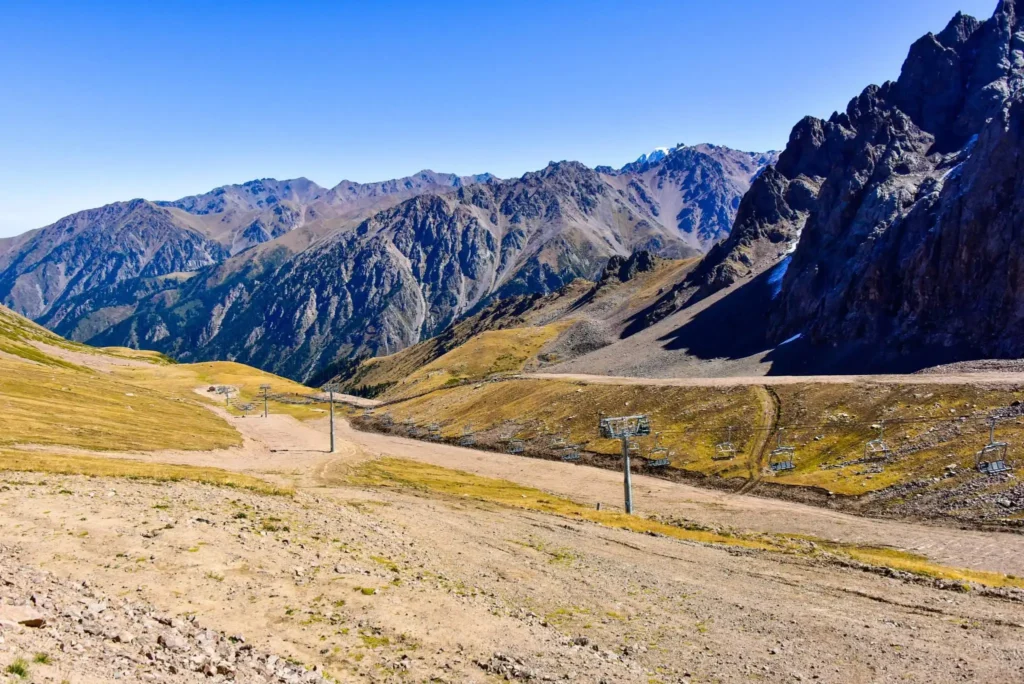
For a better perspective on Kazakhstan’s new fortunes, I head the next morning into the Trans-Ili Alatau mountains and the Shymbulak ski resort, which will host the 10th Asian Winter Games in 2029. We climb steadily away from the city, the suburbs of Almaty quickly replaced by dense forests, the towering peaks growing larger in the windscreen.
The modern gondola that climbs to Shymbulak departs from beside the Medeu, an iconic high-altitude outdoor speed skating and bandy rink in the valley below the resort. Construction of the stadium began in 1949, and both it and the alpine resort high above were revitalised in time for the 2011 Asian Winter Games, which Kazakhstan co-hosted in Almaty and Astana. In summer, the Medeu also welcomes the Voice of Asia music festival, which was revived in 2023.

Two-thirds of the way up the craggy peaks, Shymbulak could be in the Italian Alps or the Canadian Rockies. There are chic international restaurants with fusion menus and Old and New World wine lists, and clutches of well-heeled locals and tourists basking in the sun at al fresco tables, enjoying views that reach far down to the new skyscrapers of Almaty.
Despite the flow of new money into Kazakhstan, or perhaps because of it, preserving the region’s traditional culture is in vogue. In the alpine valley below the resort, Kazakhstan’s rich nomadic hunting culture is kept alive at Sunkar Falcon Farm, where Pavel Pfander, a Kazakh-German falconer, thrills visitors with displays by his falcons, griffon vultures and massive golden eagles.
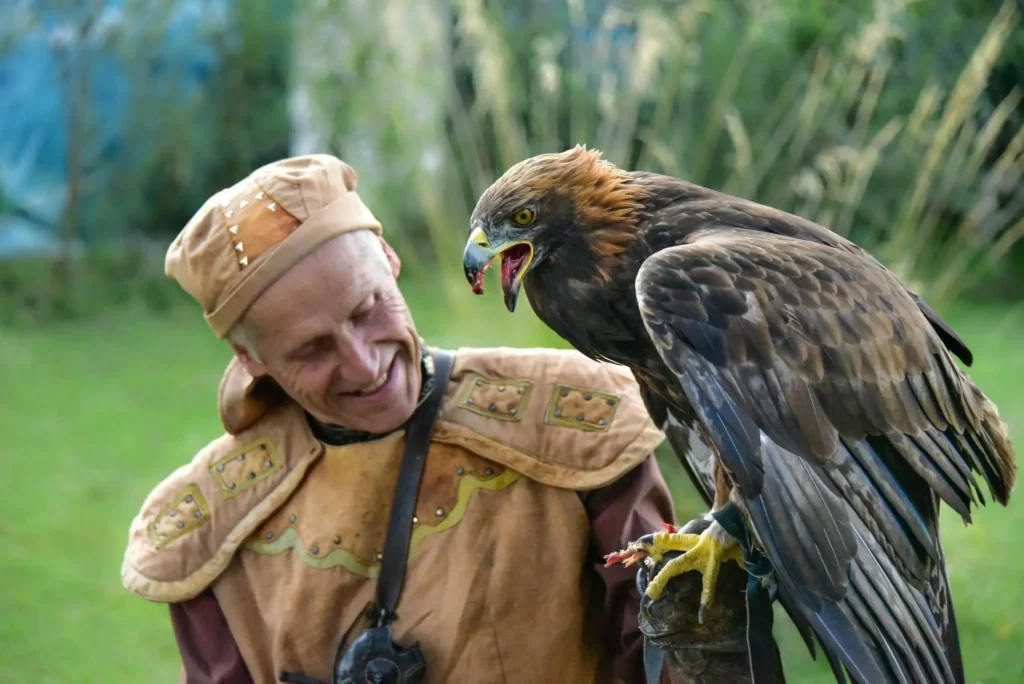
As the sun climbs high, he explains the breeding and training process, and the nomads’ traditional use of birds of prey for hunting, before unleashing the birds, some the size of small children, on a series of mock hunts, each taking its turn to swoop from the heavens, feathers dusting the heads of the crowd as it passes.
On the way back into the city I stop at Alasha, a traditional Uzbek restaurant capped with glistening blue domes, favoured by day by the city’s idle rich and by night by its power brokers. We dine on horse meat salad and plov, a traditional dish of rice, lamb, carrots and raisins cooked over open fires, amid Timurid architecture that evokes the grandeur of Samarkand.

With billowing curtains protecting them from the afternoon sun, young Almaty socialites sip tea, smoke shisha and gossip in hushed voices in the booths that line Alasha’s terrace. It’s a far cry from the perception of Kazakhstan abroad, that of a nation still mired in its Soviet past, struggling towards modernity.
Astana: A Capital Rising From the Steppe
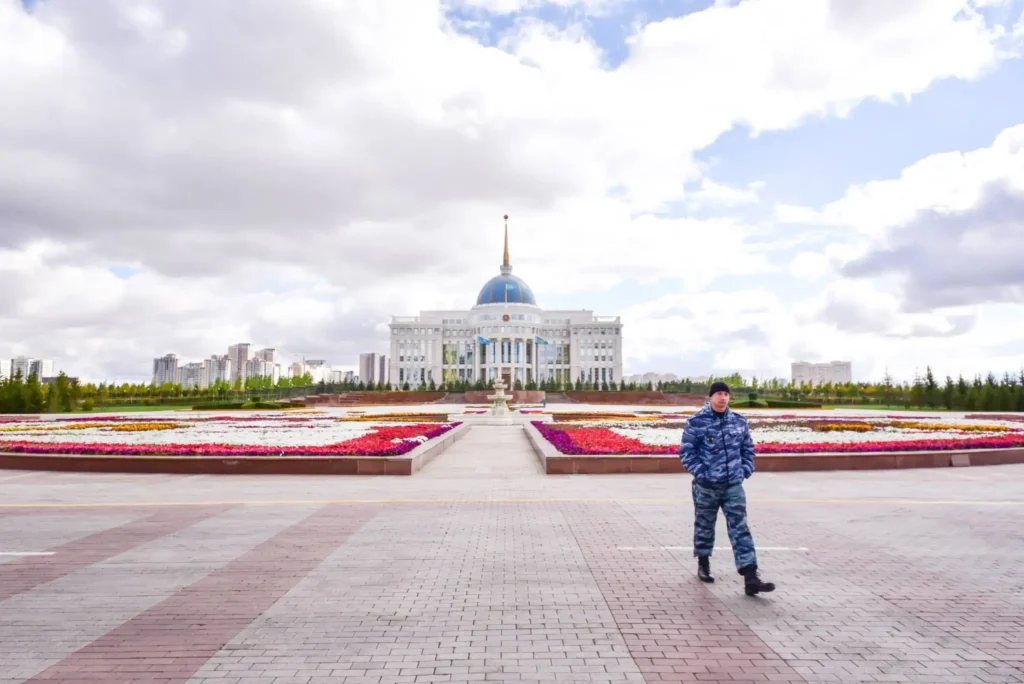
But that’s the beauty of Kazakhstan: it’s balancing a rich culture while navigating rapid progress, and much of that new prosperity can be seen in Astana, a flight of less than two hours north. The city, a provincial centre that became the capital in 1997 and took the name Astana a year later (it was briefly known as Nur-Sultan between 2019 and 2022), couldn’t be more different from mountain-ringed Almaty.
Mirage-like, there is the shimmer of new commercial towers and apartment blocks; wide, proud boulevards, master-planned by Japanese architect Kisho Kurokawa, that stretch towards the horizon; and grand palaces and monuments, including Norman Foster’s pyramid-shaped Palace of Peace and Reconciliation and his yurt-shaped Khan Shatyr Entertainment Centre, home to an indoor beach.

Beyond, the 3,500-seat Central Concert Hall, its sweeping blue form likened by Italian architect Manfredi Nicoletti to both the petals of a flower and the dombra, a traditional Kazakh instrument, ranks among the largest in the world. Everything is shrouded in the hesitant silence of a newly minted capital.
Recognised by UNESCO as a City of Peace, Astana stepped into the global spotlight in 2017 when it hosted the World Expo. Its theme, “Future Energy”, spoke not only to the future of energy, in which Kazakhstan, with its vast oil, natural gas and coal deposits, plays an increasingly important role, but also to the energy of this emerging, captivating destination. Today the Expo’s landmark Nur Alem sphere houses a museum of future energy, while the surrounding site is home to the Astana International Financial Centre.

From the top of the Bayterek, an observation tower at the city’s centre inspired by the mythological Tree of Life, it’s easy to see how far the city has come. Within the giant gilded orb atop the tower sits the golden palm print of Nursultan Nazarbayev, the country’s ambitious first president, who stepped down in 2019 after nearly three decades in power.
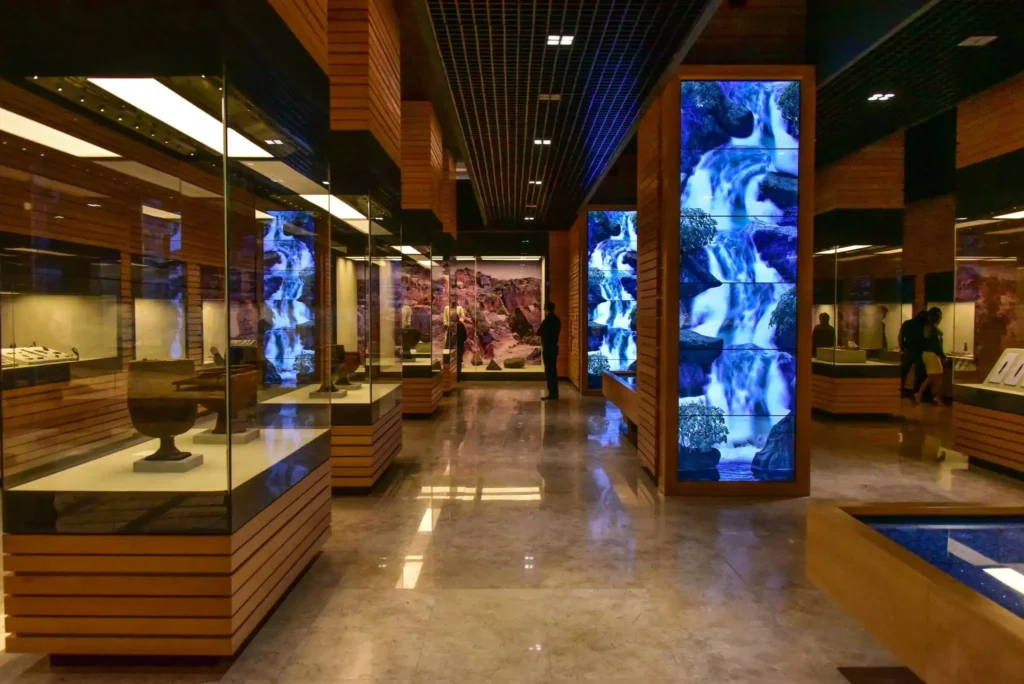
At the nearby, world-class National Museum of the Republic of Kazakhstan, visitors can journey through the country’s often tumultuous past before watching Astana grow from the floor in a fascinating light and sound display. But for now, from the city’s highest point, billiard-table-flat steppes wreath the sparkling new city and sprint into the distance, bringing a sense of Kazakhstan’s nomadic heritage to its bright new future.
Travel Essentials
Air Astana flies direct to Almaty from Bangkok, Seoul, Beijing, Shanghai and Guangzhou, with a new twice-weekly service from Tokyo Narita launching on 30 November 2026 and a new Astana–Bangkok route from 11 December 2026. Even more exciting is the launch in January 2027 of Cathay Pacific‘s nonstop service from Hong Kong to Almaty, with three flights a week. Multiple daily domestic flights link Almaty and Astana in about 1 hour 45 minutes. The best times to visit are late spring and early autumn, while the ski season at Shymbulak typically runs from December to April.
Frequently Asked Questions
Kazakhstan is a fantastic destination bridging its historic past with its bright future. Here’s what you need to know before you go.
Is it worth visiting both Almaty and Astana?
Yes. Almaty offers Silk Road heritage, markets and easy mountain access, while Astana showcases bold contemporary architecture. Five to seven days allows time for both.
How do I fly to Almaty from Hong Kong?
There is currently no nonstop service; connect via Bangkok, Seoul or mainland China with Air Astana. Cathay Pacific plans direct Hong Kong–Almaty flights from early 2027.

How far is Astana from Almaty?
Around 1,000 kilometres, or about 1 hour 45 minutes by air.
What food should I try in Almaty?
Beshbarmak, the national dish of slow-cooked meat and noodles, plov, horse-meat specialities and, for the adventurous, qymyz (fermented mare’s milk) at the Green Bazaar.

When is the best time to visit Kazakhstan?
Late spring and early autumn for sightseeing; December to April for skiing at Shymbulak.